Saturday, 14 March 2020

Into the Trenches!

The pioneers are just the sort of adversaries that the Fenwickian grenadiers are keen on: surprised, poorly-equipped  auxiliaries, armed with little more than shovels and slices of toast. If they are perhaps a little more alert than the Fenwickians would like, by being mainly awake and dressed, they make up for this in having the very low commitment to a fight that comes from being both poorly paid and from Mittelheim. 


(Above) 'Attack! Charge!' mimes Captain Dreihumpe loudly. Luckily, in the dark his troops can't see the captain, because the frenetic and exaggerated waves of his hat and pistol look less like an imperative command to charge the enemy and more like a medical emergency precipitated by an excess of port and opiates. With a loud shout, the grenadiers swarm forward, their attack column spilling into the enemy trench. The ensuing hand-to-hand combat is of the sort favoured by Mittelheim troops: in other words, their isn't one. (Below) Terrified, the pioneers don't even wait for the enemy to contact them: instead, they drop everything except their toast, and rapidly decamp the position. Making the judgement that the best contribution that they can make to fight is to engage in a quick tactical repositioning, they sprint off into the night to reposition themselves somewhere that has more protection and fewer screaming enemy grenadiers.


(Above) Not all of the defenders are so easily cowed, however. There is a thunderous crash of musketry from the left. Spotting the attacking troops, the nearest enemy infantry company fires off a volley into the night. Luckily for Dreihumpe, the casualties are small - both of them, in fact, are under five feet four in height, and also very unpopular, so that the losses effect no serious check upon the impetus of the grenadiers' advance.

(Below) The left-hand column moves swiftly into the enemy position. Recognising that in surprise attacks, momentum and initiative are everything, or at least something, Dreihumpe orders the troops to sweep along the enemy trenches, attacking any forces encountered. In the meantime, the right-hand column begins to set about ruining the existing defensive works. Gleefully, the Fenwickians begin digging out gabions, spreading dog hair, and throwing golden syrup hither and thither. No Gelderlander who values his coat and britches will ever be able to reoccupy this position.


(Above, top) The attacking grenadiers reach the first of the defending enemy infantry companies. Looming out of the night, they fall upon the enemy flank! (Below) Sadly, and quite surprisingly, the morale of the defending troops holds and they turn to face the attack.


(Above) 'Form line! Form line!' instructs Dreihumpe loudly from his prime learning position to the rear. Catching himself, he quickly adds 'Warm fine! Warm fine! It's a ... warm and fine night for an officer such as myself to be strolling around these delightful ... ah ... trenches ... and such, just minding my own business'. (Below) The grenadiers warm fine, and a nasty hand to hand combat ensues.


(Above) As his troops struggle manfully to overcome the enemy in a vicious bout of hand-to-hand combat, Dreihumpe contemplates ways in which he too can make a more substantive contribution to the Fenwickian cause. Looking at the fight and recognising that his troops would benefit from some help, the captain does what any other self-respecting Mittelhaim officer would do: he steals a Nabstrian wheel barrow - that'll learn them! To his front, however, things aren't going well. Despite being surprised, the defending musketeers pull off an unlikely early success in the melee, inflicting more losses upon the grenadiers than they themselves suffer. The grenadiers check how they feel about this unpleasant turn of events ...

Sunday, 8 March 2020

Cry Havoc, and Let Slip the Dog Hair of War!

The target of the assault is the enemy's third parallel. These defensive works have continued to be extended. Their immediate defence is in the hands of two companies of infantry and some artillery. Further defending troops are positioned in the second parallel, but in the dark they are, like one of King Wilhelm's furballs, likely to take a little while to bring up. At the far end of the parallel, Nabstrian pioneers are as busy as one might expect from military workmen - which is to say, they are having a hot beverage, whilst sucking their teeth and commenting on the many ways in which the task at hand is likely to take longer and be more expensive than first anticipated.


(Below) The Nabstrian pioneers are working on the approach trench towards Fort Pippin's glacis. Once this trench has reached the glacis, the glacis itself can be 'crowned':  that is, batteries will be positioned on top of it. Then, the cannon will begin directly to bombard the nearest Fenwickian bastion, with the intention of neutralising it: or, as any nearby nuns might term it 'shooting the XXXX out of it'. To the casual eye, it might seem as if the balance in the pioneers' work between digging and sitting on their backsides playing cards is weighted more towards the latter than Vauban, certainly, might have recommended. But, as any self-respecting Fenwickian orphan knows, sieges can be risky propositions and sensible folk should take precuations - such as lying down a lot and making toast.


For the Nabstrians, events are afoot that are likely to lead at the very least to some burnt crumpets. and possibly even some eye-watering adventures with a toasting fork. The Fenwickian grenadiers have exited the covered way as quietly as they can (below), and now make their way down the glacis. Once they have reached the bottom (not something that can actually be said out loud in Fenwick), they will divide. One column will seek to strike the pioneers digging the new approach trench. The other will concern itself with destroying as much of the other trenches as they can get their hands on.


From the bastion, Governor Schroedinger-Skatt peers into the gloom (below).
'There they go. Probably', he says, pointing vaguely at the blackness in front of him.
'When, sir, might we know if they have arrived at the enemy?', asks Colonel Gordon Sanitaire.
'I suppose that we will know because of the noise, confusion, screams of fear and cries for mercy', the governor replies. 'After that, perhaps we might also hear something from the enemy'.


(Below) Miraculously, the two assault columns manage generally to head in the right direction, despite the inevitable deviation caused by the darkness. Orientating on the smell of toast, the left-hand force heads directly for what seems to be the main site of the enemy works. The other troops continue towards the right. They are encumbered with all of the paraphenalia required to make a terrible mess of the besieging trenches - picks, shovels, chamber pots, and a quantity of the sort of dog hair that just can't be brushed out easily. To maximise the confusion caused to the enemy, they have also brought some crossword puzzles and a copy of the rules of war (excellent condition; as new; unused; but slight soiling on the entry for 'Prisoners: the Tying up and Beating of'').


(Above) Captain Dreihumpe we could say with some accuracy is 'positioned firmly in the rear'. In reality, however, it would actually be better no to say it, because in Fenwick, with their tiresome sensitivity to double entendre, saying such things out loud would certainly accrue a fine; or, if accompanied by the word 'column', perhaps even a prison sentence. As the captain stalks forward carefully behind his troops, he is struck by an unwelcome feeling of optimism - thus far, things have gone well. This is always, always a bad sign ...

Wednesday, 4 March 2020

Sally Ho!

'So, we are preparing a sally, my lord?' asks Colonel Dougal Entendre.
'Indeed, yes, Entendre', replies Governor Schroedinger-Skatt. 'The attack will commence presently'.
(Below) The two men stand upon one of Pippin Fort's bastions. Around them, gunners are scurrying to prepare their pieces in case supporting artillery fire is required.
'And how is Sally feeling, sir' asks the colonel. 
'Oh, in the end I didn't ask her, Entendre' replies Schroedinger. 'It seemed somehow unmanly to expect our surprise attack to be launched by a middle-aged matron, however tough. So I have ordered some grenadiers to undertake the operation instead'.


'Aye, sir - that's probably wise', nods Entendre. 'Although, I'm a wee bit surprised that you did'nae get those nuns to lead the attack'.
'Oh, I asked them, colonel', replies the governor, distractedly.
'Aye, and they refused nae doubt?'
Schroedinger shakes his head. 'Oh no - they agreed to fight. It's just that they appear to have got hold of some more perfume - and so the fight they started was with one another. So I just left'.
The chief engineer nods. 'Aye, sir. As nuns, they're nae what I was expecting'.
'I know what you mean', replies the governor. 'I too was expecting from them more in the way of love and charity; and less, as it turned out, in the way of blunt weapons and violent disorder'.
'That's religion for you', says Entendre.
The governor nods. 'So it seems'.

(Below) The attacking force assembles in the covered way. It consists of three companies. Two companies, the regulars, will remain here to provide supporting fire. The third company, converged grenadiers, will comprise the strike force. These grenadiers are elite Fenwickian troops - and so, quite average. Comprising the tallest, bravest and most enterprising of the available imperial troops,  they can be relied upon mostly to stay in ranks and, roughly on command,  to fire their muskets generally in the broad direction of the enemy. In the rest of Europe, armies generally have much better sources of quality manpower than in Mittelheim, not least because the prisons are also better. In Mittelheim, infantry really doesn't get any better than this. Which helps to explain why the wars here last so long.


The Fenwickians have chosen to attack at night to maximise the chances of overrunning the enemy trenches. (Below) The target is the enemy's third parallel, viewed here from the nearest ravelin. Because this is a night attack, any artillery fire is likely to be highly inaccurate. So, no change there then. Because of the gloom, for the most part the attacking troops will have to rely upon their own skill and fortitude if the attack is to be successful. Which is a shame.


The governor descends from the bastion and has a last word with the commander of the attacking forces - Captain Dreihumpe (below). Dreihumpe is technically parolled, having been captured at the crossings of the Strudel. But no self-respecting Mittelheim army would let little things like the laws of war get in the way of military necessity.


'So, Dreihumpe - you know what needs to be done?' asks Schroedinger.
'Yes, sir.'
'And you have your story straight in case you are seen by the enemy?'
'Indeed, sir. "Seeing a large party of grenadiers exit the covered way, I followed them in case they were heading to a particularly entertaining party. Realising that they were actually attacking the enemy, I then kept asking them the way to the nearest tavern - questions that might, in the confusion and to the untrained ear, have sounded like me giving them orders to manoeuvre and to fire". I think that covers it, my lord'.
'Excellent. I'd like to say that I have the highest confidence in you, captain'.
'Why, thank you very much, sir'.
'No, no', says the governor. 'What I mean is that I'd like to say that I have the highest confidence in you: but I can't because I feel that you're probably a dreadfully mediocre officer'.
'I ... er ... I ...', says the captain, a little crestfallen.
'Still', continues Schroedinger, 'being merely mediocre, you are the best fellow that I have available. So, have at it'.
' Er, thank you, sir', says Dreihumpe, saluting the retreating form of the governor. 'Yes, thank you for the vote of confidence'.


(Above) the captain turns to his troops. 'Order the men forward, lieutenant', he barks to the nearest subaltern. 'Quick, but quiet. I shall position myself to the rear: there I shall be in the best station to ... ah ... you know ...whatever.'
'To the rear, sir? It's just, I thought ... I mean that I gained the impression ... or perhaps indeed a strong certainty, sir, that you might be leading the attack. To inspire the men. To take the same risks that they take'.
'Me? Front? Well, I'm not quite sure how it is that you would have gained such an impression, my man'.
'Well, sir, one strong hint was the speech that you gave to the men in which you told them that they had nothing to fear because you would be leading them from the front: to inspire them and to share their risks'.
'Really?', says Dreihumpe.
'And that you would be the first out of the trenches'.
'Is that so?', nods Dreihumpe.
'And the first into the enemy trenches'.
The captain waggles his finger. 'Well, let that be a lesson in the dangers of jumping to false conclusions from the flimsiest of evidence; indeed, a tissue if supposition. You see, the key to excellence in leadership is survival. After all, if as an officer I don't survive, then how can I learn? And I do think that learning is important.' He looks up into the gloom. 'Well men - I think that it is time. Advance! Two columns! Up! Up!'
In the dark, there are muffled clatters as the troops climb out of the covered way ...

Saturday, 29 February 2020

Now Wash Your Hands!

Brevet Brigadier General Ernst Leopold von Rheinfunkt, commander of the forces besieging Fort Pippin, groans inwardly. Returning after surveying the latest progress of his troops, who should he see outside of his tent than Horace de Saxe. To say that the general is displeased is something of an understatement: he would rather have bumped into an amorous plague-carrying French mime artist than the self proclaimed genius and philosopher of war, Horace. Worse, afflicted by that most tedious of encumbrances, a sense of social etiquette, Rheinfunkt is unable to do what he really wants to do (which is to saw Horace in half with a blunt butter knife whilst slapping him around the face with an angry otter) and instead feels compelled to go through the motions of polite behaviour.
(Below) 'My lord Horace', says the general, gesturing unenthusiastically towards his tent. 'Will you not join me and share a glass of port?'
Saxe shakes his head whilst adjusting his blanket. 'Oh no, I've been in', he replies. 'I'd give it a minute', he says, wrinkling his nose and wafting his hands. 'Perhaps a few minutes, actually'.
'That's ... that's my headquarters tent', says Rheinfunkt, appalled.


Horace pauses. 'Headquarters? Really? Well, ah ... then ride with me', he says shooing Rheinfunkt away from the tent. 'It is a fine night for some conversation and reflection'.
'It's about to rain hard and it's very cold', says the general, unconvinced.
Horace nods. 'So much the better. We shall ride and talk about the old times, and then I'll tell you a story about your headquarters tent that might surprise you; but I think, in a few days, that you will laugh about the strange vicissitudes of war, and the entirely understandable problems in correctly identifying commodes'.
Rheinfunkt gestures towards his tent. 'But I need access to my travelling trunk'.
'A trunk?', replies Horace. 'In the corner?'
'Yes. A large wooden trunk'.
'Is there ... anything valuable in it?'
'Well, yes - my father's old campaigning coat: an irreplaceable heirloom of immense value to me'.
'A blue campaigning coat - that could perfectly understandably be mistaken for a seat cover?'
'Blue, yes'.
Horace winces. 'Is it ... washable?'

(Below) Successfully diverting the general away from his tent, Horace engages Rheinfunkt in harmless conversation. 'Well general, that was quite an explosion we caused'.
'We caused it?', says the general suspiciously. 'I thought that it was an accident. I gave no orders for an attack'.
'Oh yes', says Horace in conversational tones. 'My engineers blew up a nunnery'.
The general blanches. 'You ... you ... blew up a nunnery?'
'Indeed, general', replies Horace. 'Of course, I was trying to blow up the wall. But we rather underestimated the distance. The men had had an extra ration of leech brandy and got a wiggle on. And then what with misplacing my ruler there was some ... ah ... misapprehension of the distances'.
Rheinfunkt gesticulates, horrified. 'You. Blew. Up. A nunnery?'.
'Yes, but don't worry - our intelligence indicates that there were no nuns in it'.
'Thank the Lord', says the general, in relief. 'Thank the good Lord'.
Horace nods. 'Yes, that's the funny thing: apparently it was filled to the rafters instead with baby orphans'.


'Baby ... baby ...', Rheinfunkt is lost for words. There is something about his demeanor, though, which begins to give Horace indications that perhaps the general is taking the news less well than anticipated: the spittle, for example; the contorting of his face; the loading of his pistol and the pointing of it at Horace's forehead.
'One can't make military omelettes', says Horace placatingly, 'without breaking a few orphan eggs. I used the best of my military judgement in the circumstances'.
'Used your judgement!' utters Rheinfunkt in a strangled tone. 'Used your judgement? But ... you don't have any judgement, military or otherwise! If you had judgement, you wouldn't have joined the Gelderland army! In fact, you wouldn't even be in Gelderland! I don't employ you to exercise judgement - you are an officer in a Mittelheim army: I employ you to do what you are told! Badly. And then to do it again equally badly when I tell you to!'
Horace begins to realise that things are going badly, and that he hasn't so much poked the bear than, as it were, slathered his nether regions in honey and bounced them repeatedly on the bear's nose. 
Rheinfunkt continues, his voice rising. 'We've blown up a building full of orphans, Saxe! What will people say! This is the Enlightenment! One can't just go around blowing up orphans - at least, not without a watertight scientific justification!'

As Rheinfunkt becomes increasingly agitated, as does his grip on his pistol, there is the sound of an advancing horseman - it is messenger!
'Sir! Sir!' cries a messenger. 'The enemy are assaulting our third parallel!'

Monday, 24 February 2020

Do You Come Here Orphan?

Governor Schroedinger-Skatt's residence is one of the largest to be found in Fort Pippin: much like his salary, his ego, and his prized collection of Delft egg cups (he has two). (Below) The building resembles something not unlike an old German merchant's house. This is because that is indeed what it is, the old German merchant in question being quite upset to be informed that it was being requisitioned for the war effort. Mind you, if the governor had known before hand just how much effort a war would be, he probably would have have turned down the offer of his present position when it was made and instead followed the advice of his wife, who recommended that he "shove his head in a cow and set fire to his wedding tackle". His wife, to be fair, had just discovered him in bed with one of his mistresses; still, contemplating the misery of his current occupation, Schroedinger can't help feeling that his wife was a strangely perceptive woman; and one who also had a surprisingly robust right hook.


(Below) The governor's activities include, at this particular moment, a frustrating interview with his quartermaster. The topic of the conversation - orphans; or, more particularly, the lack of them.
'So, captain', says Schroedinger, 'you're saying that, thankfully, there were no orphans in the nunnery'.
'That's right, sir. Right enough', says the captain, nodding vigorously. 'We were just storing our porridge in the nunnery'.
'Of course', replies the governor. 'Of course. Because this is war in the Age of Enlightenment. So, the porridge was in the nunnery. This leads me to the obvious question ...'
The captain stares blankly.
'Captain, the porridge is in the nunnery; so the nuns were in the ...'
'Oh', says the captain getting the drift, 'oh yes, sir. So, the nuns were put in the orphanage'.
'So', begins Colonel Sanitaire. 'Logically, my fine fellow, yev therefore put the orphans in the ... porridge ... store?'
'Does such a thing exist?' asks the governor.
'Hmmm', says the colonel. 'I suppose, my lord, that that would depend upon how much porridge yev got'.
The discussion is interrurpted by the sound of running and thumping on the wooden floor above.


There are some shrieks; a bang; and then some shouting and crying.
The colonel and captain look at one another.
Schroedinger shrugs. 'The nuns ...' he says helplessly.
'Sisters of God?' says the captain, looking a little shocked.
'Sisters of God help us', replies the governor under his breath, before continuing. 'But where then, captain, are the orphans? Are they where the porridge was - before it was moved?'
The captain shifts awkwardly. 'It's not clear sir'.
Schroedinger scowls. 'Well, captain. it had better start getting quite a lot clearer, quite soon'.
'Captain', interjects Sanitaire, 'there are a limited number of places that one can store baby orphans, surely'.
'I don't have a list' says the captain, afraid.
'Just use a process of elimination', says Schroedinger, tartly. 'Which, incidentally, is what I'm going to apply to you if you don't get some results quickly'.
'Or', says Sanitaire, suddenly clicking his fingers, 'couldn't you just ask the nuns, my lord?'
The governor pauses; then he sighs. 'I'll get you for this, captain' he says trudging towards the stairs.


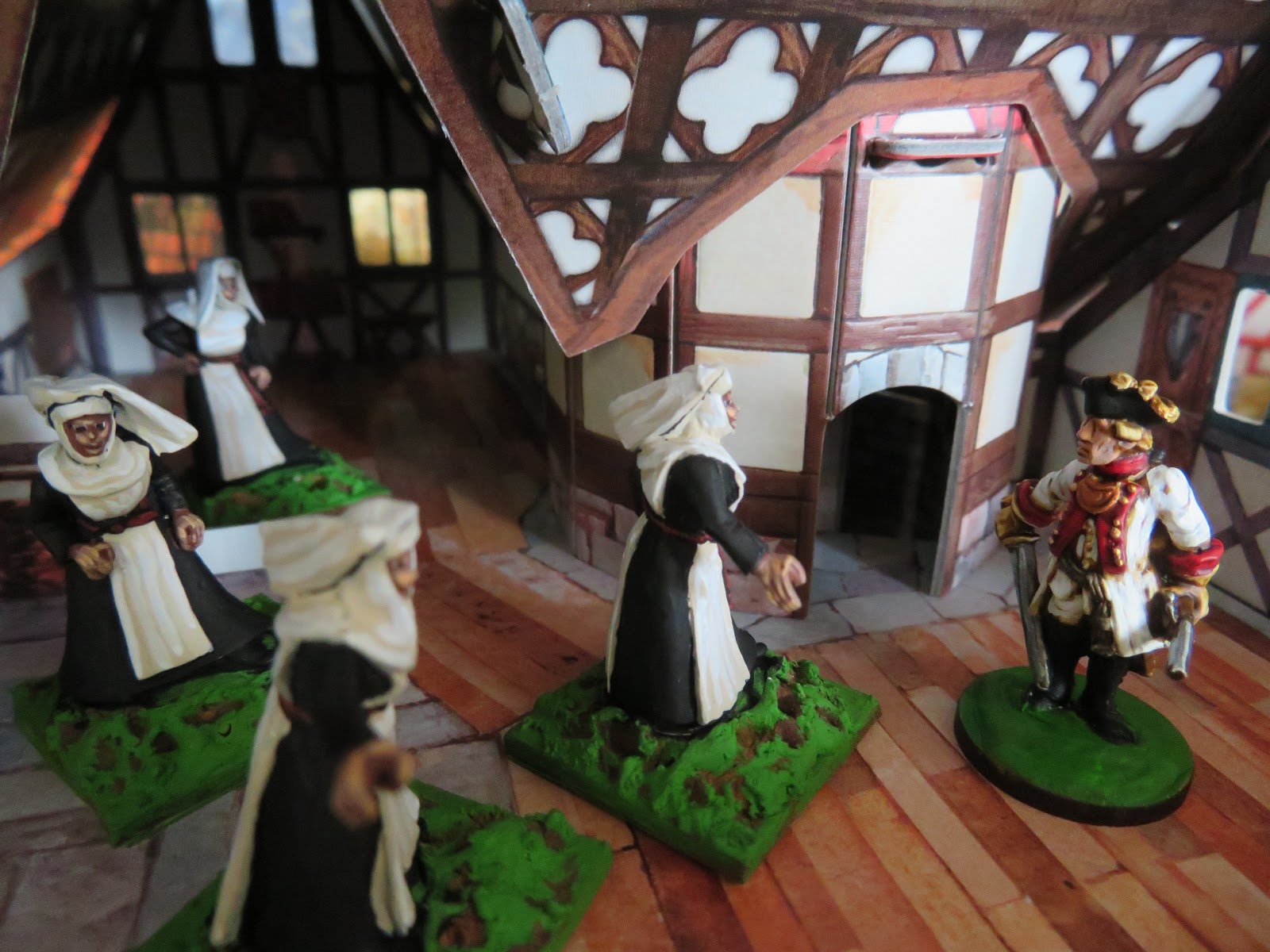
(Above) At the governor's interruption, the nuns look both guilty and combative. Schroedinger stays near the door, the better to expedite his withdrawal should circumstances warrant it. There is the smell of beer and ladies perfume. Looking at the nuns, it isn't obvious which of the two they have been drinking and which they have been applying.
'So', he says. 'Sisters. Yes. So, the orphans it turns out weren't in the nunnery. That was the porridge. Do you have any idea, therefore, where the porridge was before it was moved, because it seems likely that the orphans are there'.
'Oh no', says the nearest nun. 'No. It was the gunpowder that was moved to the porridge store'.
'Gunpowder?' replies the governor aghast. 'Gunpowder? But that means ...' The youngest nun nods and makes a movement with her hands. It looks a little bit like she is playing a very small string instrument - a violin, perhaps.
'... the orphans are in the armoury?'
The lead nun shrugs.
'And you didn't move them?'
The nun shrugs again. 'XXXX XXX! Orphans are so ... sticky. We don't like touching them'.
'But why would we keep baby orphans in the armoury?' asks Schroedinger incredulously.
'It keeps them out of the damp?' suggests another nun.
'And that's useful because?' replies the governor.
'They are less likely to foul the cannon barrels?' replies the young nun helpfully.
'XXXXXXX XXXX!' explodes Schroedinger. 'XXXX! XXXX! XXXXXXX XXXX! Do I look like the kind of man who fires orphans from a cannon? How do you think that would go down! How do you think my wife would take that? "Anything happen today dear". "No, no, my love. Oh, Except that I fired some orphans from a cannon."."Oh thats nice". We don't fire orphans at the enemy! It's just not something one does as an officer. Well, not at this stage of the siege, anyway'.
'Language', replies the young nun. 'We are holy sisters', she adds, sticking two fingers up the governor.

Wednesday, 19 February 2020

XXXXXXX XXXX!

Hurrying towards the crater is a small group of women in suspiciously religious looking garb.
'Who are those lassies?' asks Major Sanitaire.
'Those ladies', says the Governor, 'are nuns'.
'Are you sure, sir?' asks Sanitaire.
'They have wimples, major' replies Schroedinger firmly.
'Nuns with wimples', says Sanitaire, confused. 'But wouldn't that make them ... men?'
'Wimples, major', interjects Colonel Entendre, 'not winkles'.
'What's the difference?' asks the major.
The governor snorts. 'Well, Sanitaire, try standing in public with one in each hand, and I think that you'll soon find out'.
'They look a wee bit angry' says Entendre.
'Angry?' replies Schroedinger. 'It's fine. After all - they're nuns: placid, cerebral, other-worldly'.


(Below) 'Sisters!' says the governor warmly. 'What a pleasant surprise - for we had thought that ...'
'Holy balls!' shouts the lead nun. 'You’ve blown up our nunnery!'
The governor looks shocked: like the nun had just told him that she was his father. 'Sister! Your language!'
'Aye!' chips in Sanitaire. 'Where are the exes to censor yer profanities!'
'What XXXXXXX exes?' asks the belligerent nun.
'Thank goodness!' replies the major.


'My dear sisters!' says Schroedinger. 'How is it that you survived the blast?'
'We weren't XXXXXXX here!' pipes up another of the nuns. 'One of your XXXXXXX quartermasters XXXXXXX moved us.'
'Thank goodness!' says the governor. 'What excellent forethought on my part. Probably.'
'Yes', says the nun. 'You XXXXXXX well threw us out and moved in a bunch of XXXXXXX orphans'.
'Orphans?' says the governor in surprise, sensing that some probably unwelcome news is about to be revealed. 'The quartermaster moved in some orphans?'
'Yes!' replies the nun. 'But not big ones - a gaggle of XXXXXXX little ones'.
'Baby orphans' whispers Colonel Sanitaire, staring at the crater. 'Little orphan bairns. All blown up'. He then surreptitiously begins to check the soles of his boots.


'So what the XXXX are you you going to do!' demands a nun, belligerently. 'This is a disaster! Everything's gone: the nunnery! The money! The XXXXXXX soft furnishings!'
'And the orphans', says Entendre.
She pauses momentarily. 'Obviously. Yes. And the baby orphans. Obviously. But what the XXXX is going to sustain us in the coming days?'
'Well, sister', replies the governor. 'There's God's love, and ... such things, isn't there?'
The nun pauses. 'Obviously. Yes. And God's love. Obviously.'
'And prayer, contemplation and such good work as helping the town's poor and needy?' adds Major Sanitaire.
The nun pauses. 'Well yes, obviously. Those are a given. Obviously. But aside from those things, how the XXXXXXX XXXX are we going to survive?'
' I suppose', says Schroedinger cautiously, 'I suppose that I could look possibly at putting you up with me in the governor's palace ....'
'Excellent!' the nuns say happily. 'XXXXXXX excellent! We'll get our things and move in now!'
'Yes but ...' says the governor weakly. But he is already speaking to the backs of the nuns as they jog happily in the direction of Schroedinger's abode. 'Yes, but ...' he says again quietly.
There is a moment of silence.
'You'll be wanting to speak to the quartermasters, I suspect sir?' enquires Entendre.
'Oh yes', says the governor. 'Yes. Very XXXXXXX much so'.

Saturday, 15 February 2020

Now That's a Big Hole!

The nunnery of the order of Saint Seefora of the Immaculate Combustion actually is something of a famous building in Mittelheim. Seefora is patron saint of Mittelheim artillerymen and midwives, both having a professional interest in encouraging the rapid and accurate unloading of their respective charges. Seefora herself was a 14th century noblewoman and wife of an influential and important Teutonic Knight. Seefora's journey to sainthood, began, they say, in one of the Teutonic campaigns against the pagan Lithuanians. Frau Seefora found herself trapped in one of the Order's border forts after the unexpected arrival of a Lithuanian raiding party. Legend has it that the Lithuanians called upon her to surrender the fort and to renounce her catholicism. According to the tale favoured by the Catholic Church, her reply was 'Surrender? Renounce? Nay, nay - rather, I would die than cast aside the true faith!'; and with that she was said to have set alight a store of gunpowder, pitch, lamp oil, hay, and baking powder. The resulting conflagration killed everyone, although the baking powder did result in pleasantly fluffy smoke. Lithuanian stories tend to recount a rather different version of events. According to their version, Seefora instead cried out 'Surrender? Renounce? Verily, verily - that is absolutely no problem! Also, mine husband, who is a bit of a tit, can be found hiding in the privy'.

Whatever the true events, Seefora was made a saint, and an order of nuns was established in her name in the town of Pippin, now Fort Pippin, in Grand Fenwick.


(Above) The nunnery itself is something of a local land mark. For a long time, it was unusual for a nunnery in that it functioned exactly like a tavern. This was due to the fact that the first Mother Superior had come to the conclusion that the best way to prevent the Devil from tempting women of the order with such sins as drink, revelry, profanity, and late night whist was to get in there first. In theory, novitiates were supposed to spend so long engaged in these sorts of activities in their nunnery that they would soon tire of them and see the benefits of a more routine nun lifestyle - abstinence; prayer; rough undercothes. As it turned out, the nuns of the order had a rather higher tolerance for having a good time than had been anticipated, and the order quickly become so popular that it had to start a reserve list for membership. In the end, this early regime had to be ended, since happy, single, and empowered women seemed to the Church to be dangerously uncatholic. This decision was finally enforced on the combative nuns only by the use of two witchfinders, six bishops, and the whole of the local militia. Since that time, the nunnery has been a place of quiet contemplation, disturbed only by prayer and now the unexpected detonation of a large enemy mine directly below the building.


(Above) 'That', says Colonel Dougal Entendre, 'is a big hole'.
'Aye, sir', replies Major Gordon Sanitaire. 'Yed have to go far to find a crevice of this capacity'.
Governor Schroedinger-Skatt surveys the devastation glumly. 'And what of the nuns?'
Entendre shrugs. 'It's hard to tell, my lord. It must have been breakfast, because we've found a lot of porridge. But it was a very large explosion: it's difficult to tell where the porridge stops and the nuns begin'.
Suddenly, there is a commotion nearby. The three men turn, just in time to face a barrage of fruity language ...