Showing posts with label Rotenburg. Show all posts

Saturday, 8 March 2025

Schwimwehr, the Last!

They say that all good things must end; luckily, the same is true of mediocre things, like Mittelheim battles. And so, dear reader, we reach the final stages of the battle of Schwimwehr: a battle that will go down in the annals of military history as a battle, that took place near  Schwimwehr. Few songs are ever likely to be penned about this encounter, and almost none that don't involve a woman from Venus, but it's final stages are marked by the usual drama.


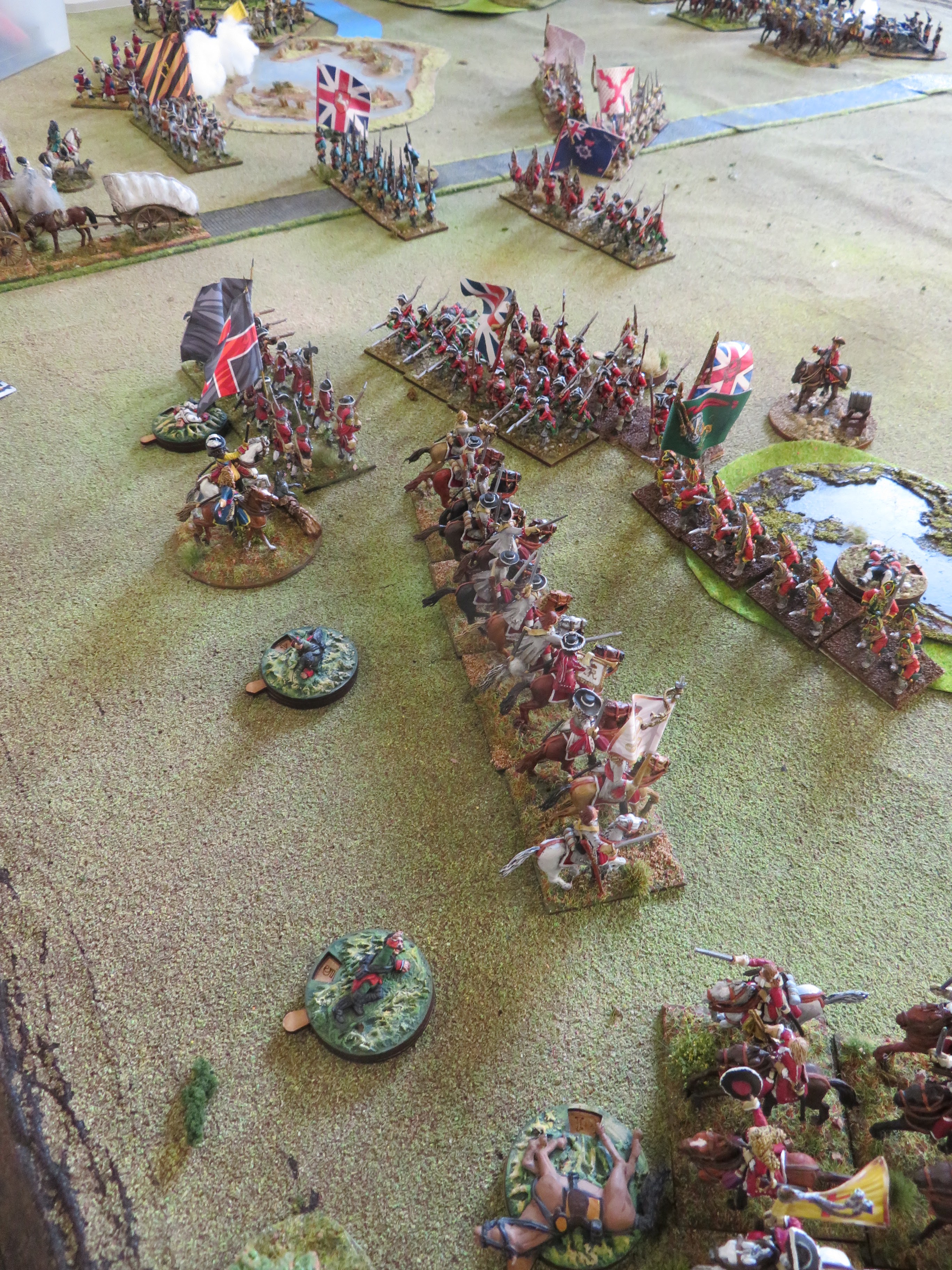
Rentall orders two of his remaining regular regiments forward in a do-or-die assault upon the Rotenburg line. (Above) On the right, Graf Orlok's Regiment charges the confused Rotenburg conscripts. The Orlok's are heavily disordered, but their adversary isn't in much better condition and, as conscripts, are more used to licking windows than engaging in honest hand-to-hand combat. 


(Above) On the left, the Liebgarde Feratu-Osterburg, the very finest of the Vulgarian regiments, the invincible Nosferatu elite, advance to contact twice their number of enemy infantry.


Alas for Rentall and for the Vulgarian cause, the Vulgarian guard cannot break the enemy line. After savage fighting, the Rotenburg regular regiment is overwhelmed and routed but the Rotenburg mercenaries succeed in driving the Osterburg's back. Even worse, a quick round of volleying from Furst Augustus' line proves that the Nosferatu are not so invincible. On the contrary, they prove to be really quite vincible and, being well vinced by the enemy musketry, the guard are driven from the field (above).

To compound matters, the Rotenburg conscripts prove to be more spritely than expected, and Count Orlok's regiment is also driven back Below). Rentall curses, and because he curses in Dutch it sounds even ruder. Less Nosferatu and more Tosferatu, his army has let him down. There is now nothing to stop the enemy from advancing forward and occupying the critical roadway. The game is up; the goose is cooked; the fat lady has sung. Rentall concedes the battle.

The Vulgarians are defeated! Or are they?

On the far left of the Vulgarian line, Captain Kleinvarken looks unhappily at the swamp.
'So, Colonel Kurtz, when I asked if we could fire when we climbed into the swamp, you said "no". And yet it turns out that the answer should have been "yes"'.
Kurtz considers this gloomily. 'Well, there were a few qualifying factors that were too negligible to include in that assessment'.
'Those factors being?'
'Well, mainly that the answer that I should have given was "yes". But, then, in my defence, I delivered the wrong answer with the right amount of confidence. So really, it's your fault for believing me. I asked the Rotenburgers, and they said that we couldn't fire if we were in the swamp'.
Kleinvarken considers this. 'But they are the enemy'.
The colonel shrugs. 'Who'd have thought that they would lie? They sounded so confident'.

As the battle comes to an end, it becomes clear that, not for the Furst time, Augustus might have been treating the rules of war as less of a set of stringent regulations to ensure equitable treatment of both sides and more like a pirate code. There are no hard feelings, of course, and so, as General Rentall bids adieu to the cheating Rotenburg donkey-fondling monkey sucker Furst Augustus Saxe-Peste, the two armies disengage.

Furst Augustus remains cheery, however. For Rotenburg, any sentence that contains the word "victory" is worth celebrating, even if that word is bracketed by the phrases "It's not a" and "you cheating b*stard". The Landravial army has lost only a single regiment, although it is one of their precious trained units. On the plus side, however, three of the existing units of conscript infantry are promoted to trained status. Saxe-Peste's cavalry has also benefited from their time spent hanging around somewhere to the rear, and the regiment of conscripts is promoted to trained, and another unit reaches elite status.

The Vulgarians have lost two regiments of regular infantry and one of cavalry - these the Vulgarian depots will replace with trained troops. The Liebgarde have also been lost, but they retain their guard status.

Having inflicted four losses and having suffered one, the Rotenburgers also receive a point for having inflicted heavy losses on their enemy. 


Sunday, 16 February 2025

Schwimwehr, the Ninth!

The battle begins to reach its critical moments! Despite their many advantages, the Vulgarian cavalry are driven off by the Landgravial Guard (below). Perhaps the amphibians in the marsh imposed too much frog of war.


All riled up, General Rentall finds an alternative method of twisting Furst Saxe-Peste's melons. One of the Rotenburg conscript regiments is suddenly seized by a confusion so vigorous that it causes them to interpenetrate the units in front, taking their place in the first line (below).


For the conscripts, this is not wise. It is, indeed, the very definition of something that is decidedly unwise. There are reasons why Saxe-Peste placed these troops in the second line of the attacking formation. Some of the reasons are evident in the physical condition of the conscripts: the bandy legs; the drool; the hairy limbs; and their penchant for bananas. Other reasons could easily be found in the tactical handling of their weapons, the quality of which could be described in that portion of a Venn diagram that overlaps two circles marked 'Ineffective' and 'Blancmange'.


Rentall's satisfaction is short-lived, however. Exchanges of fire ensue in which at other parts of the line the Rotenburg's lethal volleys begin to tell. (Above) Another one of the Vulgarian regiments collapses in the heat of the musketry fire. There is now a hole in the Vulgarian line, and the vital road is uncovered!


(Above) Two of Rentall's five infantry regiments have now been routed, and the remaining three infantry units are split into two separate groups. Even in Mittelheim military doctrine, this is recognised as a Bad Thing about which Something Must Be Done. With no allies to blame and with no one smaller to hurt, the Vulgarians make one last throw of their curiously weighted green dice.

Monday, 10 February 2025

Schwimwehr, the Eighth!

Abandoning his Landgravial Guard to whatever watery wastery they can pass their time with, Furst Augustus searches for other ways in which he might put pressure on Rentall: sitting on him until he stops breathing is his preference; but failing that, and having been stymied in his earlier charge in the centre, the Furst decides to take advantage of an excellent series of musketry volleys on his left.


(Above) Saxe-Peste orders a charge against a badly disordered enemy unit, and pushes one of his regiments forward! Desperate hand-to-hand fighting ensues: desperately bad, that is. Still, war is a relative activity, and it turns out that the Rotenbergers are relatively better at bayonet fighting than their adversaries: in the same way that otters are relatively better at badminton than snails.


(Above) The Vulgarian infantry unit is routed and driven from the field of battle. Alas for General Rentall, this regiment turns out to have been very popular with the rest of the army. Perhaps they were good listeners. Whatever the reason,Vulgarian morale droops lower than a long moustache on a short Bulgarian! Here at least Rentall has a reserve to plug the gap, but the pressure is now on the defending Vulgarians, with all four of their remaining infantry regiments part of the firing line.

One option available to the Vulgarians might be to move their irregular infantry into the marsh (below, at the top) and from there fire upon the Rotenburgers. But, as Furst Augustus has already claimed loudly and confidently, this just isn't allowed; and, even if it were, it's an option that only thigh-slapping shandy boys would resort to. In Mittelheim, the main role of irregular infantry is to frighten geese, although military doctrine lacks clarity on why this would be an urgent operational role.

Rentall decides it's time to regain the initiative with a cheeky charge of his cavalry. In Mittelheim warfare, though, this is rarely a good idea: initiative requires action; action requires intrepidity; and intrepidity, like nubility, jocundity, and bipedality requires a thesaurus, one of any Mittelheimer's least favourite dinosaurs. (Below) Despite this, with a slight wheel to the right, Rentall's cavalry throw themselves into the fray!


The cavalry charge with a certain measure of confidence. The enemy are Rotenburg guard, true: but that simply means that they are a bit taller than average, which just brings them closer to the Vulgarian sabres. More to the point, the defending infantry are deployed in the marsh, a feature that is to effective linear warfare what geese might contribute to irregular operations. It looks like it's time for Furst Augustus to broach the brandy again!

Friday, 24 January 2025

Schwimwehr, the Seventh!

It's bad news for the Vulgarian cavalry. But then, isn't it always? If only they were currently enrolled in a competition focused on acquiring the most disorder in the shortest space of time. Then, they would surely be guaranteed to win an exciting prize. The cavalry charge through the marsh, disordering themselves; their attack is quickly driven back by the defending infantry, disordering them even more; they are then disordered again as they retreat; alas too quickly to pick up their prize. One wonders indeed whether the term 'disorder' might be a strong enough term for the colossal bundle of bedlam that characterises their condition. Luckily, the problem is resolved almost straight away when a volley from the infantry completely routs the Vulgarian cavalry regiment from the field.

Though he has now worked off some of his frustration, it is clear to Saxe-Peste that no further progress will be made on this flank. The Furst decides to shift to a new and more direct approach. 'Grenadiers forward!' he orders, and 'charge!'. 'Hold the line! Hold the line!' shouts Rentall in response. The centre clashes in bloody hand-to-hand combat! (below). Even in Mittelheim, the term 'hand-to-hand combat' generally does involve the use of muskets and bayonets and not actual hands, although there is still rather more eye-poking, hair pulling and wrinkled sack wrenching than would be normal in most Enlightenment tactical military doctrine.


There follows an extended period of mithanthropic mayhem as the Mittleheim murder muppets melee with one another! But to the chagrin of Saxe-Peste, the Rotenburgers fail to make a breakthrough and their line falls back (below). In fact, it's a close-run thing, with one of the attacking units themselves teetering on the brink of routing.

This isn't the only bad news for the Rotenburg commander. General Rentall can't help himself and tests the Furst's temper with even more marsh-related miscreancy. A great bout of confusion overcomes the Rotenburg Landgravial guard, and they find themselves strangely tempted to undertake an ambulatory excursion into the slushy water feature in front of them. The water looks so inviting, what with the delightful crust of algae, the choking toads, and the same smell of gassy flatulence that reminds them of home. They stagger forwards, splashing through the marsh. (Below) Now unable to fire and with portions of the line hanging out in places ripe for an enemy cavalry counterattack, the troops come to a halt right in front of the Vulgarian cavalry.


Furst Saxe-Peste is drinking brandy again. Marshes seem to be on his mind; and also various ways that these geographical features might be forced painfully into Rentall's bodily cavities. It doesn't look good for the Rotenburgers ...

Friday, 17 January 2025

Schwimwehr, the Sixth!

General Furst Augustus Saxe-Peste is drinking brandy. Lots and lots of brandy. While this isn't likely to improve his powers of concentration, it does at least force him to interrupt his swearing and so breathe occasionally. The general's petulant profanity mixes references to swampy water features, the enemy general, bodily orifices, large spikey objects, and the sort of vigorous transit through narrow straits that might make the eyes of Magellan himself start to water.


(Above) With the Rotenburg infantry stymied in their advance, the Vulgarian cavalry are able to about face and redeploy beyond musket range. Suddenly, the pressure on the Vulgarian army is released.

(Below) Thwarted in his attempts to trap and destroy the enemy cavalry, Saxe-Peste orders his infantry to commence volley fire. Or at least, that's probably what he is trying to order, although his instructions to his troops do sound a lot like he is still keen that Rentall should take his marsh and investigate the extent to which it might fit in that place of the Dutchman's body which is currently resting upon his saddle.


Not that he is petulant or anything but the Furst makes it a priority to find ways in which Rentall can be punished for his marsh mischievousness. Suffused with swampy spite, Saxe-Peste finds just the thing, (Below) Suddenly, overwhelmed by the heat of the moment, one of the Vulgarian cavalry regiments gives a loud 'huzzah!' and charges forwards into the swamp and then into the Rotenburg infantry.


It is a brave move. And also, of course, immensely stupid. If cavalry were meant to charge through marshes, then they would have flippers instead of hands and gills instead of noses. Actually, some of the Vulgarians do have both of these given that in rural Vulgaria the term 'my wife and sister' doesn't always refer to two people. But still, this is a charge that will require some quite extraordinary luck if it is to succeed.

It is also a slightly controversial act. Captain Sebastian Wankrat, Furst Augustus' orderly, hurries to speak to the general. As he meets Saxe-Peste, the latter is standing in front of a fire. He has in front of him a book and he is ripping out each page, screwing it up, and then throwing it on the fire.
Wankrat salutes. 'Sir, is it the case that troops that have acted in the heat of battle can charge through difficult terrain?'
Saxe-Peste shrugs. 'Well, captain, they seem to have done so. I think that the restrictions only apply if they are in or behind cover'.
'Well, sir, we could check the rule book. Do you know where it is?'
'Nope', says the Furst, ripping out the last page of the volume in his hands and throwing it in the fire. 'No idea'.

Monday, 13 January 2025

Schwimwehr, the Fifth!

Continuing to reflect the triumph of optimism over experience, the Vulgarian artillery fires upon the advancing Rotenburg line. Like an old opium addict in the bath, they produce a lot of smoke but their balls swing uncomfortably low into the water in front of them. The enemy infantry are unaffected.


(Below) On the other flank, Rentall's cavalry suffers casualties to Rotenburg infantry fire. The enemy has crept forward until they are at the closest of ranges and now pour volleys into the Vulgarian horsemen to their front. The cavalry must now draw on their training to provide a solution. Sadly, four days spent tied to a horse and five months attending wild gala dinners do not immediately provide many useful suggestions.


(Below) The Vulgarians draw off, but they are hemmed in. What can they do now? Are they just destined to be cut down in their saddles? How can escape their situation? And where is it exactly that babies come from? The enemy infantry shuffles forward, closing the range again. This is exactly the sort of tactical situation to avoid. Attack, and the cavalry are likely to lose badly; retreat, and the infantry will simply continue to advance.


Rentall considers his options. In such circumstances, there is only one possible response. Rentall turns to Duke Neucheim.
'Neucheim, get me a map!'
'At once sir!'
'Neucheim, get me a marsh!'
'But there isn't a ma ... goodness, sir, what's that?'


'Gottle a geer!' chortles Baron Tostov gleefully.
 

Thursday, 9 January 2025

Schwimwehr, the Fourth!

On the Rotenburg left, the Vulgarian cavalry adjusts itself: after all, those saddles aren't always comfortable. (Below) The regiments of Vulgarian horse wheel to the left, more fully to menace the advancing enemy foot.


(Below) Saxe-Peste's infantry line grinds forwards. Or obliquewards. Or whatever word describes the process of going wards when one is also heading to the side. On the left, his front line is now within musketry range of the enemy cavalry who have no space with which to move around the enemy flank. No doubt the general has the intention of forcing the cavalry to commit themselves to a frontal assault upon his infantry's bayonets. 


On the other side, the Rotenburg infantry move sufficiently to avoid the marsh. Some of the second line begins to wheel to the right, though, because of the potential threat from the Vulgarian irregulars. Of course, this would be more of a threat if the irregular infantry could fire whilst they were in the marsh. Alas, they aren't allowed: though in this case 'not allowed' refers to an extra-special interpretation of the rules by the Rotenburg commander - an interpretation which could be described as 'imaginative but somewhat contestable'. If, that is, by 'somewhat contestable' one meant that it was entirely wrong and that by 'imaginative' one meant something that was in fact a bald-faced lie, but one told with panache and confidence.

Also on the Rotenburg right, the cavalry is having an altogether less strenuous battle. Nevertheless (bottom) Saxe-Peste has ordered his horsed troops forward. This is partly in order to fulfil one of the key principles of Mittelheim warfare which is that one's own artillery should whenever possible be masked. This prevents them from firing and so reduces the chance of them embarrassing themselves.


However, a second reason for the cavalry to advance somewhat is that the Vulgarian irregular troops have also begun to creep forward (above, top right). The last thing that any gentleman needs is Vulgarian irregulars threatening to lap his flanks, so the cavalry have been ordered into a position where they can charge any of the enemy cheeky enough to cross the stream.

Saxe-Peste is happy with the progress of the battle thus far. His plan is unfolding as he had hoped, and he has also hidden the rule book. Now, anything is possible.

Saturday, 21 December 2024

Schwimwehr, the Third!

The battle commences with an opening salvo from the Rotenburg artillery. 'Salvo' though probably implies more of an impressive roar than the actual sound made by the artillery, which is more akin to a losing entry in a squirrels-only yodelling contest. One of the batteries is masked by the Rotenburg infantry, and so it is just a single battery that can fire. It aims for the enemy irregulars and misses, of course. Hitting the target would set a dangerous military precedent that might require every battery in the armies of Mittelheim to inflict damage upon the enemy: imagine the work that that might generate for artillerymen everywhere. Furst Saxe-Peste uses the time to try and acquire more initiative


(Below) The Vulgarian gunners return in kind, concentrating their fire upon the enemy infantry. This too has no effect, the Vulgarian artillery maintaining solidarity with their brother cannoneers in the opposing army. General Rentall, though, is able to spend the time acquiring more stratagems.

Still, the guns generate an impressive amount of smoke, an effect that many would argue is reward enough for the enormous sums of money spent training, equipping, and sustaining the artillery arms of the respective belligerents.

(Below) The Rotenburg infantry advances. At this stage, they march directly forward, a manoeuvre that most, though by no means all, Mitteleheim troops are reasonably well-versed in. When they are closer to the Vulgarian battle-lines, Saxe-Peste will order his troops to oblique to the left in order to avoid the marsh and bring his muskets to bear against the enemy cavalry.


(Above, at the bottom) It looks like this might be quite a restful battle for the Rotenburg cavalry. The landgravial mounted arm “hold themselves in reserve, ready to intervene at the decisive moment”. As any experienced observer of warfare in Mittelheim knows, this is just a euphemism for exploring their cavities with their fingers.


(Above) A view of the Rotenburg infantry lines. -  regular troops to the front and conscripts to the rear. Ahead, the Vulgarian cavalry gird their loins - and what loins they are. TheVulgarian horse are of an excellent quality. Whilst the Voivoidina Carmilla's Horse are trained, the Regiment Karnstein are elite, and von Ruthven's Osterberg Cuirassiers are guard. In addition, all of the Vulgarian cavalry are 'Cavaliers'. If only they had the Rotenburg cavalry to fight against instead of the enemy infantry. But Rentall is too experienced a general to trust his mounted arm with any role that doesn't just have cheese and pickle in it.

Saturday, 7 December 2024

Schwimwehr, the Second!

On the other side of the field of battle, Furst Augustus Saxe-Peste, Generalissimo of the Landgravate of Hesse-Rotenburg, surveys the Vulgarian deployment and makes his plans. The general could really do with a victory. Though related to the Landgrave Choldwig III, this being one of the main requirements for promotion to high military office in Rotenburg, his relationship with Choldwig has not always been harmonious. Choldwig holds the view, problematic in Mittleheim, that commanders should win battles. The Rotenburg army, whilst it has had its moments, not least at the legendary Battle of Chestwig, has of late suffered badly, and many of its troops are newly raised conscripts.
                            

(Above) In some respects, General Rentall has done his job too well. With a wood, a stream, and a marsh clogging the front of the Rotenburg right wing, the Furst concludes straight away that there is no point in him attacking on that front. There's going to be no getting around behind the Vulgarian line there. Not for the first time, Saxe-Peste curses the fact that his troops are a bunch of useless flankers. Instead, he deploys all four regiments of his cavalry on this wing, and he places both his guns to support them. This force will act defensively to prevent any advance by the enemy irregulars. 

(Below) The rest of his army, all of it infantry, he deploys in a double line astride the road. The road itself is the main objective for this battle.


The front rank are trained troops; the whole of the second line are newly raised. Saxe-Peste hopes that, with the advantage of his troops' lethal volleys he will be able to advance, win the ensuing musketry duel, and triumph before his conscripts learn that they are actually in combat. If his conscripts actually end up having to fight, then Saxe-Peste's chance of victory in the battle is as low as something that was already quite low; but then, thanks to poor maintenance during an extended public holiday, had been allowed to sag even further.


The general attaches considerable importance to his troops' ability to conduct oblique manoeuvres. His intention is that his infantry will advance, obliquing to the left with the hope that this will not only make it impossible for the enemy cavalry to move around his flank, but that he will in fact be able to force the Vulgarian cavalry to take his infantry on frontally: a very difficult proposition for them. Having defeated the enemy cavalry, he will then wheel his left flank around and roll up the enemy infantry line. As long as his troops only have to do an oblique, and don't have to spell it, there is at least some chance that they might succeed.

He summons his orderly, Captain Sebastian Wankrat.
'Wankrat!' says the Furst. 'Sound the advance!' 
With a glass of brandy in his hand, and a small barrel for refills in case of emergencies, Saxe-Peste watches as his infantry begins their attack!


Friday, 22 November 2024

Military Revolution!

It has been quite some time since this publication last reported on the exploits of Landgrave Choldwig. The reasons for this relate partly to the low tolerance that the editorial staff here have for cruelty to terrapins*; but also that too frequent a focus on the Rotenburg court would breach recommended moral guidelines on gratuitous nudity and the use of olive oil. 

Still, as a core participant in the Wars of the Gelderland Succession, our gaze needs must alight on the Landgravate at this period of crisis. At this very moment, the landgrave is reviewing his newly reformed unit of palace guards. These reforms are a reflection of Choldwig's desire to push through the fruits of his programme for a military revolution in his army. Choldwig's idol is Alexander the Great, and so the landgrave has particular views on what constitutes the foundations of military effectiveness.

In other places a military revolution might entail radical innovation in technology, doctrine, and organisational culture: in Rotenburg it just means making the sticks longer. As such, his guards have been re-equipped with pikes. Since Greek-style tunics might leave his troops too exposed to the depredations of the weather and of angry terrapins, they have been issued landsknecht uniforms. These changes have been received enthusiastically by Choldwig's senior officers: if the word "enthusiastic" is defined by responses such as holding one's head in one's hand and sighing loudly; or saying things such as "For the love of God", and "Kill me now".


For the troops themselves, it has all been hugely entertaining. As palace guards, their chances of being committed to combat seem about as low as their likely combat effectiveness if they actually had to fight; and what Mittleheim soldier doesn't like frolicking in parti-coloured costumes, poking other people with big sticks, and saying things like "Halt, who goes there?"; or "I wouldn't touch your wife with this barge pole".

The landgrave's fun is interrupted by the arrival of Baron Lothar von Prohlaps, the Minister for Alexandrification. 'My lord, a message has arrived from our field army. It seems that General Saxe-Peste has committed his forces to battle against the Vulgarians!' cries the minister.
'When will this battle take place?' asks Choldwig with interest.
'My lord, it seems likely, given the time taken for this missive to reach us, that the battle will already have been fought'.
The landgrave fiddles with some olives. 'What are our chances in battle, minister?'
'Many of our troops are conscripts, my lord' says Prohlaps delicately.
'Hmmm', says Choldwig. 'Then I feel confident. Conscripts are less likely to be bound by the dangerous constraints of traditional military thinking and practice'.
The minister nods. 'If, sir, you mean that they don't know what they're doing, then yes'.
'This is the Enlightenment' replies the landgrave. 'I don't want mindless automata in my army. I want Alexandrian style enterprise and initiative. Surely that is what matters on the field of combat?'
'Opinion is divided, sir'.
'Is it?'
'Yes sir: you think that that might be the case; but everybody else doesn't'.
Choldwig frowns. 'What will the result of the battle be, minister?'
'I think, my lord, within the usual parameters of success'
'That bad?' The landgrave sighs. 'Well, we'll just have to see. And when the troops come back, I have some more Macedonian surprises for them'.
'It's not more olive oil is it, my lord?'.
'Not this time, no', replies Choldwig. 'Although', he continues, 'I could be persuaded'.


* And other amphibians. Except axolotls, who deserve everything that's coming to them.

Friday, 19 April 2024

The Guns of Naverhon, the Final!

Alas for the Zentan cause, the janissaries continue to treat the battle like a long weekend away. Having done some additional sightseeing to the rear of the Albanian positions, the slave-soldiers clearly conclude that a sight definitely not worth seeing would be the enemy firing line. Some of the Albanians rally and push forwards again. Others recommence their fire upon the lead unit of Pandurs (below).


The Zentan commander is understandably frustrated at his inability to get his best troops into the fray. Various colourful metaphors are uttered; hand gestures, not all of them supportive or child-friendly, are also made; and some frustration is evinced over the rules of war. 

(Above) Nevertheless, the Albanians continue to fight on manfully. More Pandurs tumble to the ground! (Below) The Pandurs' morale, never terribly high, crumbles at the sight of blood. They flee the field, leaving the remaining engineers dangerously exposed!


(Below) Alas, the Albanians are unable to take advantage of the situation. The engineers manage to run backwards before the Albanians can open fire on them. More mercenary infantry move up and open fire on the Zentans.


Any plan that relies for its success primarily on the efforts of  Zentan irregulars is never likely to be one in which the chances of success are high. Given the continual failure of the janissaries to move or act, the performance of the Albanians has been commendable. However, without the help of the Zentan elite troops, the chances of Zentan success were always going to be lower than a hedgehog's gonads. 

(Below) Many hits are inflicted, and the remains of two platoons of Albanians rout the field.


Having lost more than half their troops, the Zentans find themselves having to test morale. They fail, of course, as is the Zentan way and the attacking force must now retreat! The engineers are safe!

Sunday, 14 April 2024

The Guns of Naverhon, the Fourth!

War, as a rule, is known to be quite a stressful activity. It's not, of course, the most stressful human experience. That accolade would be reserved for those circumstances in which one has been asked that sort of particular question by one's partner in which a fate worse than death might come from giving the wrong answer: questions such as: 'Do you think I should I wear the green or the blue?'; or, 'Do you think I'm putting on weight?'; or 'Do you think that my sister is attractive?'

Nevertheless, and not withstanding the physical harm that can also come from giving the wrong answers to the previous questions, war is generally a worrying state of affairs. There are the physical traumas that result from being hit by musket shot or cannon balls; the mental traumas that derive from discovering that not all of the latter have been fired by the enemy; and the moral dilemmas concerning whether, as a good Mittelheim Christian, one should bayonet civilians and then set light to them; or whether they should instead be lit and then bayoneted. Having said all of this, there is one kind of warfare that it much less taxing, physically, mentally, and morally: and that is Zentan Janissary warfare. Zentan Janissary warfare has more in common with such non-military pursuits as sleeping, drinking coffee, or going on holiday. 

And so it is that, as the Zentan struggle to kill or capture the enemy engineers intensifies, the main concern for the janissaries seems to be whether there will be sufficient sun loungers available: a question of concern given that their enemy are Germans. (Below) The Albanians have driven back one of the units of Pandurs. Another unit sidles outwards along the road, trying to cover the engineers. The unit that has been driven back rallies on a nearby hill.


(Below) The mercenary musketeers are now unobstructed by the Pandurs. Using formed fire they pour volleys into the Albanians: although, in reality, applying words such as 'formed' and 'pour' would probably be stretching the meaning of those words somewhere near breaking point. The mercenaries are 'formed' in the sense that they are noticeably more clumped together than the Pamdurs; and they 'pour' fire in the same way in which something that was recently happening quite slowly is now beginning to occur a bit faster: like the panic that might start seizing a gentlemen when he realises the consequence of saying something like: 'Well, you know, as it happens your sister is actually quite saucy'.


(Below) The Albanians take more casualties and one of the remaining units is forced to retreat from the edge of the woods. The dilatory janissaries have now managed finally to get close to the action. One platoon is now behind the wood containing the Albanians, a position that they have reached in their search, no doubt, for a quieter stretch of beach in which to unwind.


(Below) The rallied unit of Pandurs now move up again. Their intention is surely to advance to the left of their compatriots and so extend the screen of troops that will protect the remaining engineers as they attempt to exit, stage left.


 With the remaining engineers close to escaping, surely now is the time for the Zentan janissaries to step up and demonstrate their elite status!

Sunday, 31 March 2024

The Guns of Naverhon, the Third!

The Zentan's janissary dysfunction continues. Try as the Sanjak's commander does, he just can't get his slave-soldiers up. (Below) The Albanians have moved to the edge of the wood, and they are at least on the right side of field of battle to cause some mischief to the engineers, if they can reach them.


(Below) Whilst hanging around in woods and skirmishing from a distance is probably the Albanian way, there is quite a lot of open ground to cover if they decide that it might be necessary to close with their adversaries.


The Zentans decide to open fire, and a contest of musketry begins. It's a rubbish contest, of course: Albanians versus pandurs is the military equivalent of an under ten's recorder contest. The wily Zentans then decide to switch targets and focus on the slowest of the groups of engineers. A few hits are sufficient to rout the latter and they quit the field! (Below) the surviving engineers cower behind the mercenary firing line.


The Zentans switch targets back to the enemy pandurs. As the firing continues, the accumulation of casualties begins to have an effect. (Below) One unit of Albanians recoils back into the woods. More significantly, however, the lead platoon of pandurs takes hits and then routs backwards.


(Above, right) Suddenly, there is a large hole in the Rotenburg line, and the lead element of engineers is now exposed!

Wednesday, 27 March 2024

The Guns of Naverhon, the Second!

Fate smiles upon the Rotenburgers; gormlessly, perhaps, but favourably, nevertheless. As the Zentan troops hang around, admiring the local scenery, the mercenaries are able to begin executing their plan; although the word 'plan' might be stretching the meaning of the speculative guesswork that underpins their activities.


(Above) The engineers start making their way off the road. Behind them, the pandurs and musketeers attempt to form a firing line; or a firing wiggle at the very least. This line will provide cover as the engineers make their way up towards the road exit.

(Below) The pandurs are masking the fire of the musketeers, of course. The musketeers use the opportunity to form a two-deep formation ready to fire by ranks.


The Zentans continue to dawdle, handing the initiative to the mercenaries. (Below) As the engineers bathe in the luxurious safety of the cover of their infantry support, the pandurs begin loosing volleys off into the woods to their front.


Most of the casualties are squirrels, of course, but the odd Albanian is also taken out. The Albanian wounded are unlikely to be well treated if they are captured by any of the woodland animals. 


(Above) On the other flank, a platoon of musketeers and the remaining pandurs form up ready to fire. The pandurs find themselves a handy wall to hide behind. Thanks to the dilatory behaviour of the Zentan janissaries, things are already beginning to look a little difficult for the Zentans. Still, there's plenty of time for the mercenaries to knock loudly upon the door of Mr Cock Up. 


Saturday, 23 March 2024

The Guns of Naverhon, the First!

In the wild northern reaches of Zenta, near the village of Naverhon, we turn our gaze to a small encampment of Rotenburg mercenaries. These fellows have long been employed in the service of Hospodar Casimir, their skills being applied to the production of high technology weapons; although the term 'high technology' mainly refers to the height of what has been produced, rather than its sophistication. A prime example of this are the WMD, or 'Wagons Moste Destructive', that have been produced by adding cannons to ox carts. This blending of artillery and sub-optimal transport has had the effect of producing a weapons system that makes the cannons less accurate and the wagons slower. It has also made the ox even more truculent by giving them the self-confidence that comes from access to small-bore artillery. 

At this moment, some of the mercenary artificers are standing around one of their latest creations.


'What's this?' asks one, with interest.
''My latest creation', replies another. 
'It's very small', adds a third.
'Indeed, that's the point. It is a miniature mortar produced according to a design drawn up by my grandmother'.
'Miniature weapons designed by your grandmother?'
'Why yes - I call it "Nanotechnology"'.
This scholarly exchange of views is interrupted by the sudden sounds of drumming. Alarm! Alarm!


(Above) A little way to the east, Zentan troops seem to be approaching. By the silly cut of their caps and the sourness of their demeanor, these must be janissaries. Taken from their parents at the age of seven and then converted to Islam, these troops are just as angry as one might expect if one were looking at ex-Mittelheim children who have suddenly been prevented by their new religious strictures from drinking strong alcohol.


The general air of military indiscipline is reinforced by the arrival of some Albanian mercenaries. (Above) To describe these troops as badger-biting loonies would be to have caught them in one of their rare moments of quiet reflection. 

(Below) The Rotenburg mercenaries exit their tents and begin to try and form up.
'I don't understand', says one. 'Why are the Zentans suddenly so angry with us? I thought they liked us?'
'Hmmm', replies another. 'I had noticed the mood changing over the last day or so. Didn't you see those lasses yesterday who mouthed obscenities at us and then drew a finger slowly across their throats, before pointing at us'.
'I thought they were just saying how much they liked us', replies the first. 'My wife often does the same thing when I come back late from the tavern'.


The Rotenburg mercenaries consist of two parties of engineers, two platoons of Rotenburg Pandurs, and one platoon of Rotenburg reserve infantry. Being poor quality, ill-disciplined sweepings from the sort of prisons where even the cockroaches suffer from depression, these troops are a cut above the usual Rotenburg soldiery.


The mercenaries try and put themselves into some kind of order. (Above, right) The engineers are the key troops. In order to succeed, the engineers must exit from one or both ends of the road.


The mercenary commander decides to try and shepherd the engineers to the west. In the trees to the front, the Rotenbergers can hear the sound of angry Albanians. The is indistinguishable from just hearing the sound of Albanians. The Pandurs and infantry begin to try and form a firing line behind which the engineers can shelter. 


Meanwhile, a third platoon of Pandurs appears. They have been hanging out with the bears in the woods. It is clear that one issue of importance to the battle is whether these Pandurs can get to the scene of the fight before the janissaries do ...