Friday, 24 February 2023

Merkenwig, the Third!

Like a slow tide of thistle porridge, the Wurstburp clansmen flow forwards (below). They have in the main dispensed with firearms. This is for cultural reasons: in Scotland, most combat is conducted with broken bottles in that period after the taverns have shut. However, the Jacobite infantry have discovered that longswords and shields are even better than bottles at dispatching enemies, even if they are more difficult to smuggle into a bar. Because of this, they will no doubt prove to be tough fellows in hand-to-hand combat. 


Seeing the mass of enemy infantry advancing, the Kurlandian artillery is ordered to open fire (below). There is no good military reason for this, of course. Experience in Mittelheim has indicated that artillery has the same battlefield effectiveness as mild double entendre - although the balls are larger.


One interesting development, however, is that there is a notable lack of coordination between the Wurstburp infantry and their cavalry. The former stride manfully onwards, keen to set their steel against the flesh of their opponents; the latter seem happy to sit idly in their saddles, singing mournful Jacobite songs about long-lost combined arms doctrine over the sea.


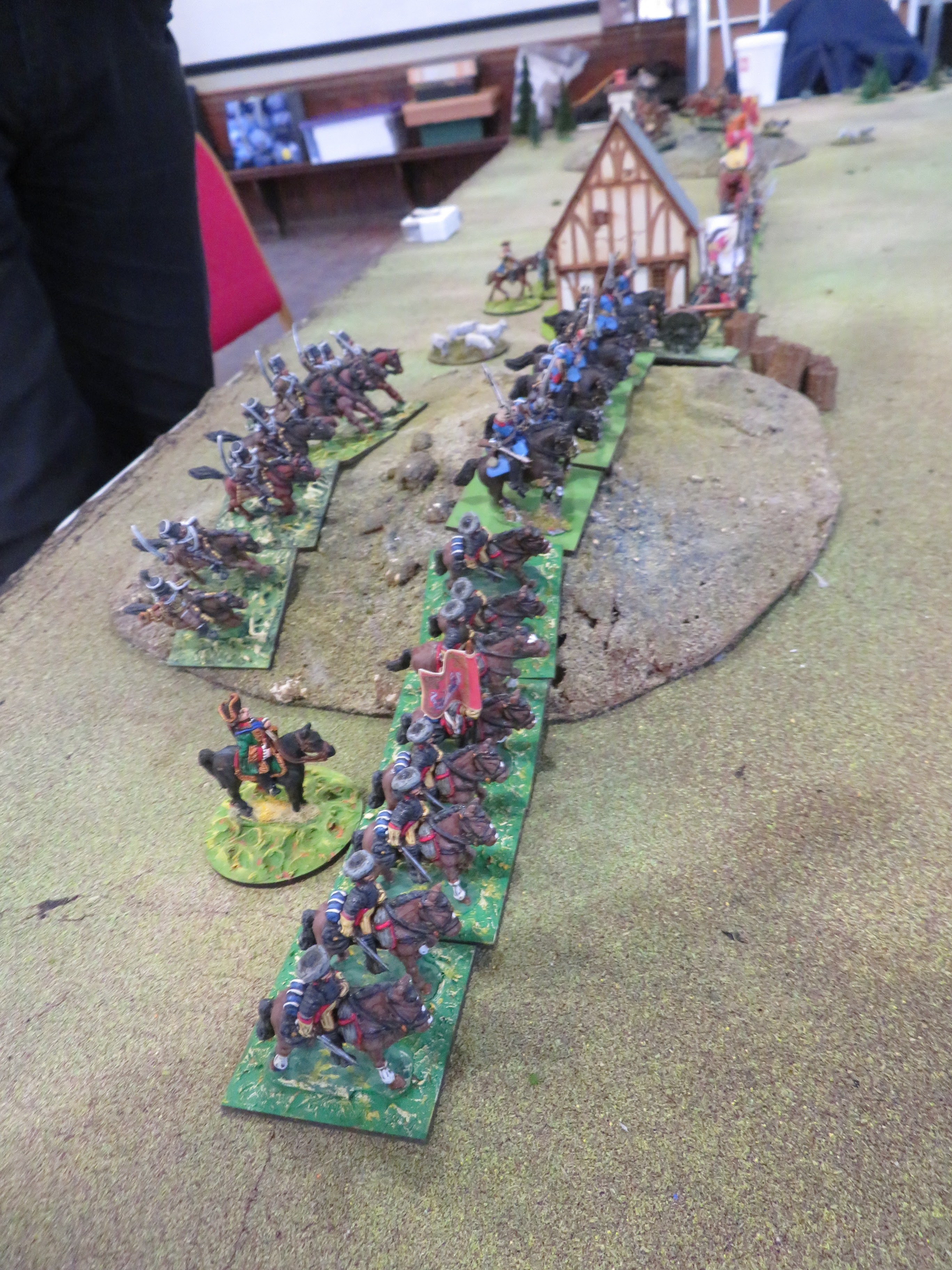
(Above, top left) The left wing of the advancing Wurstburpers begins to swing to the flank, no doubt to protect it from any interference from the Kurlandian regular cavalry. On the other flank, the Cassock irregulars stay huddled upon their hill. The gap to their front, though, between the enemy infantry and their cavalry is getting really quite wide. This is just the opportunity that any enterprising cavalry might look for - which means, of course, that the Wurstburpers are probably safe.


(Above) The main infantry lines are now in close proximity. There is a rough growl from the Wurstburpers that signals both the impact on their thighs of the chafing of their sporrans but also their desire to close immediately with the enemy and put them to the sword. Ordinary infantry might be tired by their prolonged advance across the battlefield - but not the Wurstburpers. True to their Scottish heritage, the clansmen are always keen to proclaim their willingness, first to walk 500 miles; and then to walk 500 more; just to be the close combat infantry that would fall down at one's door. 

The Kurlandian infantry lower their muskets and prepare to fire: they need a good volley to disorder the enemy and deter them from closing ....

Friday, 10 February 2023

Merkenwig, the Second!

On the opposite side of the field of battle stands the army of the Margravate of Wurstburp. The Margrave, Kasper Johan von Porckenstauffen, is not a man of martial inclinations, and so command of his army is given over to General Bazyli Antonin Unpronunski. Often, the general's command is merely notional because of the presence in Unpronunski's headquarters of Margrave Kaspar's nephew, Prince Karl von Porckenstauffen. The Prince, known because of his pronounced and rather rabbit-like front teeth as 'Bunnie Prince Karlie', is the Margrave's heir. Because of this, his opinions on military matters tend to take precedence. The Prince, however, is still in the capital rallying additional forces; so Unpronunski has a rare opportunity to exercise sole command. Alas for him, though, he is not alone at his headquarters.

Unpronunski's reflections on the most efficacious deployment of his troops have been interrupted by the arrival of Horace de Saxe. Brother of Maurice, he is widely regarded by himself as the foremost military thinker in Mittelheim. That he has been reduced to forcing himself upon Wurstburp, the least successful military organisation since novice nuns were forbidden from kick-boxing, is because his presence has not been universally welcomed elsewhere in MittelheimAlthough he is not the only military philosopher in the region, he is certainly, by a long sausage length, the wurst.


General Unpronunski is being subjected to some of Horace's excellent military advice.
'You are neglecting, I think, to address the elephant in the room, General', Horace says.
'Which is, Herr Saxe?'
'Why, the elephant. of course! It's the elephant. Like I said. Who has the elephants? Because the side with the elephants usually loses'.
Unpronunski frowns. 'I don't think that there are any elephants in the enemy army, sir: I certainly can't see any'.
'Or', says Saxe waggling his finger, 'perhaps you only think that you can't see the elephants'.
'Yes, I'm quite sure that I think that I cannot see the elephants, Saxe: because there aren't any'.
'Or, the enemy has just hidden them very well?'
'On that basis, Saxe, isn't it possible that, because I can't see a travelling circus of Portuguese mime artists, the enemy also has a large number of those within its order of battle?'
'Exactly - and, being mimes, they would be even harder to detect. In war, one must expect everything! And then again, also nothing!'
'Well', says Unpronunski wearily, 'this has been very illuminating'.

Partly because it means that he won't have to talk to Horace, Unpronunski sets about issuing orders for the deployment of his troops. Much of this force is composed of the remnants of Jacobite forces from the '45 rebellion. Since these were the survivors of Culloden, one can at least be assured that they have some skills as long-distance runners


(Above) The Wurstburp army moves into place. Orders are shouted and officers beat their men into position. The ex-Jacobites are a wild and fractious lot, their truculence explained in part by an excessive consumption of their national tipple: a libation made from fermented thistles and metal filings, known as Iron Brew.

(Below) The main element in the Wurstburp army are the regiments of ex-Jacobite highland infantry. Their natural fighting spirit, buoyed up by Iron Brew, is further reinforced by their anger at being forced to live in exile in Mittelheim, a place where vegetables proliferate and you can't get a decent bowl of porridge. Pronunski lines his infantry up opposite the Kurlandian musketeers. Whilst the highlanders aren't great shots, having a tendency to snort their gunpowder rather than put it into their guns, they are really quite handy in a hand-to-hand fight. 


(Below) On the right of the infantry, Pronunski has deployed two regiments of his cavalry: Baggin's Hussars and Fitzbadlie's Cavallerie. These troops have been deployed in line as a way of blocking any attempt by the enemy Cassock horsemen to their front to work their way around the flank of the Wurstburp advance. In addition, should it be necessary, the Wurstburp cavalry stand ready to attack and sweep away the poor quality Kurlandian irregular horse.


The left of the Wurstburp line is held by the Fitzinnisholl Horse (Below). These stand opposite all three regiments Kurlandian regular cavalry, and so Pronunski has supported them by deploying both batteries of his artillery. They won't hit anything of course; but the smoke that they make might be useful.


When all is ready, there is a moment of relative calm. Then, to the skirling of pipes and twirling of thistles, Pronunski orders the Wurstburp attack to commence! Someone in the highland regiments kicks a haggis forwards towards the enemy and then, with a roar of 'See You, Fritz!' the main body advances! 

Monday, 6 February 2023

Merkenwig, the First!

Wherein the army of the Margravate of Badwurst-Wurstburp under General Bazyli Antonin Unpronunski encounters the forces of the the Duchy of Kurland, commanded by Grand Duchess Catherine.

Monday is rarely anyone's favourite day. For many in the civilised world, it is the first day of the working week; and so signals that point of the greatest distance from a lovely Sunday lie-in. For those in Mittelheim, it often signals the end of one working week and the immediate start of the next. Thus, it unhappily combines the discontent experienced by those who do not have a day off, with the feelings simultaneously of mutiny at the prospect of having to do it all again. In the Margravate of Badwurst-Wurstburp, however, there is yet another reason to feel that this day is a rather a sub-optimal one: a suprise attack by their neighbours to the north, the Duchy of Kurland. Mobilising the army, the Wurstburp commander, General Bazyli Atonin Unpronunski has been ordered to sweep the invaders back across the border. Or, if a broom doesn't work, to actually fight them.

Heretically for many within her own country, the Grand Duchess had taken up the burden of commanding her military forces. (Below) At her headquarters, Grigori Savvinos, a recently arrived notable, has been established as the army's chief of staff. Savvinos' qualifications put him well ahead for this role of any native Kurlandian: he can read and write, and he does what he is told.


The Kurlandians have advanced cautiously, and have occupied the area in the vicinity of the Wurstburp village of Merkenwig. It stands amid open terrain, marked by a low hill or two, and small woods: so, much like the forest terrain that has featured in other recent battles. As a student of military history, Catherine has realised that nothing says that one means serious military business like deploying an army in a big, long line. And so, to rueful shaking of heads from her Kurlandian subordinates, she orders her troops deployed into a big, long line (below).


Catherine has deployed her army between the two hills that stand either side of Merkenwig village (above). The Kurlandian irregular cavalry, three sotnias of Cassock horsemen, hold the left flank (below). Of course, being Cassocks, they don't really 'hold' the hill, so much as mill around on it looking lost. If the hill were smaller, and more mobile, they would try and steal it; if it were more attractive, and more mobile, they would try and carry it off and ravish it. But as it is, since the mound doesn't fall into either of the two categories, the irregulars hang around, non-plussed.


In the centre, the infantry are deployed. One regiment holds the village; two are held in reserve; the remainder form a firing line between the village and the Cassocks. The reserve infantry are the army's conscript troops. Catherine hopes that their role will be more in an observatory capacity, since if they actually have to fight it will be a sign that things aren't going altogether to plan. 


To the right of the village, the Duchess has decided to mass all three batteries of her artillery. This is a decision that some sceptics might argue is already an exercise in reinforcing failure. Having one battery of artillery is bad enough: but placing three in close proximity only increases the chances of some embarrassing failure on the part of technically-minded social inferiors.


Finally, holding the right, Boris Katsonov commands the Kurland regular cavalry. He himself is attached to the Berndt-Lippe Carabiniers. Catherine's army watches at the Wurstburpers form up on the other side of the field. Notwithstanding the poor record thus far of their Wurstburp adversaries, many of the Kurlandian officers are sceptical about their chances in the coming encounter. Real wars are fought by men; badly, it is true - but can one really have full confidence in a commander who is largely immune to being kicked between the legs? 

Tuesday, 31 January 2023

Catherine the Great!

'Silence!' cries the Grand Duchess. 'As you may discern from my attire and my splendid painting, it is I who will break down the barriers of gender and command our forces in the field'.
'Madame ...' says the patriarch. 'Forgive my previous expectoration. But, are you sure that this is ... seemly?'
'I do, indeed, seem to think so', replies Catherine. 'And I can assure you that, whilst breaking down the barriers of gender, I am not too busy to break a few others things while I'm at it'.


'But', says Countess Yakenup. 'Commanding in battle - is that wise? Battle is dangerous and requires skills of a distinctly masculine nature'.
'Such as?' asks the duchess.
'Well', says Ignyshin, 'smoking pipes'.
Plinkiplinsk nods. 'Yes, and vodka. Drinking vodka'.
'And there's life on campaign - which is completely unsuitable for a lady' adds Pushimov.
'Yes - there's quite a lot of mud' says Ignyshin.
'And you have to piddle standing up' replies Plinkiplinsk.
'No - that's very much optional, I feel', says Pushimov.

Catherine raises an eyebrow. 'Have any of you actually studied war? The classics - Vegetius? The Byzantine emperor Maurice?' 
'Study? I mean, reading things?', cries Ignyshin incredulously. 'How would reading ladies' romances help, madame?'
'So you haven't, as I have, studied campaigning; operational art; logistics; command and control; lines of operation; decisive points?'
'I can point decisively!' says Ignyshin, pointing. 

'But madame', says Pushimov, 'there's, you know, the fighting'.
Plinkiplinsk nods. 'Yes, war - it's quite violent'.
'Have any of you actually done any fighting?' asks the Grand Duchess.
'Well, not as such. Not in a battle', admits the foreign minister.
'My brother did bully me mercilessly, though' says Plinkiplinsk.
Pushimov nods. 'Yes, and my sister was quite a scrapper'.
Catherine makes an exasperated sound. 'So really, none of you have actually fought in a battle?'
'No. No', admit the ministers. 
'And, overall', says Catherine, 'do generals tend actually to do the fighting?'
'Oh no', is the horrified reply. 'Combat is very dangerous. One can get injured or even killed. No, fighting is best left to the serfs'.


'So none of you, even those that have notionally commanded troops, have actually fought in combat?'
'I fought my chief of staff!' says Ignyshin.. 
'I punched my chef' says Plinkiplinsk, 'The cheeky Frenchman!'
'Borisov will accompany me', says Catherine. 'I'm sure that if there is any requirement to fight my own headquarters staff, then he can do the honours'.
The objections decline into a resentful grumbling.

'Now', says the Grand Duchess, 'unless anyone here would like me to put on another "special breakfast", I think that that is decided. Borisov, order the troops assembled: we march! Wurstburp or bust!'


Saturday, 28 January 2023

War!

In the anteroom, the ministers are joined by Countess Yakenup, a prominent member of the faction of traditionalists. In the centre of the room there now stands a large painting of a woman on horseback, dressed in martial fashion.

'No, no, no, no!' says the Grand Patriarch in alarm. 'This won't do! A woman! Astride a horse! Legs akimbo! Ankles on show! What modern perversion is this? A lustful panoply of pleasure! Madame Duchess, to save you, I shall need to take this back to my chambers where I can examine it in detail, more fully to determine the ways in which it offends the Church!'
'The rider does look familiar, though', says the countess.
'Yes', says Plinkiplinsk. 'But I just can't place her'.
'Perhaps', says Grand Duchess Catherine, 'I might in a moment provide you with a clue. But first, to business!'


'Now, ministers', says Catherine decisively. 'There are reasons why it is that Kurland currently is a nonentity in Europe! And most of those reasons were standing before me previously in the audience chamber, bleating! It is time to instill some purpose into them! We shall galvanise! We shall reorganise! Will shall modernise! And we shall, most of all, pulverise!
'War!' shouts Ignyshin.
'War! War!' shout the others.

Catherine waves a calming hand. 'War, yes. But we need a war that we can win. So, who is the weakest power in Mittelheim?'
Ignishyn, the foreign minister bites his lip in concentration. 'Oooh, a quiz! I like it!'
Catherine sighs. 'You are the foreign minister - you're supposed to be an expert. Isn't that the point of foreign minsters?'
'Madame, this is a dangerously radical line of thought', says the patriarch worriedly.
'Yes', says Ignishyn. 'Because if, as foreign minister, I'm supposed to know about foreign affairs, then that would imply ...'
'... a meritocracy', adds Countess Yakanup in deathly tones. 'Appointments on the basis of knowledge. expertise and competence instead of hereditary privilege'.
There is horrified silence
'Expertise might improve our foreign policy, though' says Borisov.
'You take that back!' shouts the patriarch.

'Enough!' says Catherine, heading off what might otherwise descend into a long and bloody altercation. 'Enough! We shall begin by building our military reputation. We need to commence with easy victories against a useless military opponent'.
'Wurstburp!', everyone says in unison.
'Indeed!', says the Grand Duchess, 'my choice also. Now, our priority is to mobilise our troops and commence the campaign as quickly as possible'.

'But who shall command the army?' asks Pushimov.
'Me! Me!' says Ignyshin putting his hand up. 'Pick me!'
'Don't start, Ignyshin', says Borisov wearily. 'You know as much about war as Pushimov does about a woman's physique'.
'Possibly more than we think, then?' says Plinkiplinsk, nodding towards the altar boy.
Borisov pulls a face. 'One can climb into a carriage, Plinkiplinsk, without knowing how it is constructed'.
'Again, enough!' cries Catherine. She gestures to Borisov. Borisov bows before turning to the others and says: 'Ministers! The Grand Duchess will retire for a short while, before returning presently. Our sovereign has a very important announcement to make!' 
With that, Catherine leaves, Borisov in tow.

Time passes. There are some polite attempts at small-talk, but there is only so long that a shared interest in cruelty to the poor can be stretched.
Then, there is the neigh of a horse and the sound of clopping hooves. Borisov enters and bellows: 'Behold, good folk of Kurland! Bow before the Grand Duchess Catherine the Great - our leader and commander of all our armies!'
Catherine enters upon a white steed.

'Satan's shiny bell-end!' croaks Pushimov in horror. Countess Yakenup covers the ears of the altar boy.

Wednesday, 18 January 2023

Dignity!

' ... it is about dignity that I wish to speak! Dignity! Isn't that the issue? What dignity can we have as a peripheral power in the most peripheral place in Europe?' The Grand Duchess gestures dramatically, fixing the audience with her gaze. 'Don't you tire of never being able to visit other places in Europe for fear of having to admit where you come from? Don't you tire, if you do go, of conversations that never get past the question 'and where do you come from?' because your answer causes foreigners to laugh so much they rupture their corsets?'

There is much rueful nodding amongst the audience. Rather than admit to their true place of origin, many is the Mittelheimer abroad that has preferred to introduce themselves to locals as being Hessian, or Polish, or a Dundee fruitcake.
'Dignity! This is my objective! Let us put aside the tiresome debates between modernisers and traditionalists and unify behind my plan to get us out of Mittleheim!' There is silence from the audience: but this seems more interested and less hostile than hitherto.


'But', pipes up one in the audience. 'But ... aren't there certain ... geographical realities to  our being Mittelheimers such as ... ah ... being geographically in Mittelheim?'
Catherine waves expansively to her audience. 'Not, gentleman and ladies, if I conquer all of Mittelheim and then change the name'.
There is stunned silence.

'Uh, can you do that?'
'When I am absolute ruler of Mittelheim - yes! And I can change the name of my empire to whatever I like. A name that will expunge the memory of Mittelheim and instead generate awe amongst foreign peoples. A name such as  ... Prussia!'
There is another stunned silence.

'Uh, isn't that name ... taken? Can we also use it?'
'Is it, you know, allowed?' asks someone else.
Catherine shrugs. 'I am, of course, just thinking out loud. It could be any name that I like; or indeed', she looks at them slyly, 'that you might like!'
'Oooh! Oooh!' someone cries out. 'Let's be Spain - I've always wanted to go there!'
'No', cries another in a rapture of excitement. 'Let's be Britain - I've always hated them: then we can ban the drinking of tea! And ban ships!'
'Yes! Yes! And ban the use of that annoying snarky superior sort of sarcasm that they think passes for a sense of humour!'
'Or', says someone else in hushed tones, 'we could be Lilliput!'
'Yes! Yes!', cries another. 'And we could force the serfs to pretend to be really, really small, whereas we could pretend to be giants, and then squash them with our feet! Our naked, naked feet!'

'All excellent ideas, everyone', says the Duchess. 'But of course, to achieve this goal, we must first unite behind my agenda and conquer Mittelheim!'
'Huzzah! Huzzah!' cries the audience. 'Long live the Grand Duchess! Long live Catherine the Great!'
The Grand Duchess acknowledges the newly enthusiastic praise of her leading subjects. Not wishing to risk spoiling the mood with anything so tawdry as evidence or policy details, she retires to her antechamber.

Wednesday, 11 January 2023

Speech!

The Grand Duchess is announced. There is an unenthusiastic smattering of claps and then obstinate silence from the assembled audience of notables. There is an atmosphere in the room: uncooperative; predatory even - the same sort of ambience that might attend an attempt by a penguin to extol the virtues of a vegetarian diet at a polar bears-only cooking club. Catherine clears her throat and then commences speaking.


'In the months since the unfortunate and unknown events that led to the death of my beloved husband ...'
'You had him strangled!' shouts out a voice from the back.
'And where our investigations have sadly still yet to unearth evidence of  the assault upon him ...' perseveres the Grand Duchess.
'You had him strangled here, at breakfast!' shouts someone else. 'We were all there!'
'... by an unknown assailant ...' continues Catherine.
'It was Borisov!' shouts another. 'We saw him do it. You said "Borisov, strangle him. Give that neck a good wringing!"'
'... and where unfounded allegations against me have been spread by unknown persons ...'
'Everyone here!' squawks a voice. 'We saw it! Hello! We were there!'
'... malefactors and miscreants, who will be garrotted as soon as I identify them ...'
'Yes, no one knows anything' says her audience, suddenly nodding. 'Not a thing, At all. It's quite a mystery'.
'... It has become evident that not all here support the new direction in which I wish to take our beloved country'.

'But', says Catherine, softening her voice and making conciliatory gestures with her hands, 'it is time to put the unfortunate events surrounding the manner of my ascension behind us. It is time that I, the first female ruler of Kurland, lead our beloved Grand Duchy into a new age of vigour! With your help, we shall make our country great again, and I shall become the most famous Catherine that Europe will ever know!'

One of the dignitaries puts his hand up. 'There is that other Catherine, my lady - you know, the wife of Czar Peter III of Russia. They do say that she has some metal'.
'Pah!' scoffs the Grand Duchess, bridling. 'Peter will reign for decades, and his witless wife will no doubt die as a nonentity! She will be Catherine the Utterly Mediocre, whereas I shall be Catherine the Great! Anyway, she isn't even a real Catherine - what is her actual name, Borisov?'
'Sophie of Anhalt-Zerbst, madame', says Count Borisov.
'Yes, that's right', says Catherine dismissively, 'Sofa of  Anal-Slurps'.
'Madame! Dignity!' cries Borisov. There is some grumbling amongst the audience. No ruler of the duchy has ever before had the temerity to use in public the word 'slurps'.
'Anyway ...' continues the Grand Duchess ...