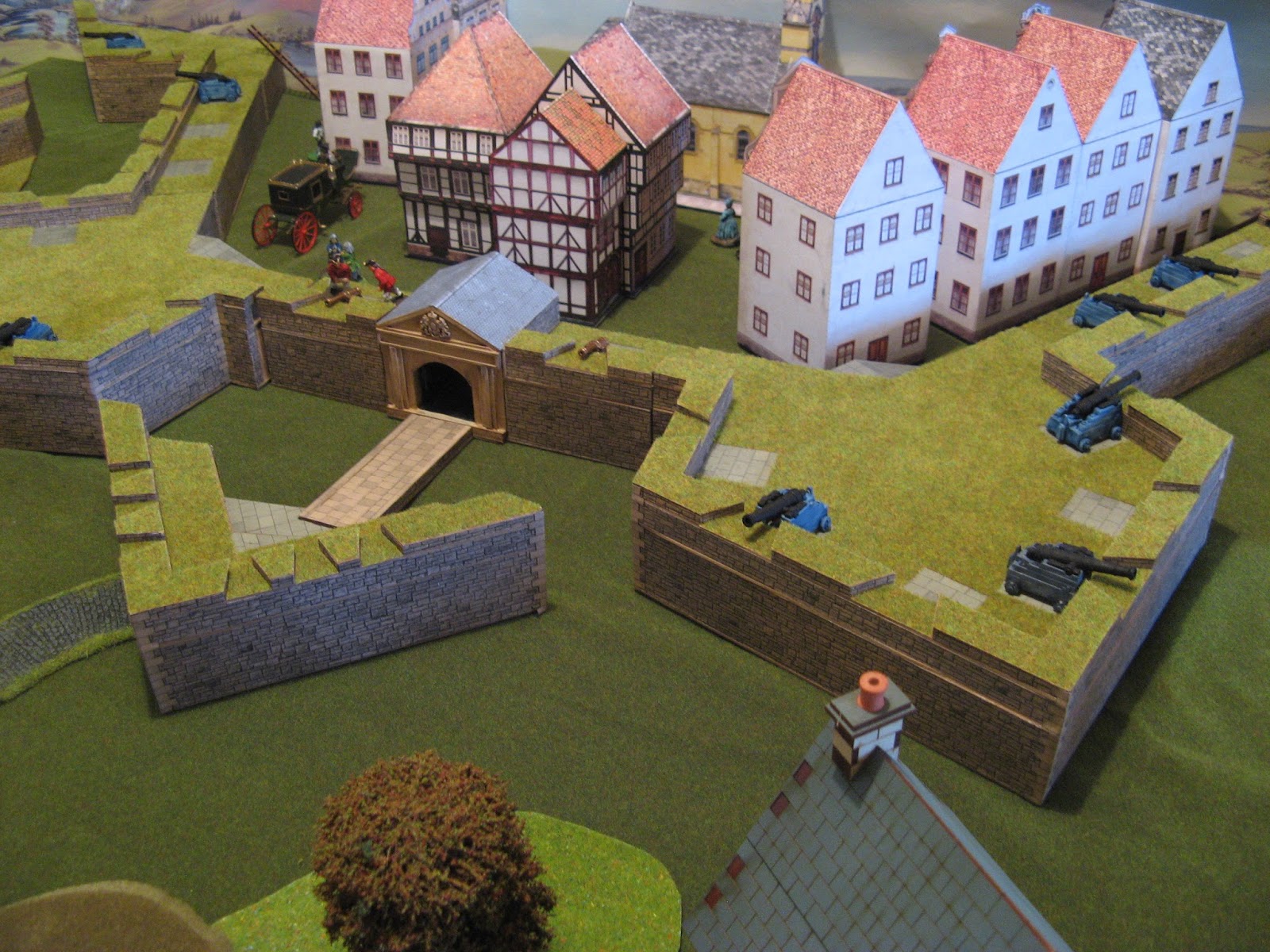
Colonel Zeigler and his intrepid force of troops approach the capital in the bright sun of the early morning. The Colonel is not pleased: his plan to attack at dawn has foundered on the inability of his scouts to agree on the relative importance on the Gross Schnitzelring clock tower of the big hand and the little hand. Still, with the sun up, it gives everyone, including any Gelderland guards, the opportunity to admire the uniforms, of a stylish jager fashion, acquired by Zeigler en route. Right about now, a unit of Gelderland jager some ten miles to the west will be waking up in an inn to find that their uniforms seem now to include rather more in the way of petticoats than is normal and also are substantially roomier around the chest. The Colonel has managed to acquire, not just a marvelous new uniform, but also a rakish eye-patch.
'It looks a bit nautical, sir,' says his Sergeant. 'A bit, you know, pirate-ish.'
'Really?' says the Colonel, warming to his new accoutrement. 'Well, then, I shall wear it - I like the buccaneer look.'
'I think it's a mistake, sir,' says the sergeant, 'begging your pardon.'
'A mistake, eh?' says Zeigler. 'Well, you know what they say, sergeant: to err is human, but to 'aaarh!' is pirate.'
In addition to the uniforms, Zeigler has managed to impose a semblance of discipline on his force, as the plethora of black eyes can testify. All told, the Colonel's force looks rather more military, and certainly much more imposing, than it did when it commenced its journey. The Colonel has also received welcome reinforcements: two companies of musketeers, and two squadrons of dismounted cavalry.
Zeigler eyes the cavalry suspiciously: 'Where are their horses, sergeant?'
'They ate them, sir.'
'Zounds! Is our supply situation so perilous?'
'No sir, they, um, just ate them.'
Zeigler divides up his force. The Jager and one company of musketeers heads for the walls, in search of the secret postern gate revealed in Miss Nora Hindquarters' intelligence. The Colonel, though, is also keen to destroy the bridge leading to Gross Schnitzelring, in order to make it impossible to wheel Wilhelm back over the stream should any of the Gelderlanders have the strength to unwedge King Wilhelm and the mind to 'unfind' him. Zeigler details the cavalry, the other company of musketeers, and a large barrel of gunpowder for this task, all under the command of Captain Stefan von Kobblers. As Kobblers' force heads off to the south, Zeigler turns his attention to the question of the postern gate. The small door itself isn't difficult to find, but the Colonel is worried - password protected defences: whatever might that mean?
With some trepidation Zeigler approaches the small portal. The door seems very, very robust. The men look on expectantly, and Zeigler suddenly realises that he has no idea at all how it is that he is going to get through. The moments pass. It all starts to get very, very embarrassing. Suddenly, a small sentry door at head height whips open, revealing the grim visage of a thickly mustachioed guard of the garrison regiment.
'Halt - what's the password!', the Gelderland sentry barks.
Zeigler shrugs despondently, nonplussed - 'Dammit, how should I know?'
'Well, then,' says the guard. 'You can't come in.'
'But,' says Zeigler, 'we really need to come in. I'd enter through the main gate, but I'd be embarrassed to be seen marching in public with this lot.'
The guard looks at the gaggle of jager behind Zeigler. 'Fair enough,' he says. 'But I still can't let you in. You might be a Trojan.'
'I'm not a Trojan,' says Zeigler, 'I'm German.'
'It's a classical allusion, sir' says the sergeant. 'Secret infiltrator, like the Trojan horse of the Iliad.'
'I haven't got a horse either,' says Zeigler.
The sentry pauses. 'Well, in that case, I need your security question.'
'Eh' says Zeigler. 'What's the security question?'
'Well,' says the sentinel, 'I ask you what your mother's maiden name is, and then, if you get it right, I can give you a copy of the password.'
Zeigler looks nonplussed, and then shrugs.
'Er, okay.'
'So, Herr Colonel, 'what's your mother's maiden name?'
'Ur, well, it's Hofstedter.'
The sentry nods. 'Is that right?'
'Um. Yes?' Zeigler says hopefully.
'Promise?' says the guard.
'Um. Yes?' says Zeigler.
'Marvelous' says the sentry, passing Zeigler a small envelope. 'The password is written on that. Or, if you like, you could re-set it by choosing another.'
'You know,' says Zeigler to the guard, as he opens the door, 'wouldn't a sturdy padlock be more secure? Isn't all this talk talk rather ... insecure?'
'Oh no, no, no,' says the guard. 'This is the future, believe me. Safe as houses. Although my predecessor was hacked.'
'Hacked?'
'Yes - cavalry sabre: his head came right off.'
Zeigler's force heads into a dark corridor leading through the fortress walls.
The Colonel turns to the sentry. 'There's just one more thing.'
'What's that?' says the sentry.
'This,' says Zeigler. There is a hollow 'bonk' sound as the last jager hits the sentry over the head with his horn.
'I'll bet that hurt', says the Colonel to the jager. 'Next time use your instrument.'
Being in the main a tale of heroic encounters during the late wars in Mittelheim
Friday, 30 October 2015
Friday, 23 October 2015
Gross Schnitzelring!
And so, gentle reader, we find ourselves contemplating the Mittelheim metropolis that is Gross Schnitzelring, capital of the Kingdom of Gelderland.
It would only partially be accurate to say that the city was founded in 843AD; for the word 'founded' implies some deliberate act. It would perhaps be more true to say that the city 'happened to occur' on that date as a result of the Bishop of Prick's wheeled commode having got stuck at the muddy crossroads that marked the centre of what would become the city. It then just seemed too much effort to continue the journey, not least because his destination was Rotenburg. Over the years, the settlement expanded until in 1503 it was declared by King Oskar II the capital of the Kingdom of Gelderland. Oskar, it is fair to say, did not do this with much enthusiasm: Gross Schnitzelring did not have much to recommend itself except that everywhere else was slightly worse: slightly damper; slightly muddier; smelling slightly more of boiled cabbage and leeches. None of the Kings of Gelderland had been keen on the place, generally with good reason. Still, it was Oskar who made Gross Schnitzelring the capital, and it was Oskar who first ordered the building of walls to surround the city, though this was less to defend the town than it was to keep the mud in.
Over the years, in an attempt to improve the general ambiance of the city, the Kings of Gelderland had made strenuous efforts to encourage various marauders and ravening hordes to sack the place, but to no avail. In 1597, King Herman 'the horse buttocked' went so far as to make use of his recently acquired printing press to send formal invitations to every pirate, sell-sword, mercenary, and ego-maniacal monarch in Europe, inviting them to his capital for a 'wine, gunpowder and matches' party. The response was disappointing, though that was not so surprising given that Herman's lamentable spelling had led him to offer an opportunity for 'days of drinck and fisting'.
Khan Chaka of the Mongols, known widely as Khan Chaka 'the bastard son of a thousand maniacs' stopped briefly at Gross Schnitzelring on his grand reconnaissance into Europe as part of his search for a defensible frontier, more slaves to crucify and some more kittens to glue together. But he left quickly suffering from mild depression. Gross Schnitzelring was then occupied by Gustavus Adolphus' Swedes during the 30 Years War, but after a few days in the city they just could not get into the mood for fire, bloodshed, and pillage. After stealing some spoons, just to show that they could, they contented themselves with constructing some furniture and enacting some new by-laws creating a more socially just society.
One could pen many poems or write many songs in praise of the wonderful charms of the Gelderland capital. But, if one did, one would clearly be drunk, or have never been there, or perhaps been in the process of being threatened with a very large cudgel. Possibly the only reference to the place in wider European culture is Handel's little known ditty, 'Maybe it's Because I'm in Gelderland / That I love London so'. Herr Hans Pantzpuller, Mittelheim's famous poet and badger wrestler, wrote perhaps the only specific piece on Gross Schnitzelring, shortly before the voyage that would lead him to the Leech Coast. An autobiographical work, his poem 'I'm Not Going Back There, You Can't Bloody Make Me' was a long poem, of which only the first two verses survive:
'Gross Schnitzelring! My little Sack!
Has shrivelled, for I am ordered back!
From Paris, post haste to you, alack!
The thought has made my wurst go slack!
Gross Schnitzelring! Please find a quack!
With poisons many, who has the knack!
To kill me now, before I pack!
Wild horses could not drag me back!
The King's Royal Chamberlain, Graf Petr Peiper-Pickderpeck, lord of Pickelpeipers, has been promising publicly to do his best to make Wilhelm once again the hub of government. In reality, however, the Chamberlain, like the King himself after a hard night on the figs, has really been going through the motions. The story that the King was merely stuck in a doorway had begun to wear, ironically considering the state of the King, rather thin. Graf Petr has now put about the notion that the King managed to free himself, but was then abducted by Nabstrian agents. The palace has issued descriptions of the abductors: 'four men' with 'heads and noses', that were reported 'to be wearing clothes, possibly including britches'. One of the felons was reported to be 'possibly Italian, Russian, or ginger, with a moustache or belly-button.' The local garrison has carried out pain-staking searches of taverns, bakeries, ladies boudoirs, and exporters of lard and walruses but nothing has been found. There has also been an extensive campaign of posters. The walls in Gross Schnitzelring are plastered with missives bearing the words 'Wanted - but only if you have time,' and 'Have You Seen This Man - if so, tell the authorities (but, you know, there's no rush, it you have something else urgent to do),' and 'Reward! But it's probably not as big as you think'.
Absent King Wilhelm, Don Penguino has become the power behind the throne. However, Wilhelm's throne is actually very large with plenty of space for others behind it as well. In consequence, Don Penguino has usually had to share the back of the chair with the Chamberlain, Lord Petr, and also the Minister for War and Strudels, Count Matthias von Sachsenblaus. The three have divided up the rule of the kingdom. All matters relating to internal affairs are dealt with by the Chamberlain; all those relating to war, foreign affairs, and pastry products are the remit of Sachsenblaus; and any issues best handled through the medium of a comedic Spanish accent go to Don Penguino. Naturally, Don Penguino is by far the busiest of the triumvirate.
The three have taken as read the ability of the capital's defences to ward off an enemy attack. In this, they are perhaps a little over-confident. The garrison consists of a company of jager, who, their poor standard of drill meaning that they are widely recognised as being unable to find their own backsides with both hands and a lantern, spend most evenings with lanterns telling one another worriedly, 'My arse! It's been stolen!' The jager are supplemented by a company from the Gelderland garrison regiment. Since the Gelderland regular army is less likely to see military action than a collection of pacifist toddlers, the garrison regiment can be reliably assessed as being about as war-like as a kindergarten for piglets during their afternoon nap.
There has been some investment in the physical defences around the capital. Gross Schnitzelring is protected by a modern system of walls, bastions, and ravelins. There is no glacis, though, because the King could see no use in surrounding the walls with French ice creams. Citizens have no doubt been comforted by the sight of so many cannon peeking menacingly from the battlements. However, the effectiveness of these pieces is questionable. Gelderland was intent on acquiring, in the fashion of King Frederick II, a selection of 24 pounder 'brummers'. However, entirely predictable bureaucratic confusion led the garrison artillery to procure some 240 pound 'brummies' instead. The appearance of four cart-loads of folk from the midlands of England was compounded by the fact that even those Gelderlanders who spoke English couldn't really understand anything that the brummies said. The new arrivals having been sent off profitably to the Leech Coast, the capital is protected now by some antiquated ships guns that lack crews.
Sunday, 27 September 2015
This way, men!
The place: a small patch of Nabstria, near the River Strudel on the frontier with Gelderland. The time: five days before the battle of Heisenleman, just before supper. The dramatis personae: Captain Hugo von Stumpe, staff officer to General von Rumpfler; Colonel Zeigler of the Nabstrian army; and a select body of troops chosen especially for ...
'Operation Probable Death?' says Zeigler, an eyebrow raised higher than a gymnastic caterpillar.
Stumpe nods. 'I wanted a code-name that was dramatic but that was also broadly accurate. I thought that "Operation Certain Death" might be bad for morale.'
'You can't include the word "death" in the code-name,' says the Colonel: 'think of something more optimistic; something that will buoy up the spirits of the troops.'
Stumpe reflects for a moment. 'Fair enough, Colonel: "Operation Possible Survival," it is.'
Zeigler casts a look at King Wilhelm, strapped, for his journey to Grosschnitzelring, onto a specially strengthened wheelbarrow.
'If you want accuracy', says Zeigler, 'then "Operation Certain Hernia" would seem a reasonable one. Look at him. He's like a middle-aged walrus that's really let himself go.'
Stumpe continues. 'I've taken the liberty of picking the best fellows available for your mission. Now bear in mind', and here his voice becomes to Zeigler suspiciously placatory, 'that with the need to bring our musketeer regiments up to strength, the pool of available manpower for your mission was not as large as it might otherwise have been.'
'How big was the pool?' asks Zeigler.
Stumpe shrugs. 'Well, I say pool; it was more of a ... puddle, really.' He shouts out an order, and Zeigler's intrepid troops shuffle forwards. Zeigler groans inwardly: these are 'rank and file' only in the sense that they 'file in, smelling rank.'
Also, to man, they are dressed in women's clothes.
At this, Zeigler nods approvingly: 'Excellent idea, men - on a secret mission like this, we need to disguise ourselves.'
The troops look confused: 'What secret mission? Are we going somewhere?'
The Colonel looks despairingly at Stumpe. 'How am I to complete this mission with such a force? You may as well have recruited for me a flock of sheep.'
At this, there is some grumbling from the front rank of troops, and then some 'baas' from the second. 'When I said "puddle of manpower,"' says the Captain. 'it was really more of a ... small spillage. Anyway, I have to be off: you should say a few appropriate words to, you know, enthuse them for the mission.'
'A few appropriate words?' whispers Zeigler to Stumpe incredulously. 'Well, yes: how about "sodding hell, we're all going to die."'
Zeigler closes his eyes, slows his breathing and takes himself to his happy place - a place, unsurprisingly, that is far, far away from Mittelheim.
Zeigler sighs wearily and then turns to his troops.
'Time for the men to tool up, Sergeant', he says.
'Righto sir, I'll sort it out'
Stumpe mounts his horse, and then leans over to Zeigler, addressing him quietly. 'The mission is even more dangerous than we thought - as it turns out, Ms Hindquarters' intelligence was not complete. The postern gate which will be be your means of ingress through the defences of Grosschnitzelring has a state of the art security system, comprising of successive layers of password protection. You will need to navigate your way through by using your wits.'
Stumpe then addresses Zeigler's men. 'This is it, my brave fellows - it is time now to do or die in the name of our Burgrave. God save Nabstria!'
Amidst answering rousing cries of 'God save the Burgrave!', 'Death before dishonour!' and 'Oooh, my corset's killing me', Stumpe rides off to rejoin Rumpfler's army.
Zeigler busies himself awhile with the last preparations for his mission, and then, at midnight, the small force assembles for the march on the Gelderland capital.
'Everything ready sergeant?'
'Yes sir, all done.'
Zeigler pauses as if he has just had a thought.
'Sergeant.'
'Yes sir?'
'When I said that the men should tool up ... they've got muskets, pistols and swords, yes? Not screwdrivers or, um, lathes and stuff.'
There is an awkward pause: 'Sir ... I'll be back in a minute'.
Zeigler nods wearily. 'Of course, sergeant; of course.'
'Operation Probable Death?' says Zeigler, an eyebrow raised higher than a gymnastic caterpillar.
Stumpe nods. 'I wanted a code-name that was dramatic but that was also broadly accurate. I thought that "Operation Certain Death" might be bad for morale.'
'You can't include the word "death" in the code-name,' says the Colonel: 'think of something more optimistic; something that will buoy up the spirits of the troops.'
Stumpe reflects for a moment. 'Fair enough, Colonel: "Operation Possible Survival," it is.'
Zeigler casts a look at King Wilhelm, strapped, for his journey to Grosschnitzelring, onto a specially strengthened wheelbarrow.
'If you want accuracy', says Zeigler, 'then "Operation Certain Hernia" would seem a reasonable one. Look at him. He's like a middle-aged walrus that's really let himself go.'
Stumpe continues. 'I've taken the liberty of picking the best fellows available for your mission. Now bear in mind', and here his voice becomes to Zeigler suspiciously placatory, 'that with the need to bring our musketeer regiments up to strength, the pool of available manpower for your mission was not as large as it might otherwise have been.'
'How big was the pool?' asks Zeigler.
Stumpe shrugs. 'Well, I say pool; it was more of a ... puddle, really.' He shouts out an order, and Zeigler's intrepid troops shuffle forwards. Zeigler groans inwardly: these are 'rank and file' only in the sense that they 'file in, smelling rank.'
Also, to man, they are dressed in women's clothes.
At this, Zeigler nods approvingly: 'Excellent idea, men - on a secret mission like this, we need to disguise ourselves.'
The troops look confused: 'What secret mission? Are we going somewhere?'
The Colonel looks despairingly at Stumpe. 'How am I to complete this mission with such a force? You may as well have recruited for me a flock of sheep.'
At this, there is some grumbling from the front rank of troops, and then some 'baas' from the second. 'When I said "puddle of manpower,"' says the Captain. 'it was really more of a ... small spillage. Anyway, I have to be off: you should say a few appropriate words to, you know, enthuse them for the mission.'
'A few appropriate words?' whispers Zeigler to Stumpe incredulously. 'Well, yes: how about "sodding hell, we're all going to die."'
Zeigler closes his eyes, slows his breathing and takes himself to his happy place - a place, unsurprisingly, that is far, far away from Mittelheim.
Zeigler sighs wearily and then turns to his troops.
'Time for the men to tool up, Sergeant', he says.
'Righto sir, I'll sort it out'
| Mopping his brow, a soldier propels Wilhelm slowly back to Gelderland. |
Stumpe then addresses Zeigler's men. 'This is it, my brave fellows - it is time now to do or die in the name of our Burgrave. God save Nabstria!'
Amidst answering rousing cries of 'God save the Burgrave!', 'Death before dishonour!' and 'Oooh, my corset's killing me', Stumpe rides off to rejoin Rumpfler's army.
Zeigler busies himself awhile with the last preparations for his mission, and then, at midnight, the small force assembles for the march on the Gelderland capital.
'Everything ready sergeant?'
'Yes sir, all done.'
Zeigler pauses as if he has just had a thought.
'Sergeant.'
'Yes sir?'
'When I said that the men should tool up ... they've got muskets, pistols and swords, yes? Not screwdrivers or, um, lathes and stuff.'
There is an awkward pause: 'Sir ... I'll be back in a minute'.
Zeigler nods wearily. 'Of course, sergeant; of course.'
Friday, 4 September 2015
Heisenleman, the final!
Entirely unlike King Wilhelm, the battle has taken nearly all day to reach its climax. With the Imperial assault upon the Palatinate's forces stalled, it is down now to the sprucely uniformed musketeers of Nabstria to make the decisive attack. Trumpets sound, the drums beat, and the impeccably dressed Nabstrian foot march forwards determinedly. As the sun begins slowly to set, glittering redly upon cold steel, General Von Rumpfler rides up and down the Nabstrian lines, waving his hat and shouting vigorously: 'Forward, men! Now is the time! Drive the enemy from the field! Give them your bayonets, or any other sharp objects that you might have about your person!' His men advance in silence. Nine regiments of musketeers step forwards, supported by a unit of the Burgrave's mercenary infantry.
(Below, left) Furst Augustus helps himself to a brandy from his personal barrel, although, given the lateness of the hour, an ovaltine might be more appropriate. Saxe-Peste remains confident. He has seven regiments to hold the line, and he really doesn't have to hold it for very long. On his far left, two units will be able to take cover behind walls. At the moment, the Furst has ordered them to hold back, to prevent the enemy artillery from being able to fire upon them. He also has two regiments in reserve, ready to move to whatever point is threatened. Moreover, as the Nabstrians advance, their numerical advantage begins to shrink. Looking to his left, Rumpfler sees the threat posed by the Landgravial cavalry - cursing the limp performance of his own mounted forces, the General is forced to order two regiments of his troops to wheel in order to screen the flank of his advance. However, Rumpfler still has a trick or two up his sleeve that he believes will restore the advantage to his troops.
On the other side of the field, the battle has petered out faster than Landgrave Choldwig's new year's resolutions concerning olive oil and debauchery. Cavandish and Barry-Eylund seem to have taken very different approaches to supporting their respective allies. The good Marshal has dispatched Nitzwitz directly to the Imperial artillery. All of Cavandish's attention is now given to working his grand battery in support of the Nabstrians. Barry-Eylund, it has to be said, seems to have chosen a rather different path. When an officer arrives from the Palatinate cavalry asking if they might cross the stream and move around the Imperial flank, the General cannot be found. Indeed, Barry-Eylund has inveigled his way into Rupprecht's card game.
'Pass!' says the General, picking up more cards.
'Snap!' says the Prince, enthusiastically taking them all.
'What are we playing?' says the General, confused.
'Billiards', says Count Erlock-Weisse, dejectedly.
As Barry-Eylund continues to treat the battle as a card game, Furst Augustus suddenly begins to understand the peril facing his troops. (Below) As the Nabstrian infantry bear down upon the Rotenburg line, Furst Augustus is now necessarily forced to order his troops to line the walls in front of their position so that they can bring their musketry to bear upon their foes. In doing so, however, the Rotenburg musketeers can now be seen again by the Imperial artillery. The cunning Von Rumpfler signals the Nabstrian infantry to halt, and waits for his ally to pour in some preparatory fire. At Marshal Cavandish's orders, the grand battery belches out once again its hail of death, destruction, and mortuary-related unpleasantness. Despite the obstacle of the wall, the skilled Imperial gunners seem to have regained the joie de malleting that they exhibited at the commencement of the battle, and they wreak havoc upon the Rotenburg defence.

Such is the carnage behind the Rotenburg lines that Death has been forced to substitute his usual scythe for a large shovel. Although, metaphysically, Death obviously is present everywhere and at all times, still, the effort that he is forced to put into matching the effects of the Imperial artillery means that he is rather, well, thinly spread, elsewhere. Thus, somewhere near Limoges, the dreadful violinist Armand Gateaux, assaulted badly by his unhappy audience, finds that having a violin bow thrust manfully right through his head is not the terminal experience that one might expect. The fellow lives for another thirty years, most of it spent trying to navigate through doorways. And in Grimsby, the Scottish-French engineer, Colonel Dougal Entendre, is most surprised that the half ton block of marble dropped accidentally on his head, bounces off and merely flattens his wig a tad. Suspecting that no one has such luck without it catching up on him, Colonel Entendre makes passage on the first ship out of the port. Sadly for him, its destination is Mittelheim.
Furst Augustus is forced now to commit his two reserve regiments to plug the gap on his left. The threat from the enemy's artillery means that these regiments cannot line the wall, and so the Nabstrian infantry are protected from Rotenburg musketry. 'Forward!' cries Von Rumpler, and the general himself gallops to the scene of the action. The rat-a-tat of Nabstrian drums continues as the Nabstrian infantry recommence their advance. (Below, middle) But what's this? By this stage of the Wars of the Gelderland Succession, Rumpfler can barely raise a shrug of his shoulders when, of course, it transpires that there's something not marked on his map: a patch of rocky ground so obvious that a mole with a comedy eye-patch could see it.
'There's nothing else on the map is there?' says Rumpfler.
'I don't think so, my lord', reply his staff officers.
'Not a mountain range we haven't seen? Or Ragnarok itself?'
'No, no, my lord'.
'Saint Paul's cathedral?'
The officers pause for a moment and then quickly cast their eyes over their maps.
'No, no, my lord. Definitely, probably not.'
Despite the map-related inconvenience, Rumpfler is unperturbed. Soon, and just as he anticipated, a bout of confusion strikes one of the Furst's reserve regiments, and it hops over from the safety of the wall, advancing towards the Nabstrians. Musketry crackles and, though the Landgravial musketeers do creditable damage to their opposition, one Nabstrian regiment breaking, the weight of fire opposing them is too great - the unit buckles, then routs, the troops pouring backwards. (Below, bottom) There is now a gap in the Rotenburg line again, and there are no reserves left to fill it. Furst Augustus' infantry is reduced to but four battalions, and seven Nabstrian units now bear down on them. The evening gloom begins to deepen.
(Below, right) There is some consolation for the Rotenbergers as one of the Nabstrian regiments, its blood up, conducts a foolhardy bayonet attack over the rocky ground and across the wall. It is beaten back and routed. But the situation remains grim.
'Give me night!' wails Furst Augustus. 'Give me night, or give me a marvelously creative supporting action from my ally, Barry-Eylund!'
The latter, sadly, is unlikely.
'What are we playing now?' asks Barry-Eylund.
'Bridge', says Count Erlock-Weisse, wearily.
Prince Rupprecht slams down his hand, but before he can say anything Barry-Eylund interrupts.
'My Lord, I understood that in order to claim the cards, the card that you put down has to be the same as mine. But, see, my lord, your card is different. I have a nine of spades and you seem to have ... Mrs Bunn the Baker. An easy mistake to make my lord, what with the din of cannon and such, and so not in any way, I should wager, an attempt to pervert the rules of the game.'
Rupprecht nods slowly, and then gestures for the general to lean forward.
Barry-Eylund leans forward, and the Prince then punches him mightily in the face.
'Snap!' says the Prince, happily.
As the last sliver of sun begins to slide below the horizon, the Nabstrians, like King Wilhelm eating a large plate of scones, make one last heave. Once again, one of the Furst's units confuses its orders, interpreting the command 'Halt! Defend in place!' with 'Advance! Into the rocky ground! Yeah!' (Below, centre)
But actually, the regiment performs surprisingly well amidst the difficult terrain. None of the Nabstrian volleys hit it at all, and with the light now dimmer than their own officers, it it clear that the Nabstrian troops have simply run out of time.With night having fallen, the chances of any further Nabstrian success are lower than a hedge-hogs kneecaps, and the prospect of launching another assault about as inviting as King Wilhelm's belly-button after a particularly vigorous frolic.
(Below) And so, the battle of Heisenleman draws to a close.
'Indeed, my lord', says the Colonel, 'It was quite a tussle'.
'How vicious those Nabstrians were', says Furst Augustus. 'I mean, look at that poor ensign there. He seems to have been shoved bodily onto his own trumpet'.
'Inexplicable',says du Vicque, in a neutral tone.
'And then he seems to have beaten himself around the head savagely with his own instrument'.
'Battle can do that to a man', says du Vicque, avoiding eye contact.
The Imperial and Nabstrian forces are able to retire in good order, but the battle, and also the war, are now lost for them. It is a splendid victory for Rotenburg and for Bachscuttel: hurrah for Landgrave Choldwig! Hurrah for Prince Rupprecht!
For King Wilhelm, however, the excitement is far from over; and we turn now, dear reader, to the strange adventures of Colonel Zeigler...
(Below, left) Furst Augustus helps himself to a brandy from his personal barrel, although, given the lateness of the hour, an ovaltine might be more appropriate. Saxe-Peste remains confident. He has seven regiments to hold the line, and he really doesn't have to hold it for very long. On his far left, two units will be able to take cover behind walls. At the moment, the Furst has ordered them to hold back, to prevent the enemy artillery from being able to fire upon them. He also has two regiments in reserve, ready to move to whatever point is threatened. Moreover, as the Nabstrians advance, their numerical advantage begins to shrink. Looking to his left, Rumpfler sees the threat posed by the Landgravial cavalry - cursing the limp performance of his own mounted forces, the General is forced to order two regiments of his troops to wheel in order to screen the flank of his advance. However, Rumpfler still has a trick or two up his sleeve that he believes will restore the advantage to his troops.
On the other side of the field, the battle has petered out faster than Landgrave Choldwig's new year's resolutions concerning olive oil and debauchery. Cavandish and Barry-Eylund seem to have taken very different approaches to supporting their respective allies. The good Marshal has dispatched Nitzwitz directly to the Imperial artillery. All of Cavandish's attention is now given to working his grand battery in support of the Nabstrians. Barry-Eylund, it has to be said, seems to have chosen a rather different path. When an officer arrives from the Palatinate cavalry asking if they might cross the stream and move around the Imperial flank, the General cannot be found. Indeed, Barry-Eylund has inveigled his way into Rupprecht's card game.
'Pass!' says the General, picking up more cards.
'Snap!' says the Prince, enthusiastically taking them all.
'What are we playing?' says the General, confused.
'Billiards', says Count Erlock-Weisse, dejectedly.
As Barry-Eylund continues to treat the battle as a card game, Furst Augustus suddenly begins to understand the peril facing his troops. (Below) As the Nabstrian infantry bear down upon the Rotenburg line, Furst Augustus is now necessarily forced to order his troops to line the walls in front of their position so that they can bring their musketry to bear upon their foes. In doing so, however, the Rotenburg musketeers can now be seen again by the Imperial artillery. The cunning Von Rumpfler signals the Nabstrian infantry to halt, and waits for his ally to pour in some preparatory fire. At Marshal Cavandish's orders, the grand battery belches out once again its hail of death, destruction, and mortuary-related unpleasantness. Despite the obstacle of the wall, the skilled Imperial gunners seem to have regained the joie de malleting that they exhibited at the commencement of the battle, and they wreak havoc upon the Rotenburg defence.
Though the Landgravial musketeers have their bodies protected by the wall, their heads remain cruelly exposed. The Imperial gunners use all of the fruits of their specialist training, skipping and richocheting their ballons du morts into the poor infantryman. Though one might argue that, for an infantry musketeer in the Age of Reason, the head is perhaps the least useful of all of the body's appendages, still, it soon becomes apparent that separating it from the body does make infantry drill more problematic to execute in a timely manner. As more and more are decapitated, the musketeers' effectiveness ebbs, and, despite valiant attempts by subalterns to balance heads back onto the bodies (though not always the right ones), it becomes clear that the battalion's combat effectiveness is broken irrevocably even if its cognitive capacity has been reduced only marginally.
(Below, at top). With a final wet bouncing sound, the last of the musketeers is fatally shortened above the neck, and the regiment is finished. There is now a gap in the Rotenberg line!
Furst Augustus tries to hurry along his reserves to plug the hole. In the meantime, Cavandish directs the Imperial artillery to focus on the next regiment along. The slaughter wreaked by their guns proves to be a moving experience for the Fenwickian cannoneers: songs are sung, tears are shed, though the wetness of Fenwickian cheeks is nothing compared to the condition of Rotenberg underpants, as the guns destroy the other regiment behind the wall.
Such is the carnage behind the Rotenburg lines that Death has been forced to substitute his usual scythe for a large shovel. Although, metaphysically, Death obviously is present everywhere and at all times, still, the effort that he is forced to put into matching the effects of the Imperial artillery means that he is rather, well, thinly spread, elsewhere. Thus, somewhere near Limoges, the dreadful violinist Armand Gateaux, assaulted badly by his unhappy audience, finds that having a violin bow thrust manfully right through his head is not the terminal experience that one might expect. The fellow lives for another thirty years, most of it spent trying to navigate through doorways. And in Grimsby, the Scottish-French engineer, Colonel Dougal Entendre, is most surprised that the half ton block of marble dropped accidentally on his head, bounces off and merely flattens his wig a tad. Suspecting that no one has such luck without it catching up on him, Colonel Entendre makes passage on the first ship out of the port. Sadly for him, its destination is Mittelheim.
Furst Augustus is forced now to commit his two reserve regiments to plug the gap on his left. The threat from the enemy's artillery means that these regiments cannot line the wall, and so the Nabstrian infantry are protected from Rotenburg musketry. 'Forward!' cries Von Rumpler, and the general himself gallops to the scene of the action. The rat-a-tat of Nabstrian drums continues as the Nabstrian infantry recommence their advance. (Below, middle) But what's this? By this stage of the Wars of the Gelderland Succession, Rumpfler can barely raise a shrug of his shoulders when, of course, it transpires that there's something not marked on his map: a patch of rocky ground so obvious that a mole with a comedy eye-patch could see it.
'There's nothing else on the map is there?' says Rumpfler.
'I don't think so, my lord', reply his staff officers.
'Not a mountain range we haven't seen? Or Ragnarok itself?'
'No, no, my lord'.
'Saint Paul's cathedral?'
The officers pause for a moment and then quickly cast their eyes over their maps.
'No, no, my lord. Definitely, probably not.'
Despite the map-related inconvenience, Rumpfler is unperturbed. Soon, and just as he anticipated, a bout of confusion strikes one of the Furst's reserve regiments, and it hops over from the safety of the wall, advancing towards the Nabstrians. Musketry crackles and, though the Landgravial musketeers do creditable damage to their opposition, one Nabstrian regiment breaking, the weight of fire opposing them is too great - the unit buckles, then routs, the troops pouring backwards. (Below, bottom) There is now a gap in the Rotenburg line again, and there are no reserves left to fill it. Furst Augustus' infantry is reduced to but four battalions, and seven Nabstrian units now bear down on them. The evening gloom begins to deepen.
(Below, right) There is some consolation for the Rotenbergers as one of the Nabstrian regiments, its blood up, conducts a foolhardy bayonet attack over the rocky ground and across the wall. It is beaten back and routed. But the situation remains grim.
'Give me night!' wails Furst Augustus. 'Give me night, or give me a marvelously creative supporting action from my ally, Barry-Eylund!'
The latter, sadly, is unlikely.
'What are we playing now?' asks Barry-Eylund.
'Bridge', says Count Erlock-Weisse, wearily.
Prince Rupprecht slams down his hand, but before he can say anything Barry-Eylund interrupts.
'My Lord, I understood that in order to claim the cards, the card that you put down has to be the same as mine. But, see, my lord, your card is different. I have a nine of spades and you seem to have ... Mrs Bunn the Baker. An easy mistake to make my lord, what with the din of cannon and such, and so not in any way, I should wager, an attempt to pervert the rules of the game.'
Rupprecht nods slowly, and then gestures for the general to lean forward.
Barry-Eylund leans forward, and the Prince then punches him mightily in the face.
'Snap!' says the Prince, happily.
'Curses!' howls Rumpfler.
'Zzzzzzzz', says Cavandish gently, fast asleep now that his cannon have stopped firing.
As the Combined Grand Army withdraws from the field, Furst Augustus rides forwards to visit his cavalry, the attack of which was undoubtedly the decisive event in the battle. The Furst meets with Colonel du Vicque, and in the gloom Saxe-Peste looks sadly upon the heaps of fallen cavalrymen.
'A savage fight', he says to du Vicque.'Indeed, my lord', says the Colonel, 'It was quite a tussle'.
'How vicious those Nabstrians were', says Furst Augustus. 'I mean, look at that poor ensign there. He seems to have been shoved bodily onto his own trumpet'.
'Inexplicable',says du Vicque, in a neutral tone.
'And then he seems to have beaten himself around the head savagely with his own instrument'.
'Battle can do that to a man', says du Vicque, avoiding eye contact.
The Imperial and Nabstrian forces are able to retire in good order, but the battle, and also the war, are now lost for them. It is a splendid victory for Rotenburg and for Bachscuttel: hurrah for Landgrave Choldwig! Hurrah for Prince Rupprecht!
For King Wilhelm, however, the excitement is far from over; and we turn now, dear reader, to the strange adventures of Colonel Zeigler...
Saturday, 22 August 2015
Heisenleman, the third!
The Imperial advance, all later agree, is a splendidly conducted manoeuvre. In perfect step, three lines of musketeers, each of three regiments, march resolutely towards the Bachscuttel positions, each line providing support for the other. Eight of the regiments comprise of trained regular Fenwickian infantry. In the middle of the front line marches the ninth: a unit of mercenary Zentans, clutching muskets and with stout aubergines pushed into the waistbands of their baggy pantaloons. There are no conscripts in this force: these are properly drilled musketeers from the Age of Reason. So there is no out-of-step shuffling; no complaints; no banging on and on about human dignity or the rights of man. There is simply a relentless tramp forward, with little noise in the cold grey afternoon except for the relentless tap-tap of their drums.
General Redmond Barry-Eylund watches the enemy advance towards his troops. In truth, it is something of a relief - with the enemy's infantry now on the offensive, the Fenwickian artillery have stopped firing, and the army of the Palatinate of Saukopf-Bachscuttel might soon have an opportunity at last to contribute usefully to the battle.
'My lord, should I order our artillery to fire upon the enemy infantry?' pipes up a staff officer.
Barry-Eylund pauses a moment before replying.
'Yes, why not', he says with a shrug, 'I mean, it's the sort of thing that one should do at this point in a battle. Only', he adds, 'tell them to point their cannon at the enemy this time.'
'At once, my lord.'
The General's cannons open fire upon the advancing Imperials; but, as is normal for Mittelheim artillery, its role mainly is to provide some atmospheric smoke to the proceedings. A few of the cannonballs hit the advancing Fenwickian regiments and, with plaintive cries, some enemy musketeers are prematurely shortened and then collapse into the grass, to be trodden over, and, in a few vindictive cases, kicked several times in their wedding tackle, by the next line. Sergeants push men into the gaps and the advance continues without halting.
Barry-Eylund sighs resignedly. Behind him Prince Rupprecht and Count Erlock-Weisse continue their game of cards. Barry-Eylund raises an eyebrow to a staff officer.
'It's Poker, my lord' says the staff officer.
'Snap!' shouts Prince Rupprecht delightedly, taking all of the cards.
Across the meadow, Marshal Cavandish examines the advance through his spy-glass. (Below, left) There can be little finesse to this attack. The left and right of the Imperial troops are blocked by a marsh and a wood (though the the latter must be referred to in Fenwick as a 'leafy obstacle', the word 'wood' being an unwise one to use in Imperial circles. Actually, there are some who also argue for the banning of the phrase 'Imperial circles'. For similar reasons, in Fenwick, ringing bells always make the noise 'ding, ding'). Buttressed by three batteries of artillery, each protected by gabions, the Palatinate's line consists of five infantry regiments. The Bachscuttel horse are deployed to the rear, facing, naturally, in the wrong direction. But Marshal Cavandish has a trick or two up the sleeve of his night gown. He has a veeeeery strong suspicion that, about now, a bout of confusion is likely to afflict one of the Bachscuttel units.
Barry-Eylund ruminates on the object of the Fenwickian attack.
'Do they, perhaps, expect us to to cross the stream and fight them on equal terms?', he muses out loud.
Just to his left, in the front line, the General's words are heard by Graf von Gross-Winkel, Colonel of the von Gross-Winkel infantry regiment, a fine body of elite troops.
'Was than an order to cross the stream?', he says to his second-in-command.
'I don't think so, my lord. I think it was sarcasm'.
'Sarcasm, or irony?'
'Er - I'm not wholly clear on the difference, sir'.
'Or perhaps', gulps the Colonel, 'it was actually a rhetorical question'.
'Or a logical syllogism?' suggests his aide.
'Epistomologically, I'm not sure that we have the evidence to say categorically that the order to cross the stream does not exist', says the Graf.
'Ontologically though, sir, I think that we are making a mistake to assume that simply by asserting that the order exists, that we can then presume that it does indeed exist.'
'Hmm', says the Colonel. 'On the one hand, I might fall prey to an ontological paradox; and on the other, I might be executed for disobeying an order, constructivist or otherwise. Order the advance'.
'An actual advance, sir, or a rhetorical one?'
'An actual advance, Captain - but if it makes you feel better, you can give the order ironically.'
'Righto, sir'.
(Above, top) In perfect order, the regiment advances right into the middle of the stream. As the water swirls around their chests, their muskets get wet, making it impossible for the troops to fire. They are within range now of two Imperial regiments.
'Perfect', says, the Graf, beaming.
(Above) Instead, the fighting in this portion of the battlefield degenerates into a desultory exchange of artillery. Indeed, Barry-Eylund soon comes to the conclusion that he would be glad if his artillery could indeed be exchanged, their fire being especially notable for its ineffectiveness. The General makes a mental note that any future alcoholic ribaldry in local brewery's, or lewdsome frolics in houses of ill-repute should not be organised by his artillery officers. The Imperial artillery of course proves itself to be a little more useful. The Palatinate light infantry battalion deployed in the nearby field is blown apart by enemy cannon fire. Barry-Eylund halts attempts to remove their dead and wounded from the field and orders them instead to be dug into the ground - at least then they might then be useful for something.
Eventually, it is clear that the Imperial attack here is over. Across the meadow, Marshal Cavandish curses and even Keith seems to be off his oats.
'Dammit, Nitzwitz: and to think I stayed awake for that lamentably limp performance. How I loath Barry-Eylund - always winkling himself into his defensive shell like some kind of barnacle-bottomed military crustacean. I feel like getting off Keith, hitching up my nightgown, and then waggling my backside at those Bachscuttel fools, whilst shouting 'Behold Barry-Eylund: here's another crack for you to squeeze your army into!''
Nitzwitz blanches.
'My lord - I think that that would be beneath you.'
Cavandish reflects for a moment, before sliding from his horse.
'Actually, Nitzwitz, I don't think that it would be.'
As the shadows lengthen, Barry-Eylund surveys the field through his telescope. In front, the six remaining Imperial regiments remain halted. The threat from that direction clearly is over. Some way behind, the General can just make out a pale object that looks, if he didn't know better, like a posterior being gyrated derisively in his direction. But then suddenly, to his right, amidst the Nabstrian lines, there is an obvious commotion. Emerging from the gathering gloom marches a mass of infantry - the last great attack before night falls is surely underway! The General turns to train his glass upon his ally's positions: the Rotenburgers are outnumbered. And then, in the centre of the enemy lines, he notices frenzied activity amongst the enemy grand battery. Barry-Eylund gulps - Furst Augustus is about to be subjected to a combined infantry and artillery assault of formidable strength. He realises suddenly that upon the consequences of this final assault rests the outcome of the battle ....
General Redmond Barry-Eylund watches the enemy advance towards his troops. In truth, it is something of a relief - with the enemy's infantry now on the offensive, the Fenwickian artillery have stopped firing, and the army of the Palatinate of Saukopf-Bachscuttel might soon have an opportunity at last to contribute usefully to the battle.
'My lord, should I order our artillery to fire upon the enemy infantry?' pipes up a staff officer.
Barry-Eylund pauses a moment before replying.
'Yes, why not', he says with a shrug, 'I mean, it's the sort of thing that one should do at this point in a battle. Only', he adds, 'tell them to point their cannon at the enemy this time.'
'At once, my lord.'
The General's cannons open fire upon the advancing Imperials; but, as is normal for Mittelheim artillery, its role mainly is to provide some atmospheric smoke to the proceedings. A few of the cannonballs hit the advancing Fenwickian regiments and, with plaintive cries, some enemy musketeers are prematurely shortened and then collapse into the grass, to be trodden over, and, in a few vindictive cases, kicked several times in their wedding tackle, by the next line. Sergeants push men into the gaps and the advance continues without halting.
Barry-Eylund sighs resignedly. Behind him Prince Rupprecht and Count Erlock-Weisse continue their game of cards. Barry-Eylund raises an eyebrow to a staff officer.
'It's Poker, my lord' says the staff officer.
'Snap!' shouts Prince Rupprecht delightedly, taking all of the cards.
Across the meadow, Marshal Cavandish examines the advance through his spy-glass. (Below, left) There can be little finesse to this attack. The left and right of the Imperial troops are blocked by a marsh and a wood (though the the latter must be referred to in Fenwick as a 'leafy obstacle', the word 'wood' being an unwise one to use in Imperial circles. Actually, there are some who also argue for the banning of the phrase 'Imperial circles'. For similar reasons, in Fenwick, ringing bells always make the noise 'ding, ding'). Buttressed by three batteries of artillery, each protected by gabions, the Palatinate's line consists of five infantry regiments. The Bachscuttel horse are deployed to the rear, facing, naturally, in the wrong direction. But Marshal Cavandish has a trick or two up the sleeve of his night gown. He has a veeeeery strong suspicion that, about now, a bout of confusion is likely to afflict one of the Bachscuttel units.
Barry-Eylund ruminates on the object of the Fenwickian attack.
'Do they, perhaps, expect us to to cross the stream and fight them on equal terms?', he muses out loud.
Just to his left, in the front line, the General's words are heard by Graf von Gross-Winkel, Colonel of the von Gross-Winkel infantry regiment, a fine body of elite troops.
'Was than an order to cross the stream?', he says to his second-in-command.
'I don't think so, my lord. I think it was sarcasm'.
'Sarcasm, or irony?'
'Er - I'm not wholly clear on the difference, sir'.
'Or perhaps', gulps the Colonel, 'it was actually a rhetorical question'.
'Or a logical syllogism?' suggests his aide.
'Epistomologically, I'm not sure that we have the evidence to say categorically that the order to cross the stream does not exist', says the Graf.
'Ontologically though, sir, I think that we are making a mistake to assume that simply by asserting that the order exists, that we can then presume that it does indeed exist.'
'Hmm', says the Colonel. 'On the one hand, I might fall prey to an ontological paradox; and on the other, I might be executed for disobeying an order, constructivist or otherwise. Order the advance'.
'An actual advance, sir, or a rhetorical one?'
'An actual advance, Captain - but if it makes you feel better, you can give the order ironically.'
'Righto, sir'.
(Above, top) In perfect order, the regiment advances right into the middle of the stream. As the water swirls around their chests, their muskets get wet, making it impossible for the troops to fire. They are within range now of two Imperial regiments.
'Perfect', says, the Graf, beaming.
General Barry-Eylund cannot immediately rectify the mistake, not least because he is speechless with rage: red-faced, dribbling, almost catatonic with molten anger, hitting himself about his own head with his telescope. Eventually, he is able to squeeze out two words: 'R..r..r.regiment ....r...r...r..retrograde'. Fate smiles upon Barry-Eylund - the Imperial volleys are too post-modern in their character; they swirl around ineffably, lacking fundamentally in substance, and so leave on regiment von Gross-Winkel little evidence of their existence. With a short step to the rear, the regiment is then brought back into the line, relatively unscathed and out of range of the Imperial muskets.
(Below) The lead elements of the Imperial infantry approach the stream behind which the Palatinate's forces are deployed. The latter's position is a strong one, but, as is usual with Barry-Eylund, he has constructed a defensive position that, if it is tricky to get into, it is also very difficult to get out of. The Fenwickians are masters of the lethal volley, whereas the Palatinate's infantrymen are not; and the stream makes it just as difficult now for Barry-Eylund's troops to charge the Fenwickians as it does for the Fenwickians to get at Barry-Eylund's forces.
As it transpires, however, bayonets are rather surplus to requirements. The Palatinate's musketeers deliver some deadly fire against the advancing Imperials, causing many casualties; the latter's riposte is rendered largely ineffective by some thick smoke that obscures their view. Raked by canister fire, and with yet another deadly volley from the Bachscuttel lines, the Imperial attack begins to wilt. The Zentans are the first to melt away under the Palatinate's volleys, waggling their aubergines impotently (a particularly sad way of shaking them). Over the course of an extended fire-fight, the advantages of the Palatinate's canister fire proves just enough to give them the edge. A fierce attempt by one Imperial regiment to charge Barry-Eylund's line also ends in an large heap of corpses.
'Hah!', shouts General Barry-Eylund happily, gesticulating in the direction of the enemy: 'You can stick that up your Imperial circles'.
(Below) All three lead Fenwickian regiments break. The Bachscuttel lines are not without some losses. The artillery, for example, lose many gunners. Barry-Eylund shovels irregulars in to help man the cannons - if some potatoes get mixed in as well, they don't seem to be any less effective than the light troops, and they certainly seem to exhibit greater initiative. Despite urgent representations from his Nabstrian ally, Marshal Cavandish is reluctant to throw his remaining infantry again into the jaws of the Palatinate's defences.
Eventually, it is clear that the Imperial attack here is over. Across the meadow, Marshal Cavandish curses and even Keith seems to be off his oats.
'Dammit, Nitzwitz: and to think I stayed awake for that lamentably limp performance. How I loath Barry-Eylund - always winkling himself into his defensive shell like some kind of barnacle-bottomed military crustacean. I feel like getting off Keith, hitching up my nightgown, and then waggling my backside at those Bachscuttel fools, whilst shouting 'Behold Barry-Eylund: here's another crack for you to squeeze your army into!''
Nitzwitz blanches.
'My lord - I think that that would be beneath you.'
Cavandish reflects for a moment, before sliding from his horse.
'Actually, Nitzwitz, I don't think that it would be.'
As the shadows lengthen, Barry-Eylund surveys the field through his telescope. In front, the six remaining Imperial regiments remain halted. The threat from that direction clearly is over. Some way behind, the General can just make out a pale object that looks, if he didn't know better, like a posterior being gyrated derisively in his direction. But then suddenly, to his right, amidst the Nabstrian lines, there is an obvious commotion. Emerging from the gathering gloom marches a mass of infantry - the last great attack before night falls is surely underway! The General turns to train his glass upon his ally's positions: the Rotenburgers are outnumbered. And then, in the centre of the enemy lines, he notices frenzied activity amongst the enemy grand battery. Barry-Eylund gulps - Furst Augustus is about to be subjected to a combined infantry and artillery assault of formidable strength. He realises suddenly that upon the consequences of this final assault rests the outcome of the battle ....
Monday, 10 August 2015
Heisenleman, the second!
The six batteries fire upon the village of Popdorf. There is a thunderous, deafening roar. Death, who might have jumped out of his skin if he had any, checks his pantaloons and then remembers with relief that he also has no bowels. The entire battle halts momentarily as the troops from all four armies stare at the village. (Below) As the smoke slowly clears there is no sign at all of the Rotenburg garrison regiment - it has been completely annihilated.
The troops look on in awe.
Even Marshal Cavandish has been awoken: he looks agog at the smoking remains. 'By the power of Grey Skull', he whispers.
'Let's do it again!' says Captain Nitzwitz enthusiastically, training his telescope on a new target. Death, meanwhile, sprints across the field of battle shouting 'Wait! Wait! I wasn't ready!'
Behind the Palatinate line, Barry Eylund looks at Popdorf gloomily. It is Barry Eylund's forces that are nearest to the enemy grand battery. The Bachscuttel irregulars, deployed in a field, begin to dig themselves in amongst the potatoes. The regulars sag noticeably, in the hope that the reduction in their height might produce a commensurate increase in their lifespans. Sergeants set about beating such a notion out of them - 'those are cannonballs', they shout, as another salvo is launched from the enemy gun line, 'not leech fricasees. Stand like rough approximations of men', they growl. It seems evident to the General that the only orders that he is going to need to issue in this battle are those directing the bringing up of dustpans and brushes to clear away the remains of his army.
Behind him, Prince Rupprecht remains oblivious, and continues with his roistering.
'Dammit', says Barry-Eylund distractedly to a staff officer, 'what in God's good name are they playing now?'
'Gin rummy, I believe' says the officer.
'Snap!' says the Prince, happily.
The initial bloody execution doled out by the Combined Grand Army's artillery line leads Rumpfler and Cavandish to wait out the morning in the hope that their guns can drill further bloody holes in the ranks of their adversaries. But Fate is a cruel mistress, as well (as Death can testify) as being unable to cook terribly well. It becomes apparent that the artillery, like King Wilhelm at one of his evening soirees, has peaked rather too early in the proceedings. The morning bleeds away as the enemy artillery create for the armies of Bachscuttel and Rotenburg the exact same feeling of having one's genitals flicked with a metal ruler: it hurts quite a lot, but it isn't fatal.
On the other side of the battlefield, events have proceeded in a manner that might be described as 'gentlemanly'; if the gentleman in question were aged, quite forgetful, and periodically incontinent. A few Landgravial cannon balls have been thrown into the Nabstrian lines, eliciting a rousing cheer from the Rotenburg troops. The fire, however, has succeeded only in maiming a few of Rumpfler's light troops, eliciting a rousing cheer from the rest of his army. (Below, top) This geriatric military fumbling continues for a while until Rumpfler decides that it is time to advance his light troops; a bit of gentle probing might induce some response from his Rotenburg foe. However, it soon becomes clear that the Nabstrian probing has penetrated the Rotenburgers rather too deeply, since it evokes an immediate and violent response. Positioned on the right between the woods and Dangalbalz stands a dismounted Colonel Michel-George du Vicque, commander of the Rotenburg Landgravial cavalry, along with his second in command, Captain Dietrich von Stadtmaffin, and his trumpeter, Ensign Hans Standt. Du Vicque and von Stadtmaffin wait patiently, eyeing the Nabstrian light troops as they caper forwards. Their calmness contrasts with that of the ensign, who points excitedly at the enemy jager, saying repeatedly 'Shall we charge? Shall we charge? Can we? Can we? Go on, go on, go on, go on, go on!'
'Patience, Standt, ' says du Vicque, 'A professional soldier obeys orders always. We must wait for an ... ouch, dammit!''Let's do it again!' says Captain Nitzwitz enthusiastically, training his telescope on a new target. Death, meanwhile, sprints across the field of battle shouting 'Wait! Wait! I wasn't ready!'
Behind the Palatinate line, Barry Eylund looks at Popdorf gloomily. It is Barry Eylund's forces that are nearest to the enemy grand battery. The Bachscuttel irregulars, deployed in a field, begin to dig themselves in amongst the potatoes. The regulars sag noticeably, in the hope that the reduction in their height might produce a commensurate increase in their lifespans. Sergeants set about beating such a notion out of them - 'those are cannonballs', they shout, as another salvo is launched from the enemy gun line, 'not leech fricasees. Stand like rough approximations of men', they growl. It seems evident to the General that the only orders that he is going to need to issue in this battle are those directing the bringing up of dustpans and brushes to clear away the remains of his army.
Behind him, Prince Rupprecht remains oblivious, and continues with his roistering.
'Dammit', says Barry-Eylund distractedly to a staff officer, 'what in God's good name are they playing now?'
'Gin rummy, I believe' says the officer.
'Snap!' says the Prince, happily.
The initial bloody execution doled out by the Combined Grand Army's artillery line leads Rumpfler and Cavandish to wait out the morning in the hope that their guns can drill further bloody holes in the ranks of their adversaries. But Fate is a cruel mistress, as well (as Death can testify) as being unable to cook terribly well. It becomes apparent that the artillery, like King Wilhelm at one of his evening soirees, has peaked rather too early in the proceedings. The morning bleeds away as the enemy artillery create for the armies of Bachscuttel and Rotenburg the exact same feeling of having one's genitals flicked with a metal ruler: it hurts quite a lot, but it isn't fatal.
On the other side of the battlefield, events have proceeded in a manner that might be described as 'gentlemanly'; if the gentleman in question were aged, quite forgetful, and periodically incontinent. A few Landgravial cannon balls have been thrown into the Nabstrian lines, eliciting a rousing cheer from the Rotenburg troops. The fire, however, has succeeded only in maiming a few of Rumpfler's light troops, eliciting a rousing cheer from the rest of his army. (Below, top) This geriatric military fumbling continues for a while until Rumpfler decides that it is time to advance his light troops; a bit of gentle probing might induce some response from his Rotenburg foe. However, it soon becomes clear that the Nabstrian probing has penetrated the Rotenburgers rather too deeply, since it evokes an immediate and violent response. Positioned on the right between the woods and Dangalbalz stands a dismounted Colonel Michel-George du Vicque, commander of the Rotenburg Landgravial cavalry, along with his second in command, Captain Dietrich von Stadtmaffin, and his trumpeter, Ensign Hans Standt. Du Vicque and von Stadtmaffin wait patiently, eyeing the Nabstrian light troops as they caper forwards. Their calmness contrasts with that of the ensign, who points excitedly at the enemy jager, saying repeatedly 'Shall we charge? Shall we charge? Can we? Can we? Go on, go on, go on, go on, go on!'
'My lord?' says Stadtmaffin, concerned.
'I've injured myself on this nail' says du Vicque, examining his boot gingerly.
'I don't think that's a nail,' says Stadtmaffin, leaning in solicitiously, 'its much shorter, its more of a ... a ...'
'A tack?' says du Vicque.
'Attack? Attack!' shouts the Ensign, blowing his instrument harder than Landgrave Choldwig in a Turkish bath.
'No! Nooooooooooooooo!' shouts du Vicque - but it is too late (Below, bottom) With wild neighs, not all them from the horses, and loud shouts of Huzzah!', the Landgravial cavalry surges forwards.
Galloping onwards in march columns, the Rotenburg horse are soon dangerously positioned on the flank of the Nabstrian Army.
Viewing events through his telescope Barry Eyland jumps up and down in frustration: 'We agreed!' he shouts out furiously to no one in particular. 'We agreed! No displays of initiative! None! No brain storming! No left-field thinking! No creating a metaphorical box so that we could think outside of it!' In Saxe-Peste's headquarters, the Furst, too, is apoplectic 'What's picqued du Vicque?' he asks angrily. Saxe-Peste can espy the cavalry riding forward, with du Vicque hopping behind, waving his hands about like a loon.
Actually, though, the sudden advance of the Rotenburg cavalry causes Rumpfler some difficult problems: the enemy horse have merely to wheel left, and they will endanger his whole flank. (Below): Rumpler hastily orders the jager to turn towards the enemy cavalry. His own cavalry can do little immediately - being in march column, they cannot counter-charge the Rotenburgers, and they cannot change into line where they are because this will leave their flanks exposed. Rumpfler has no choice but to send his cavalry leftwards, still in march column, ready to deploy next turn.
(Above, left) The Rotenburg cavalry halts and begins to form to line. Du Vicque and Stadtmaffin manage to catch up.
'We seem to be fine, my lord', says Stadtmaffin relieved. 'See, the enemy horse are still deploying. There's plenty of time for a measured, carefully thought out series of manoeuvres that will allow us to return to our lines'.
'Yes', says du Vicque, mopping his brow. 'We'll put the men into line and then begin a retrograde movement. We might be able to retire through the wood - there might be a road'.
'There's certainly no road, my lord', says Stadtmaffin, 'but there might be a path thingy.'
'A track?' Says du Vicque.
'Attack?' Attack!' shouts the ensign.
'Christ's bunions, noooooooooooooo!' wails du Vicque despairingly.
(Below) With much shouting and waving of swords, the Rotenburg cavalry hurls itself at the Nabstrians, who have now been able to form line. The confined space means that the lead two Rotenburg regiments must face three Nabstrian units - but the intrepidity of the Landgravial advance wins the combat, even if the Nabstrian horse remain unbroken. Charge and counter-charge ensue, with sundry hacking, slashing, and twisting of melons.
(Below) There is a temporary pause in the cavalry melee. Each side has lost one of their regiments: but the remaining Nabstrian cavalry are in some disorder. Still (below, right), Rumpfler has a key advantage - one regiment, at least, of his jager are able to bring some of their muskets to bear on the flanks of the lead Rotenburg dragoon regiment. A few volleys might be able to cripple the Rotenburgers. Volley after volley demonstrates, however, that the jagers couldn't hit the side of a barn even if they were actually deployed inside it.
Rumpfler gallops over to remonstrate with them. Strangely, the jager have dirty smudges of grey around their mouths. They all seem to be sucking something.
'What have you got in your mouths', shouts the General impatiently.
One jager halts and answers. 'We've been given lots of lovely gob-stoppers, my lord'.
'Spit it out', orders Rumpfler. The jager complies and out pops what looks suspiciously like a musket ball.
Rumpfler looks aghast. 'What in God's name have you been loading your muskets with?' he says.
'Loading?', asks the jager.
A fellow leaps by, and aims at a cavalryman - 'Bang!' he shouts, 'Bang, bang, bang! You're dead!'
The jager beams at the General. 'See the rate of fire we can get, my Lord?'
One jager halts and answers. 'We've been given lots of lovely gob-stoppers, my lord'.
'Spit it out', orders Rumpfler. The jager complies and out pops what looks suspiciously like a musket ball.
Rumpfler looks aghast. 'What in God's name have you been loading your muskets with?' he says.
'Loading?', asks the jager.
A fellow leaps by, and aims at a cavalryman - 'Bang!' he shouts, 'Bang, bang, bang! You're dead!'
The jager beams at the General. 'See the rate of fire we can get, my Lord?'
Meanwhile, Colonel du Vicque seems now to have restored some order to the Rotenburg line. He looks askance at Ensign Standt, murder in his eyes.
'If he does that again', says du Vicque to Stadtmaffin, 'I shall give that fellow the most violent smack'.
'Careful, my Lord' says Stadtmaffin, looking alarmed 'in the din of battle the words 'a smack' sounds dangerously like ...'
Again, the Rotenburgers gallop forwards!
(Below) The final cavalry battle occurs! There is a brief, savage, clash of steel before the Nabstrians, riding their horses rather less skilfully than other horses might, collapse in the face of the impetuous Landgravial assault. Both remaining Nabstrian regiments flee! Rumpfler's flank is open!
Desperate, Rumpfler sends a courier to Marshal Cavandish - in order to occupy the enemy, he asks for the Imperial infantry to begin their assault on the right wing. Cavandish is unconvinced by Rumpfler's logic, believing that the Bachscuttel defence is still too strong.
'I'm unconvinced by Rumpler's logic', he says to the courier, 'and I believe that the Bachscuttel defence is still too strong'.
However, as Nabstrian cavalrymen begin to stream past his headquarters in cheerful rout, the Marshal recognises that needs must when the Devil rides his horse as badly as a Nabstrian cavalryman.
And so, the orders are sent; the drums begin to roll; the banners wave; and, bayonets fixed, nine regiments of Imperial infantry begin their attack against Barry-Eylund's line......
Thursday, 6 August 2015
Heisenleman, the first!
Wherein the Combined Grand Army of Imperial Fenwick and the Burgravate of Nabstria encounters the Grand Combined Army of the Landgravate of Rotenburg and the Palatinate of Saukopf-Bachscuttel.
Above the meadows of Heisenleman, grey clouds are banked menacingly. The heavens, it seems, are ready to add their own drama to the events unfolding below.
'And so', says General Barry-Eylund with gravity, 'we are witness to the great struggle of our times. Who can guess what the outcome will be? The efforts of man alone will surely not suffice. Only Fate, it would seem, can decide.'
'Yes', says Furst Augustus Saxe-Peste. After a pause, he adds 'How long do you think that he'll take to work it out?'
Through his telescope Barry-Eylund continues watching Prince Rupprecht of Saukopf-Bachscuttel, as the latter tries to work out which way around his tricorne should go. 'It could be some time. It's probably best if we get this battle out of the way.'
Two armies face one another in the clash that will surely decide the War of the Spanish Suck Session. (Below) On one side stands the Grand Combined Army of the Palatinate of Saukopf-Bachscuttel and the Landgravate of Schillingsfurst-Hesse-Rotenburg. Furst Augustus and General Barry-Eylund have held a brief council of war, agreeing on the dispositions of their troops for the coming battle. (Below, top) The forces of the Palatinate hold a third of the line, occupying the position between the village of Popdorf and a small stream. The infantry are in two lines, with guns interspersed. Light troops occupy a small field to the right of Barry-Eylund's line, mainly because the General cannot think of anything better for them to do, and also because it is important to keep the irregulars away from any habitations that might be sources of leech brandy and women's clothing. To the rear, all three regiments of Horse are deployed in march column, held ready to cross the stream, swinging out, perhaps, onto the Grand Combined Army's left.
(Above, bottom) Desirous of maintaining for his cavalry the flexibility that comes with deployment into march column, but fearful also of the effects of the Rotenburg artillery, Rumpfler positions his cavalry behind the hill: what could possibly go wrong with that? After his endeavors at Dammenblatz Paul, Duke of Clarkeshire, is now back in his more familiar role as commander of the Nabstrian horse; and also, hopefully, most of the riders as well.
And so, the stage is set; the pieces arrayed; the game afoot; the metaphors exhausted. General Barry-Eylund peers through his telescope, moving it down the opposing line - when he reaches the enemy artillery, he gulps, and then, to make himself feel better, he turns the telescope around, making the grand battery look much, much smaller. Behind him, Prince Rupprecht and his entourage are making merry. The Prince has been in a boisterous mood. Rupprecht also has been up at the crack of Dawn. Having dismissed Dawn, by tipping her a few shillings, the Prince has been whiling away the hours by playing cards with one of his favourites, the young rake, Count Ferdinand von Erlock-Weisse. Rupprecht is munching on a chicken leg. His subordinates ignore the flapping and squawking of the bird. Swiftly Rupprecht slaps down a card, his tricorne, the right way around but the wrong way up, wobbles alarmingly.
'Snap!', cries the Prince.
'Um' says Count Erlock-Weisse
'What are they playing?' asks Barry-Eylund to a nearby staff officer.
'Whist, my lord', he replies.
Across the meadow, General von Rumpfler waits a moment longer. From each of the armies drifts the banging of drums and the trill of flutes; except, that is, from the direction of the army of Bachscuttel, where Rupprecht's military orchestra produce a delicate tinkle with the fruits of Rupprecht's brief dalliance in the triangle trade. In the middle of the Palatinate's musicians stands a single woman, banging on a tambourine. The musicians look askance at her: as the paramour of the conductor, they fear for the future of the band. Finally, Rumpfler turns to a courier and says simply 'It is time'. Bowing, the courier mounts his horse (not something that could be done in the army of Imperial Fenwick) and gallops towards Cavandish's headquarters.
The courier approaches Marshal Cavandish. The Marshal is upon his horse, Keith, and attended by his Chief of Staff, Captain Fabius Nitwitz. The courier bows. 'My Lord Cavandish', he says, 'General von Rumpfler begs to suggest that it is time now to commence the bombardment of the village of Popdorf.'
Cavandish says nothing. Indeed, he is slumped forward on his saddle, with no sign of life except the gentle sway of the tassle on his night cap.
'Um', says the courier. 'My lord Cavandish?'
Nitwitz interrupts: 'The good Marshal is cogitating'.
'Cogitating?', says the courier. He watches the Marshal for a moment. Cavandish moves slightly and sprawls even further forward onto Keith.
'Cogitating?' says the courier again. 'Are you sure he's not asleep?'
'No, no', replies Nitzwitz, 'just the moment before you arrived, the Marshal was entertaining me with a most amusing story about the poor footnoting conventions in Marshal de Saxe's 'Mes Reveries.'
The courier peers a little closer. 'Is that dribble on the Marshal's saddle?'
'No, no' says Nitwitz vigorously. 'He is certainly awake. My lord Cavandish, should we open fire with our artillery?'
There is a short silence. Cavandish starts suddenly, then breaks wind, and murmurs 'More lard, less pixies: that's the trick.' He slides slowly from his saddle onto the grass and begins to snore loudly.
Nitwitz turns to the courier. 'Lord Cavandish agrees: let the firing commence!'
'Fire!' shouts Nitzwitz.
'Fire! shouts the courier.
'Fire! shout the surrounding staff officers.
'Blimey, where?' murmurs Cavandish blearily alarmed.
Nearby, Death settles down for a nap against the trunk of a tree. The sudden activity amongst the nearby cannons can signal only one thing: the traditional symbolic start of a Mittelheim battle, comprising the noisy, and casualty free, making of smoke by the artillery arm. Death rests his head gently, experiencing once again the sense that naps aren't half so much fun now that he has no eye-lids.
Meanwhile, in the village of Popdorf, one Rotenburg musketeer turns to another:
Above the meadows of Heisenleman, grey clouds are banked menacingly. The heavens, it seems, are ready to add their own drama to the events unfolding below.
'And so', says General Barry-Eylund with gravity, 'we are witness to the great struggle of our times. Who can guess what the outcome will be? The efforts of man alone will surely not suffice. Only Fate, it would seem, can decide.'
'Yes', says Furst Augustus Saxe-Peste. After a pause, he adds 'How long do you think that he'll take to work it out?'
Through his telescope Barry-Eylund continues watching Prince Rupprecht of Saukopf-Bachscuttel, as the latter tries to work out which way around his tricorne should go. 'It could be some time. It's probably best if we get this battle out of the way.'
Two armies face one another in the clash that will surely decide the War of the Spanish Suck Session. (Below) On one side stands the Grand Combined Army of the Palatinate of Saukopf-Bachscuttel and the Landgravate of Schillingsfurst-Hesse-Rotenburg. Furst Augustus and General Barry-Eylund have held a brief council of war, agreeing on the dispositions of their troops for the coming battle. (Below, top) The forces of the Palatinate hold a third of the line, occupying the position between the village of Popdorf and a small stream. The infantry are in two lines, with guns interspersed. Light troops occupy a small field to the right of Barry-Eylund's line, mainly because the General cannot think of anything better for them to do, and also because it is important to keep the irregulars away from any habitations that might be sources of leech brandy and women's clothing. To the rear, all three regiments of Horse are deployed in march column, held ready to cross the stream, swinging out, perhaps, onto the Grand Combined Army's left.
(Above, bottom) Furst Augustus' troops hold the remainder of the front. From Popdorf, which is garrisoned with a regiment, to the nearby village of Dangelbalz, the Furst deploys all of his infantry, supported by his two batteries of guns. A wall springs out to the right from Popdorf, providing some potential cover to a portion of his line. A field of turnips to the immediate rear of his troops makes manoeuvre a little inconvenient. On the extreme right of the line, and massed behind a wood, are the four regiments of Rotenburg cavalry, under the command of Colonel Michel-Georges du Vicque. The allied plan is as simple as it is elegant: don't lose the battle. The troops of the two armies must fight until victory is achieved, or failing that, until their Generals and their retinues have been given an appropriate opportunity to quit the field safely. To this end, Barry-Eylund and Furst Augustus have both agreed that there should be no displays of initiative on the part of their troops; no innovative application of the campaign planning tools; no strategic ad-libbing; no displays of tactical flexibility or any other such nonsense. Flair, innovation, and blue-sky thinking are immediately forbidden in both armies on pain of death, or an unpleasant evening with some aubergines and a battalion of Zentan mercenaries (whichever turns out to be cheaper). Only blind, unthinking obedience to orders, the turnip-headed, rigid application of doctrine, and a bovine lack of interest in adapting to changing circumstances will be sufficient to execute the allied plan. If Herr Cock Up comes knocking, then emphatically, no one has permission to answer the door.
Across the meadows stands arrayed the Combined Grand Army of the Empire of Fenwick and the Burgravate of Nabstria. Marshal Ignacio Grace a Dieu Cavandish, Generalissimo of Imperial Fenwick, is already exhausted. He has been up since the crack of dawn. This is not, of course, something that he can say to his staff officers, since any sentences that have the word 'crack' in it are likely to have near fatal consequences for Fenwickians, given their wearisome love of japesome double-entendre. Besides, since General Heironymous von Rumpfler has a cousin named Dawn, it might cause some unnecessary inter-allied misunderstandings.Talking long into the night, Cavandish and Rumpfler have created a plan that seems so cunning it could con a weasel into paying for utterly unnecessary insurance protection for future financial payments. Now, the orders have been sent out and the troops arrayed. Cavandish, who in deference to the solemnity of the moment has pulled his dress-uniform coat over his night gown, looks out over the assembled forces.
(Below, middle) Behold! the Combined Grand Army has concentrated all of its artillery into a stupendous six battery behemoth of potent projectile power. Four batteries are provided by Imperial Fenwick, and these have been trained rigorously at the Camberwick School for Artillery and Gifted Children. This monstrous military mass of gargantuan gunpowder alliteration stands ready to blow a hole in the Wilhelmite line. To exploit the havoc that will be wreaked by the grand battery, Cavandish and Rumpfler have concentrated their infantry forces into two, three line formations. (Below, top) On the right, opposite the forces of Bachscuttel, are the musketeers of Imperial Fenwick. At the appropriate moment, they will launch a resolute attack forwards, cross the stream and drive the bewildered remnants of the Palatinate's forces from the field of battle. (Below, bottom) On the left, the Nabstrian infantry is deployed for an assault upon the Rotenburg line: since the Rotenburgers must defend a longer line than their callow allies, and since they lack the protection of the stream, this is likely to be the scene of the battle's decisive act.
(Above, bottom) Desirous of maintaining for his cavalry the flexibility that comes with deployment into march column, but fearful also of the effects of the Rotenburg artillery, Rumpfler positions his cavalry behind the hill: what could possibly go wrong with that? After his endeavors at Dammenblatz Paul, Duke of Clarkeshire, is now back in his more familiar role as commander of the Nabstrian horse; and also, hopefully, most of the riders as well.
And so, the stage is set; the pieces arrayed; the game afoot; the metaphors exhausted. General Barry-Eylund peers through his telescope, moving it down the opposing line - when he reaches the enemy artillery, he gulps, and then, to make himself feel better, he turns the telescope around, making the grand battery look much, much smaller. Behind him, Prince Rupprecht and his entourage are making merry. The Prince has been in a boisterous mood. Rupprecht also has been up at the crack of Dawn. Having dismissed Dawn, by tipping her a few shillings, the Prince has been whiling away the hours by playing cards with one of his favourites, the young rake, Count Ferdinand von Erlock-Weisse. Rupprecht is munching on a chicken leg. His subordinates ignore the flapping and squawking of the bird. Swiftly Rupprecht slaps down a card, his tricorne, the right way around but the wrong way up, wobbles alarmingly.
'Snap!', cries the Prince.
'Um' says Count Erlock-Weisse
'What are they playing?' asks Barry-Eylund to a nearby staff officer.
'Whist, my lord', he replies.
Across the meadow, General von Rumpfler waits a moment longer. From each of the armies drifts the banging of drums and the trill of flutes; except, that is, from the direction of the army of Bachscuttel, where Rupprecht's military orchestra produce a delicate tinkle with the fruits of Rupprecht's brief dalliance in the triangle trade. In the middle of the Palatinate's musicians stands a single woman, banging on a tambourine. The musicians look askance at her: as the paramour of the conductor, they fear for the future of the band. Finally, Rumpfler turns to a courier and says simply 'It is time'. Bowing, the courier mounts his horse (not something that could be done in the army of Imperial Fenwick) and gallops towards Cavandish's headquarters.
The courier approaches Marshal Cavandish. The Marshal is upon his horse, Keith, and attended by his Chief of Staff, Captain Fabius Nitwitz. The courier bows. 'My Lord Cavandish', he says, 'General von Rumpfler begs to suggest that it is time now to commence the bombardment of the village of Popdorf.'
Cavandish says nothing. Indeed, he is slumped forward on his saddle, with no sign of life except the gentle sway of the tassle on his night cap.
'Um', says the courier. 'My lord Cavandish?'
Nitwitz interrupts: 'The good Marshal is cogitating'.
'Cogitating?', says the courier. He watches the Marshal for a moment. Cavandish moves slightly and sprawls even further forward onto Keith.
'Cogitating?' says the courier again. 'Are you sure he's not asleep?'
'No, no', replies Nitzwitz, 'just the moment before you arrived, the Marshal was entertaining me with a most amusing story about the poor footnoting conventions in Marshal de Saxe's 'Mes Reveries.'
The courier peers a little closer. 'Is that dribble on the Marshal's saddle?'
'No, no' says Nitwitz vigorously. 'He is certainly awake. My lord Cavandish, should we open fire with our artillery?'
There is a short silence. Cavandish starts suddenly, then breaks wind, and murmurs 'More lard, less pixies: that's the trick.' He slides slowly from his saddle onto the grass and begins to snore loudly.
Nitwitz turns to the courier. 'Lord Cavandish agrees: let the firing commence!'
'Fire!' shouts Nitzwitz.
'Fire! shouts the courier.
'Fire! shout the surrounding staff officers.
'Blimey, where?' murmurs Cavandish blearily alarmed.
Nearby, Death settles down for a nap against the trunk of a tree. The sudden activity amongst the nearby cannons can signal only one thing: the traditional symbolic start of a Mittelheim battle, comprising the noisy, and casualty free, making of smoke by the artillery arm. Death rests his head gently, experiencing once again the sense that naps aren't half so much fun now that he has no eye-lids.
Meanwhile, in the village of Popdorf, one Rotenburg musketeer turns to another:
'You know', he says, 'I have a good feeling about today.'
'Really?' says his compatriot, clutching his musket tightly.
'Well yes. The birds are singing, life is good. In fact, I think it's time that I started paying into a pension or something. I have the strong feeling that something really big will be coming my way very shortly.'
'Fire!' cries the Fenwickian artillery officer.
'Fire!' shouts the commander of the Nabstrian artillery.
Thirty six porte-fires are placed into thirty six vents....
Subscribe to:
Posts (Atom)