Sunday, 15 June 2014
Snuffle!
Lying along the northern banks of the Dongo River, Snuffle was once the site of the vibrant African city of Thriddle, the Pearl of the Great Grasslands. The city thrived on the receipts of trade caravans travelling overland from Loofah and along the great green river to Kassarol. This golden age ended in pre-history – legends tell of the rise of an evil group of dark witch doctors, who called themselves Ikono M’ists, and the rapid collapse thereafter of civilization in Snuffle. The Ikono M’ists advised the Kingdom to adopt mud as its official currency, and for this reason Snuffle quickly became locked into cycles of rampant inflation (during the rainy season) and deep economic stagnation (when the weather was nice). It was during one of the latter that the Ikono M’ists opened the irrigation canals in an attempt at what they termed ‘quantitative easing,’ and washed much of the city away. Most of what was left of the wealth of Thriddle was then appropriated by the Ikono M’ists as something that they called ‘Abonus.’

Monday, 9 June 2014
Yarq!
The wide grasslands of Yarq are the home to a tribe known as the Hee Hee. The Hee Hee have lived in these lands longer than recorded history, although, since the Hee Hee cannot write, that may not actually be very long. As seems to be so often the case on the Leech Coast, the tribe’s name is not an entirely accurate one and the Hee Hee in fact are famed for their lack of humour. Indeed, at least one chief banned the use of doors to remove a dangerous temptation towards ‘knock knock’ jokes. This poorly judged decision resulted in an orgy of theft as the enterprising Hee Hee set about pinching everything from their neighbours that wasn’t nailed down. This was quite a lot, since, in addition to failing to invent writing, the Hee Hee also hadn’t invented hammers. Or Nails. Given that the Hee Hee were thus both very angry and very humourless, it was an unpleasant twist of fate for those concerned that the first white men to encounter the Hee Hee consisted of an Englishman, an Irishman, and a Scotsmen – having barely introduced themselves, the trio the experienced their very own punchline when they were beaten to death.
Absinthia!
The legendary mountains of Absinthia were famous in medieval times as the rumoured site of a fabled lost Christian Kingdom. The ruler of these legendary lands was said to be King John, known, because of his refusal to take a bath, as Fester John. Even the monks in faraway Lindisfarne had heard of ‘Ye Kingdome of Festor Jonne;’ an entry in their ‘Faire and Compleate Historie of Englande with Ye Smalle Appendix Covering Eventes in Wayles and Thee Reste of Thee Worlde,’ noted that Festor John’s Kingdom was ‘riche with gold and turnips.’ Discovering the text in the archives of Lampeter St Bunce University, the noted academic Sir Hugo Frottage in 1746 led an expedition to Absinthia on the basis that, whilst he could take or leave turnips, he really liked gold. Frottage was more than a little disappointed to find that the lax academic standards at Lindisfarne, especially in footnoting and proofreading, had led them to render as ‘gold and’ what should have been rendered as ‘golden.’ In consequence, the plunder obtained by Frottage’s expedition had a rather lower ratio of hard cash to root vegetables than he had anticipated. Frottage’s disappointment was as nothing compared with that of the Absinthians: as is so often the case with indigenous populations, the arrival of Europeans brought immense upheavals. In particular, the value of the turnip-based Absinthian currency was destroyed by the introduction by Frottage of carrots and parsnips. The principle town in eastern Absinthia is the walled mountain fastness of Gabba-Gabba.
Monday, 2 June 2014
The Leech Coast!
As the war that would later be known as the Seven Years War becomes an increasingly global struggle, spanning Europe, the Americas, India, Africa, and the Far East, so the Wars of the Gelderland Succession have begun also to expand geographically. In addition to American settlements in New Mittelheim, the belligerents in the Wars of the Gelderland Succession control small enclaves on the West African Coast. Somewhere to the south of the French colony of Senegal, between the Gold Coast and the Ivory Coast, lie the Mittelheim trading settlements of the Leech Coast.
Mittelheim’s links to the Leech Coast go back to the 1720s and the exploits of a small and bedraggled band of ship-wrecked travellers. These fellows not only discovered the Leech Coast, but were single-handedly responsible for introducing to the local population a range of the key benefits of European culture, including Christian religious practice; wigs; and chamber pots. This strange tale began in 1719, with the then King of Gelderland, Ludwig III. Tired of being left off the guest lists of Europe’s most fashionable royal get-togethers, Ludwig decided it was time to extend to Europe at large the benefits of Mittelheim culture. To this end, the King assembled a touring troupe of Gelderland’s very best cultural emissaries, including Herr Hans Pantzpuller, poet and badger wrestler; Reverend Hans Leiderhosen, scientist and inventor of the famous Leiderhosen mechanical tricorne; Hans von Frischnetz-Stockinge, playwright and alchemist; and the octogenarian Baron Hans von Sockelkock, composer, and semi-professional groper. Sockelkock, the octopus-handed coffin-dodger, was appointed the leader.
As might be supposed with anything devised in Mittelheim, this plan ran about a well as a wheeled turbot. Crossing central Europe, the group met, amongst other European luminaries, Johan Sebastian Bach. It was at this time that Bach penned what would later be known as the ‘Well Tempered Clavier’, a collection of fugues and preludes, widely considered to be one of the most influential pieces of Western classical music. In fact, it was composed by Bach in order to drown out the noise of Baron von Sockelkock’s triangle concertos’s, being named originally ‘Sod off back to Mittelheim, Mister Wobblebottom’. Arriving in England in 1720, the troupe encountered the English writer Jonathan Swift. Sadly, Swift was so bored by his time with them that he tried to end it all with a normally lethal dose of opiates and super-strength stilton: recovering later, he recorded his strange cheese dreams in his work Gulliver’s Travels. Also in England, the group encountered Edmond Halley: Halley was appointed Royal Astronomer in that year, his sudden interest in gazing at the stars motivated by a desire to find a place where no one from Mittelheim could find him. In France, things were even worse. Voltaire noted that von Frischnetz-Stockinge performed ‘acts of true theatrical alchemy: transforming at will inestimable theatrical gold into leaden horse flop.’ The Mittelheim trip culminated in a trip to Versailles to the Court of Louis XV. In the wake of Pantzpuller’s moving poem ‘Crikey, What’s This I’ve Found in my Britches’, the Mittelheimers were tried in France for crimes against the Performing Arts and sentenced to a slow and musical death. Escaping their captors, the Mittelheimers fled by ship hoping to return to England.
Sadly for the troupe, terrible storms arose in the Channel, battering the ship for weeks. Occasionally, there was a break in the weather, upon which the stark desolation of the local coastlines and the savagery of the inhabitants reassured them that they were probably approaching Grimsby. It was not to be, however. Contrary winds had pushed them far to the west and south. Lady Luck, tired, clearly of Pantzpuller’s attempts to rhyme ‘orange’ and ‘door hinge’ had had enough and one night the ship struck a rock and sank. In Gelderland, nothing was heard from the vessel after its exit from France, and it was assumed that the ship had gone down with all Hans.
A decade later, French merchant ships brought amazing news: the Mittelheimers had not only survived the ship wreck, but had survivied contact with the indigenous inhabitants, a circumstance that seemed almost miraculous given the war-like temperament and perpetual hunger of the local tribesmen. Lacking weapons, common sense, and their pantaloons, and without even a cinematic montage with which to prepare a defence, there seemed little that the four could do to prevent themselves from becoming a selection of delicious cold cuts. But having rescued his harpsichord from the wreckage of the ship, Sockelkock subjected the assembled locals to the prelude from his concerto ‘Straight outta Gelderland’, entitled ‘F*ck tha Night Watch.’ Terrified by the violent assault of sound, the natives concluded, given the god-awful noise, that Sockelkock must be some kind of deity: possibly powerful and certainly very deaf. Moreover they also concluded that, even if he wasn’t the God Snafu, Bad Spanker of the World, there was at least a chance that, by prostrating themselves before him, they might convince him to stop whatever it was that he was doing with his plinky plonky devil-box. Having saved themselves, the four Gelderlanders determined to stay in Africa, motivated by God, duty, and the spectacular nakedness of the local womenfolk.
By degrees, interest grew in the trading possibilities of this slice of the African coast. Small landings showed a coastline of fetid swamps, scorching savannahs and gloomy, humid jungles, riddled with malaria and a hundred other terrible diseases; in short, a paradise compared with Mittelheim. Eager to stake a Mittelheim claim to these territories, the King of Gelderland financed a military expedition to stamp his authority over the area. Military control was wrested from a few sleepy Portuguese forts. The garrison of one was overwhelmed when he was in the privy; the two year siege of another ended when the Gelderland troops discovered that the gate was unlocked. Reports that wended their way back to Mittelheim were encouraging. Strange, and not at all rude-looking fruits, animal skins and precious stones were all to be had. Moreover the local tribe were described by the Gelderland military commander as ‘very tall, and not unattractive’, a tribe that the Mittelheimers called the Waffa and that their Portuguese captive called ‘some Giraffes’.
Though still tiny, the trading settlements of what became known as the Leech Coast have become increasingly profitable enterprises thanks to their involvement in one aspect of commerce in particular: slavery. First to see the opportunities afforded by this mode of trade was a Rotenburg merchant, an Irish émigré by the name of Mister Ryan Hare, Esquire. Promised ‘a short and relaxing break in the sun’, bewildered Mittelheim peasantry were packed like sardines in vile conditions and then transported from ports in Rotenburg and Bestwestung by Ryan Hare’s vessels to the slaving entrepot’s of the Leech Coast. Now, many merchants are involved in the Leech Coast triangle trade: African hippo knees to New Mittelheim, where they are sold to pay for local loin cloths; loincloths to England, where they are bartered as napkins in exchange for false moustache’s; false moustache’s to Mittelheim, where they are used as part of the disguises to lure unwary peasant’s aboard ship; and sea-sick peasants thence to the Leech Coast. There the sad fellows are sold to local Arab traders, though only after having been given a very vigorous scrubbing. Then, it is off to labour in the salt mines of Bumsak or the crocodile pits of Belliboob, or to be touched inappropriately in the harems of Khazibar. Little is heard of most of them again, especially since surprisingly few try to escape back to their homeland. The back-breaking toil, appalling exploitation, poor food, and beatings at the hands of criminally insane overlords make Mittelheim an unappealing destination. In the Leech Coast, it is so hot that even psychopathic slave-lords have to take the afternoons off.
Now, as the War of the Spanish Suck Session expands faster than King Wilhelm’s waistline, Prince-Rupprecht of Saukopf-Bachscuttel and Landgrave Choldwig of Hesse-Rotenburg plot to seize the Leech Coast for themselves ...

Sunday, 23 March 2014
Chestwig
It is fair to say that Mittleheim has added little of significance to European military history. A clash was recorded with raiding Mongols in 1420 - but what Mittelheim chroniclers described as 'a vicious struggle against appalling odds' was described by a foreign observer as 'a bit of a rum do one Tuesday morning.' Amidst cries of 'Leave it Wilhelm, he's not worth it', local Gelderland militia retreated quickly. The Mongols eventually retired, but were reportedly so appalled by the conditions in Mittelheim that they tidied up before they went, and left some money and also a bar of soap. Then, of course, there was Mittelheim's participation in the Great Northern War: a four-year campaign in alliance with Russia, most of it spent trying to assemble some captured Swedish furniture. But all of this changed at the village of Chestwig. In a battle that would make the later clash at Zorndorf between Prussia and Russia look like a pillow fight in a nunnery for especially soft girls, the forces of Nabstria and Rotenburg set to and tore the bloody guts out of one another.....
May 1758. The first blow is struck in the War of the Spanish Suck Session. Furst Augustus Saxe-Peste leads the Rotenburg army in a rapid march towards the Gelderland capital city, Gross Schnitzelring. Approaching the village of Chestwig, however, his path is blocked by the Nabstrian army under General Gerhard von Rumpfler. The Nabstrians are clearly up for it and the Furst recognizes that battle is in the offing.
 |
Elite Nabstrian scouts confer: 'No, that's left.'
|
Furst Augustus has the initiative, the Nabstrians having been thoroughly out-scouted. The Nabstrian commander, General von Rumpfler, sighs wearily, as his scouts report finding some trees, a big badger, and a large army in Nabstrian uniforms. Furst Augustus takes advantage of the Nabstrian passivity and elects to attack, making use of a newly arrived unit of mercenaries. Through his spy-glass, the Furst surveys the Nabstrian deployment.
(Below, from the top) General von Rumpfler has covered the open ground on his left flank with all three regiments of his cavalry. His mounted arm is commanded by Paul, Duke of Clarkeshire. In the woods, where hopefully no one will find them, are his two regiments of light troops. In his centre, he places both batteries of his artillery and a regular regiment in line: a second regiment, in column, is placed in reserve.
 |
The Nabstrian deployment
|
(Above) But it is on his right that von Rumpfler places the weight of his forces. In Chestwig itself he deploys one of his elite regiments (in white, Infantry Regiment No.5). His six other infantry regiments are deployed around the village: three in line and three in column. The latter includes the Burgavial Garde du Corps (in white, green facings) Once the Rotenburger's are committed to the attack, Von Rumpfler hopes to use those three columns to advance to the right, from behind the village, and then envelop the flank of the Rotenburg forces.
 |
The Rotenburg deployment
|
(Above) Furst Augustus deploys his troops for his attack. His extreme right comprises all four of his cavalry regiments. His centre comprises seven infantry regiments, deployed in two lines. In reserve, the Furst deploys the Landgravial Lifeguard (white flag). The Lifeguard comprises an elite body of men: vigorous; clean-limbed; a body of troops so brave that they know no fear; in truth, so badly educated that they know almost nothing at all. The Inhaber, Graf Peiper, has lavished funds upon the regiment: resplendent in mitred helmets and outsized iron Kurlandian codpieces, the troops appear giants in every department. On Augustus' left, facing the village of Chestwig, he places both batteries of his artillery, supported by his mercenaries (in blue).
 |
'It's the boots isn't it: is blue too much?'
|
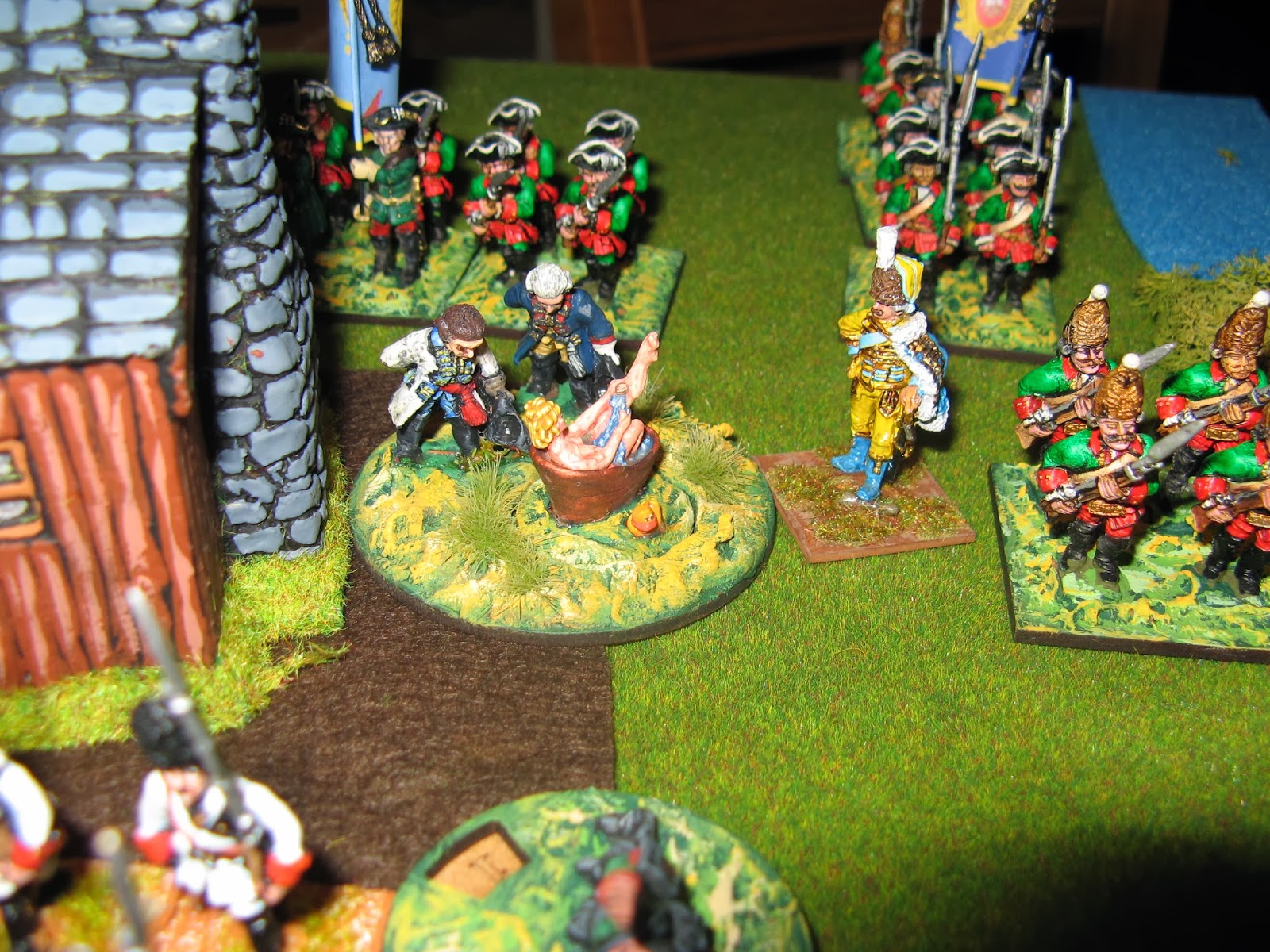
(Right) As an added incentive to seize Chestwig, the Furst spies through his telescope the winsome form of General von Rumpfler's, er, neice, a delightful seamstress by the name of Nora Hindquarters. Spending the morning of the battle in the bathtub, the poor lamb is subjected by the Nabstrian staff officers to tiresome and predictable 'Where's the soap?' jokes; they receive in return a stern invitation to 'sud off'. Also present is Von Rumpler's aide-de-campe, Hugo von Stumpe, sporting a new uniform in a lovely lemon, which, coincidentally, is a handy point of comparison for his intellect. The aide-de-campe's garish attire has led his sniggering comrades to note that, clearly, some aides are camper than others.
Morale in the Rotenburg army is less high than one might think, given its stout performance in the late Cod War. The source of difficulties are emerging concerns regarding the mental condition of Furst Augustus. Though exhibiting no obvious physical signs of cognitive distemper, the Furst's slow waltz to loondom seems manifest in his initial plan of battle; a plan which accords a decisive role to his artillery. The Furst intends for his cannons to shoot the Nabstrians out of Chestwig, following on with a massive infantry assault. There are mutterings in the camp that the Furst's crazed notion that his artillery might contribute meaningfully to the outcome of the battle can be attributed quite clearly to a bad case of 'little imps in the head'. Eschewing the recommendation from a physician that he should be hit over the head with a shovel to let all of the little goblins out, the Furst finally agrees to take a couple of leeches every four hours. Otherwise undeterred, Furst Augustus gives the signal for his artillery to open fire on Chestwig: the battle has commenced!
With a sound more akin to a rattling cough than a roar of cannon fire, the bombardment commences. It becomes clear, however, that the notion that the Nabstrians can be shot out of Chestwig is about the weakest plan since King Priam's comment at the seige of Troy: 'A giant wooden horse, you say? Seems reasonable, let's wheel it in.' As the Rotenburg gunners leaf in bemused fashion through worryingly pristine instruction manuals, their fire expends itself harmlessly against the walls of the village. Matters get even worse. (Below) Recognizing that his initial plan is less likely to work than a member of the French nobility, Furst Augustus changes to Plan B: the infantry assault. Like Landgrave Choldwig's nocturnal fumblings, however, this enterprise finishes before it even starts. Von Rumpfler orders his artillery to open fire on the advancing enemy infantry. Inconceivably, the Nabstrian artillery is deadly accurate: in a few short volleys, one of the Rotenburg infantry regiments disintegrates under artillery-fire and the advance grinds to an uncertain halt.

Discarding Plan B as a sad bag of spanners, Furst Augustus switches now to Plan C: a cavalry attack against the Nabstrian left. With four cavalry regiments against three, the Rotenburg cavalry thunder forwards, waving their stirrups about in a menacing fashion (below).

Full of confidence, the Rotenburg chivalry surges forwards. But, if Plan B sucked, it would appear that Plan C both sucks and blows. As is usual at this point, one of the Rotenburg cavalry regiments becomes confused and, peeling off from the assault, trots towards the woods, keen, no doubt, to take in the local flora and fauna. With the numbers evened out for the crucial cavalry clash, the odds, too, are levelled when it transpires that the Nabstrian horseman also have some impressive stirrups that they can throw into the fray. Paul, Duke of Clarkeshire, commands the Nabstrian horse. Eschewing his silly little hat and garish hussar uniform, he has dressed for the occasion in finest buff moleskin. All agree that he looks splendid except, perhaps, the moles. His presence instils new confidence in his nearby cavalry.
(Below) After repeated charges, accompanied in each instance by desperate sword-play, the fight is close but the Rotenburg horse is finally driven back, one regiment fleeing the field. With his cavalry weakened and vulnerable, Furst Augustus fears that it will require only a counter-charge by the Nabstrians to drive his cavalry from the field completely. What now? Only Plan D will suffice: a return to the infantry assault in the centre. The Rotenburg foot look at one another nervously. Twenty minutes into the battle and already on Plan D, the troops are worried: there are only another 22 letters in the alphabet.

(Below) Forward! Forward! With a flourish of drums, the Rotenburg infantry trudge towards the Nabstrian line. Having lost already one of his infantry regiments, and with his cavalry terribly weakened, the Furst's plan can surely have no reasonable chance of success. Matters aren't helped by the fact that the mercenaries on Augustus' left are isolated and cannot joint the advance. Von Rumpfler licks his lips and orders his reserve columns forward into a position to the right of Chestwig, where they form line. The script is written; the play already practiced: the Rotenburg advance will stall, stymied by the stream and the lethal volleys of the Nabstrian foot; then the Nabstrian right wing, led by the Burgrave's guards will fall upon the exposed flank of the Rotenburg position.

Luckily for Furst Augustus, his troops are as literate as a dyslexic hedgehog with an eye-patch; and appreciate a good play about as much as they like having a bath. Unable to read the script, and extending an impudent digit to the play, the Rotenburg soldiery hold their nerve. Approaching within musket range, rolling volleys commence from each side. Now deployed in the second line, the Landgravial Lifeguard (white flag) continues to inspire the surrounding regiments. Their sedate cadenced step is maintained even under heavy fire, the result partly of intense training and partly the chafing caused by their iron-bound cods.
It is clear that the stout Rotenburg infantry intend to write their own script for this battle; or, at least, to colour in the margins somewhat in crayon. The Nabstrians buckle first! Their initial fire inflicts minimal casualties, and the Rotenburg return volleys decimate one of the Nabstrian regiments, which quits the field! (Below) Von Rumpfler is forced to summon a fresh regiment to plug the line (centre, blue and yellow flag). Still, this is surely only a temporary success. (Below, left) The wiley Von Rumpler himself comes forwards and orders the Burgravial guard to wheel to its left, ready to unleash deadly enfilading fire against the Rotenburg lines.

Soon, the Rotenburgers find that they are having their flanks lapped: a not unusual circumstance for Landgrave Choldwig, but rather less appreciated by his weary soldiery. 'Fire!' cries Von Rumpler, and an elite volley crashes into the flank of the nearest Rotenburg regiment, (Below) The Rotenburg regiment collapses, its troops cut to pieces! Furst Augustus has now lost one cavalry and two infantry regiments whilst the Nabstrians have lost only one.

And yet, and yet ....(Above, at the top) Some subtle signs of a change of fortune are present. Having marched to within range of the Nabstrian artillery, the Rotenburg musketeers scythe down the Nabstrian gunners with deadly salvoes. (Above, to the right, in blue) And finally the mercenaries have been marched into the fray. The situation is fraught for the Rotenburg infantry assault, but all is not yet lost. The troops draw strength from the steadiness of the Landgravial Lifeguard (white flag, top). The Lifeguard, it seems, cannot feel fear; indeed, thanks to their outsized codpieces, they now cannot feel their legs either.

(Above) O Fortuna! How suddenly the situation changes! Superlative musketry from the Furst's troops tumble down the Nabstrian troops like ninepins. To Von Rumpfler's chagrin, the Burgravial guard in front of Chestwig breaks and runs, closely followed by one of the regiments between Chestwig and the stream. (Below, at the top) Now the Nabstrians are on the ropes. In the crucial position immediately in front of Chestwig they have two units, whilst Rotenburg has four. Both of the formmer are widely separated and have suffered losses.
 |
A Rotenburg victory?
|
(Above, at the bottom) Moreover, whilst Augustus continues to press the matter around Chestwig, Von Rumpfler cannot exploit his advantage over the Rotenburg cavalry. The Rotenburg right and Nabstrian left must instead to engage one another in a psychological war of words. Baiting one another, the cavalry throw out sarcasm, complex allegory, classically-themed puns, and poetic non-seqiteurs; the Nabstrian irregulars add some knob-jokes.
Heavy firing continues along the line of battle. Behind the Nabstrian ranks, the young Von Stumpe hears a hollow 'Ftoom' sound to his left. Turning, he is confronted by a small, corpulent fellow dressed in a very ill-fitting black cloak. In one hand the strange apparition clutches an enormous pie; in the other a large scythe wobbles alarmingly in his inexpert hands. 'How's it going' asks Famine, now munching on a fruit flan.' Death, blood, pain, horror' wails Von Stumpe, despairingly.' That's the spirit' says Famine encouragingly, the words now formed around a door-step of a sandwich. A Rotenburg volley thunders out somewhere to the front: nearby, a soldier has his brains messily blown out. With a frightened moan, Von Stumpe vomits hugely. As he recovers, he catches Famine looking speculatively at the pile of chuck; 'You going to finish that?' says Famine cheerily.
(Below) 'Fursty' for glory, Augustus goes for the coup-de-grace: the Landgravial Guard and Infantry Regiment No.2 are hurled against Nabstrian IR No.2 (Below, blue and yellow flag).

Fortune, they say, favours the brave, and the glittering Rotenburg bayonets soon seem to have the better of their Nabstrian opponents. The Nabstrian regiment breaks under the Rotenburg pressure. Now, the battle seems to have turned decisively against Von Rumpfler's troops: four Nabstrian infantry regiments have been lost, all in the critical position around Chestwig. But the two victorious Rotenburg regiments are now weakened by their exertions, and they take fire from the village of Chestwig, and from the remaining Nabstrian reserve regiment.

(Above) With gurgling screams, the Rotenburg IR No.2 expires in a bloody heap. There is now a gaping hole in the centre. To compound matters the Rotenburg mercenaries are swept away by fire from Nabstrian IR No.7 (yellow flag, bottom right). Augustus has lost four infantry regiments and one of cavalry: peering over the heaps of corpses, the Furst begins to worry that his army's morale might be affected a tad. Nevertheless, the Nabstrian army has also been shredded: half their infantry is either dead, or frantically wetting its pantaloons in the rear. (Below) With his lines ruptured, Von Rumpler is reduced to giving orders to his units individually. In the centre, he forms his two infantry units into a single line. On his right, he orders up his remaining reserve unit, IR No.6 (below, extreme left, light blue flag). The destruction of the mercenaries allows him to wheel IR No.7 (foreground) to bear down on the left flank of the remainder of the Rotenburg line.

Slowly, the tide turns. (Below, top) In the centre, volleys from the two Nabstrian regiments cause another Rotenburg unit to flee. Moreover, as musketry continues to be exchanged, Von Rumpfler slowly begins to flank the remaining Nabstrian forces.

(Right, middle) And so, we reach the climactic act of the battle of Chestwig. Nabstrian IR No. 6 (light blue flag) pours lethal volleys into the Landgravial Lifeguard from the front. IR No. 7 does the same from the flank. The Landgravial Guard are men of steel. Facing two units, one of which enfilades them, they fight like men. Proper men. These are no floppy Bachscuttel musketeers that run at the sudden appearance of tough-looking rabbits. Amidst the desperate screams of the wounded and the dull ping of musket balls off armoured groins, they let fly a defiant salvo at the regiment to their front. But IR No.6 survives, and the Nabstrian flanking fire finally destroys the guards entirely. With that, the Rotenburg army can take more and its morale breaks.
The field is choked with dead. Eleven infantry regiments have been lost: seven from Rotenburg, four from Nabstria. Further, Nabstria has lost all of its artillery, whilst Rotenburg has lost one of its cavalry regiments. The remains of the Rotenburg forces retire, the cavalry covering their retreat with a couple of witty literary allusions. The Nabstrian forces fall back to their encampment exhausted. The next morning, Furst Augustus is able to return to the battlefield. Scaring off some Nabstrian irregulars that are looting the local livestock and molesting the wounded, he rides sadly over to the remains of his Guards. They lie in thick lines of corpses, codpieces gleaming in the bright morning sunlight. Little does the Furst know that this place will become something of a place of pilgrimage: that strangers will come from far and wide to see the place that marks the final stand of the Landgravial Garde; that many a visitor will be taken in hand by one of the local village-folk and told: 'Come with me, Sir - I'll show you the field where the iron crotches grow.'
Despite his victory, Von Rumpfler cannot be pleased. The costs have been high: half his infantry is lost, the morale of his army has come within a hair's breadth of breaking, and Nora has been so long in the bath that she is as wrinkled now as his actual wife. As the General looks disconsolately at his casualty lists, a messenger arrives at his tent: urgent dispatches, from Sir Malilieu Fitzbuttress! Another battle has been fought! The armies of Bachscuttel and Grand Fenwick have clashed on the field of Zorninhaf. Slowly, Von Rumpfler opens the letter ....
Sunday, 2 February 2014
War!
May 1758. The sun begins to set over the rolling Gelderland meadows to the east of the village of Chestwig. 'Chestwig': a name that will live long in the annals of Mittelheim history as one of the bloodiest, most brutal, and closely fought encounters of the Wars of the Gelderland Succession.
Two mounted figures pick their way carefully through the corpses piled thickly across the grass as far as the eye can see. Clad in Nabstrian and Rotenburg uniforms, the dead make a sobering sight. Some, cut down by musketry, lie slumped in dark pools of blood, still arrayed in their ranks; others, hit by cannon balls, lie spread-eagled, ghastly looks of surprise on their faces. Many seem to have died the traditional death of a Mittelheim soldier: slaughtered as they attempt an olympic sprint rearwards. The two figures halt. One, an-aide-de-campe, surveys the scene reflectively:
'It is well that war is so terrible, my Lord; or we should grow too fond of it', he muses. His companion, none other than Furst Augustus Saxe-Peste, Generalissimo of the Landgravate of Hesse-Rotenburg, nods sagely in agreement.
'Indeed', says, Furst Augustus, 'War really is terrible - I mean, these pantaloons have chafed me raw. Pass me some ointment, won't you?'
But, gentle reader, how is that we have reached such a state of affairs? How is it that the armies of the Burgaviate of Nabstria and that of the Langravate of Hesse-Rotenberg have come to be locked in mortal, and surprisingly competent, combat? To answer this question we must go back in time some three weeks, to the palace of King Wilhelm of Gelderland, sometime in the morning.....
.... Peace talks are underway. It is symptomatic of the seriousness with which the search for an agreement is being pursued that great pains have been taken to remove the obstacles to effective negotiation: all the wisest heads in Mittelheim have been brought together and Baron Albrecht Steinhagen, plenipotentiary from Saukopf-Bachscuttel, has been locked in a cupboard. Lands are exchanged; negotiations made, but still a general peace cannot be reached, and time bleeds away. Suddenly, King Wilhelm intervenes: kingly, suave, magisterial, he smooths over the differences between the protagonists and, demonstrating his usual empathy and silky skills of persuasion, he brokers a peace agreement between the states of Mittelheim and the pixies. Pixies?
This is, of course, a dream sequence. It is a notably surprising one for King Wilhelm, since usually his dreams tend less to feature superhuman feats of sophisticated international diplomacy and tend more to feature serving wenches, uniforms, and bratwursts, in varying combinations. Congratulations are due to Wilhelm's subconscious for its valiant efforts to remind him of his duty as a sovereign to shield his subjects from war and its terrible consequences. Still, Wilhelm's subconscious, like his self-control, sense of fair play, and taste in wigs, has fought a losing battle: Wilhelm wakes with the nagging feeling that there is something important that he should do, a feeling that evaporates immediately at the sight of his morning sausage (an event that on Wednesdays and Fridays is indeed quite as unpleasant as it sounds). Beyond Wilhelm's bedroom, Mittelheim's political crisis spirals out of control.
Yet again, new political combinations arise in Mittleheim. The relationship between Emperor George of Grand Fenwick and his protege, King Wilhelm, collapses faster than King Wilhelm's self-control in a nunnery. Wilhelm has shown himself about as easy to handle as a larded monkey*, and slightly less able to appreciate opera. Wilhelm's failure to secure the passage of pro-Fenwickian legislation in the Gelderland Diet (indeed his lack of concern for virtually any passage that he can't fit a sausage into) has led the Emperor to conclude that Wilhelm must go. But King Wilhelm will never be induced to abdicate: he loves his job - the hours suit him, the job is very well paid, and he is able to work from home. Only the bayonets of the Emperor's troops will be able to prise Wilhelm's mammoth posterior out of the throne of Royal Gelderland. But the Emperor needs allies: who can he enlist he support his cause?
Not Saukopf-Bachscuttel. Relations between the two previous allies have reached new lows. Incensed at the ethnic cleansing in the Imperial capital, Pogelswood, directed against the Palatinate's merchants, Prince Rupprecht has instigated against Fenwick a savage campaign of economic warfare. A penny is slashed from the price of Bachscuttel cabbages and the Imperial economy is brought almost to its knees by a cunning 'but one, get one free' on turnips.
 |
Prince Rupprecht: 'Guards! Fetch me my Christmas monkey!'
|
Not in Hesse-Rotenburg either. For this, Emperor George has his son, Joachim, to blame. Having acquiesced finally to his father's orders to cease the wearing of a 'Vlad the Impaler' codpiece, the roistering rogue has instead spent the months sporting some of the most eye-watering items from the 'Judicial Punishment' range of Kurlandian cods. Egging on the impressionable sons of the Rotenburg branch of the Stein family, Joachim encourages them to experiment with the 'Off with Your Head' model. Sadly, the codpiece's combination of crushed velvet, metal springs, and sharp blades mixes poorly with an excess of plum brandy and a vigorous horse ride. The results are messy and leave the Steins themselves in need of urgent medical attention and the Stein family as a whole in urgent need of another means of carrying on their line. Pushed by his father to produce an apology to Rotenburg that will smooth things over diplomatically, the best that Joachim can come up with is that the accident is 'terrible: I'll be washing the Steins out these britches for weeks.'
And not, surely, in Nabstria, either. In the Burgraviate, the Enten Gessellschaft continue to agitate for the return from Fenwick of Nottelbad and its scintillating rococco duck-pond. Paulus von Fusselstein, poet Lauriate of Nabstria, has received wild adulation in the Burgraviate for his latest work, a sensitive, philosophical piece entitled 'Fenwick stinks of piss'.
But Fate is a fickle thing, and the diplomatic constellations of Mittelheim realign themselves in but a single night. The cause: a peccadillo too far on the part of Don Penguino, King Wilhelm's court favourite. The target of the amorous adventurer's attentions is poorly chosen: the wife of the Nabstrian ambassador to Gelderland, and coincidentally also Burgrave Falco's cousin, the Duchess Birgitte. Lavishing his charms upon the winsome waif, Don Penguino is caught in the act, tragically, by Birgitte's husband. Don Penguino has, quite literally, put his foot in it, being caught by the ambassador sucking his wife's toes. The ambassador chokes with rage; the Spaniard chokes on toes; swords are drawn, and before one can say 'cassus belli', the Nabstrian ambassador lies slain.
In Falkensteinburg, the news of Penguino's actions cause uproar. Only the most sensitive handling of the situation by King Wilhelm can prevent Nabstrian troops from descending on Gelderland to seize the saucy Spaniard. But Wilhelm, a man who couldn't reliably find his own backside with both hands and a lantern, naturally fumbles the moment. As messengers speed from Grand Fenwick to Nabstria offering to support Burgrave Falco in an attempt to seize the Gelderland capital, King Wilhelm is nowhere to be found. At this key point, King Wilhelm is in bed: back problems have left him unable to read the lettering that allows him to distinguish his wobbling tum from his enormous backside, and the King is now dealing with the painful consequences of an evening spent stuffing himself with eclairs.
In Pogelswood, Emperor George declares war! The Emperor announces, first, that King Wilhelm 'was never anything more than Fenwick's monkey', a comment that brings raucous cheers from his courtiers; and, second, that it is now time that he 'gave his monkey a good spanking', a comment that elicits nervous coughs from the assembled advisors, and some shuffling towards the door. With Nabstria and Fenwick declaring an alliance, Bachscuttel and Rotenburg form their own agreement in order to resist them. With Mittelheim's armies assembling, the first actions commence of what becomes known, thanks to Penguino's activities, as 'The War of the Spanish Suck Session.'
Before long, rumours are rife that the armies of Rotenburg and Nabstria have clashed in perhaps the most titanic struggle yet in the Wars of the Gelderland Succession ....
*In Mittelheim, rubbing monkeys with lard is generally frowned upon, except in Saukopf-Bachscuttel where is forms an important, if rather messy, part of the traditional Palatinate Christmas. Never turn up for Christmas dinner in Saukopf-Bachscuttel without the means to fight off a very angry primate.
Tuesday, 19 November 2013
Crisis!
October 1757. Two months have past since the Peace of Minde. For the desperate people of Gelderland, this period has been, like the love-life of Landgrave Choldwig of Rotenburg, a disappointing accumulation of unfulfilled expectations interspersed by periods of actual bodily pain. After the depredations of the Cod War, two priorities have loomed large for Gelderland: restoring the finances of a Kingdom drained by heavy subsidies to its recent allies; and alleviating the crushing poverty of the ordinary folk, ruined by the pillaging of Mittelheim's armies. The new King of Gelderland, Wilhelm I, has proved to be a brutal, boorish pig of a man who couldn't reliably distinguish his globular belly from his gargantuan backside if the latter weren't handily labelled as such in large gothic lettering. Despite self evidently being over-qualified to rule in Gelderland, Wilhelm has provided little succour to his people. Indeed, for Wilhelm, the Enlightenment was something that happened to the rest of Europe whilst he was passed out in a puddle of wine and his own dribble. Ignorant in matters of finance, the new King believes that 'quantitative easing' comprises undoing his breeches after a heavy dinner; that 'fiscal rectitude' is simply a strange disease of the bottom; and that 'poor relief' simply describes a bad trip to a Gelderland knocking shop.
Unwisely, Wilhelm has been making enemies at every turn. Some of these are external. Whilst Wilhelm owes his elevation to the machinations of Emperor George of Grand Fenwick, Wilhelm has done little to enact in Gelderland George's raft of Fenwick-inspired legislation. Thus, Wilhelm has ignored the Emperor's call to ban suggestive foodstuffs: cucumbers, obviously; large carrots; medium sized carrots if they are in close proximity to a pair of radishes; also artichokes, which sound rude; and turnips, which don't seem rude until you sit on one. But the new King has also quickly created internal enemies as well. The main reason for this are the activities of Wilhem's drinking partner and confidante, the Spanish rake Adolpho Don Pajero de Penguino. With his lewd and foreign ways, Don Penguino has outraged rapidly the sensibilities of the Gelderland court. Dismissing stately Gelderland sock operas as a tedious and backward form of entertainment, Don Penguino instead favours music comprising bass clarinets and kettledrums. This 'drum and bass' music has been accompanied by raucous Spanish-style evening gatherings, populated by glassy-eyed inebriates and known, apparently, as 'El Cid' house parties.
 |
| An El Cid House Party: 'You're twisting my melon, Sir!' |
Don Penguino's musical tastes would be more acceptable if his influence over the King were more productive in the realms of statecraft. This, however, is not the case and the Spaniard's interventions have more often led Wilhelm to focus his energies on activities that are more gland strategy than grand strategy. Rumour is, shall we say, rampant, that the Spaniard's welcome is not the only thing that he is wearing out. Don Penguino's relentless attempts to seduce the flower of Gelderland's noble matrons are becoming the stuff of Mittleheim legend. The Don's priapic probing has reached epidemic proportions. Aflame with upper-crust lust, the libidinous lord is rumoured to have importuned the wife of almost every notable at the Gelderland court. Penguino's inability to keep his chorizo in his breeches is not surprising, given that he bothers so rarely to wear any.
Elsewhere in Gelderland, events have also taken a turn for the worse. Once allies, the relationship between Grand Fenwick and Bachscuttel has plummeted lower than Prince Rupprechts chin. Following bitter mutual recriminations concerning their defeat in the Cod War, the two states are now locked into an escalating dispute the subject of which is the small number of Bachscuttel merchants that live in Pogelswood, the capital of Fenwick. Emperor George has accused the merchants (a) of selling melons in a manner likely to cause a breach of the peace, and (b) of bathing only on Saint's days which, given that both of the merchants are aethists, means that they tend to honk louder than a Nottelbad mallard. This dispute has led to appalling incidences of ethnic cleansing in which the two merchants have been forcibly washed by irate locals.
Farther afield trouble is also brewing. On the southern fringes of Gelderland lie the lands of the Sanjak of Zenta. If the Ottoman Empire could be construed as Mittelheim's Great Satan, then Zenta is the most pointy-hatted of its little wizards. The southern reaches of Gelderland have suffered historically from unrelenting Zentan raids that seek constantly to carry off the most robust women and attractive horses. Now, spies have reported military activity at the Zentan town of Dojay. It would seem that under the supervison of foreign mercenaries, some of whom seem to hail from the Landgravate of Rotenburg, the Zentans have been expanding their military capabilities, especially in relation to their artillery. Rumours have emerged of the casting of a Zentan 'Super-Gonne'; and of the existence of so-called 'Wagons Most Destructive' (or 'WMD'). Collecting their evidence together into a report, the so-called 'Dojay Dossier', the information has been passed on to King Wilhelm and his advisors, where it now props up the larger of Wilhelm's commodes.
 |
| Test-firing of a Zentan Mortar: Captain-General Taras Bulbous wisely increases his distance |
Much of this intelligence has been gleaned through the efforts of the English soldier-adventurer Sir Lawrence Bartlett Shrubbsucke, an English eccentric who has spent many years living in the Dojay region amongst the local Giezza tribesmen. Shrubbsucke's sojourn in Zenta has not been an easy one. Zenta can be described as stable only in the sense that it has a lot of horses in it - it is a dangerous place marked by feud and counter-feud amongst the various clans and tribes.
In fact, Europe knows more about the Dojay Giezzas than of almost any of the Zentan tribes. Motivated by a desire to reconnect with nature by living amongst the simple, noble primitives of far-off lands, Shrubbsucke spent many years living with the Giezzas, learning their language and customs. In truth, events did not transpire in quite the way that Shrubbsucke hoped for. Published in 1749, his memoirs began as a meditation on moral regeneration through a reconnection with nature, a state reflected in his book's opening chapter entitled 'Epicurian Simplicity and the Nomad Way.'
 |
| A 'Wagon Most Destructive.' A devil to reverse, but excellent hay efficiency on an urban cycle. |
Later, Shrubbesucke's journal took a rather different turn as evidenced by the titles of Chapter Two ('Blimey, It's So Cold and Windy'); Chapter Three ('Lordy, They never wash. Ever.')' and Chapter Four ('The Night They Stole My Pantaloons. Again.') Published in London under the title of The Seven Pillocks of Wisdom, Shrubbesucke's book contained extensive appendices cataloguing the types of flies that had bitten him, and an addendum entitled 'My Strange Stools' which, sadly as it transpired for his shocked readership, wasn't at all about furniture.
 |
| The Zentan Super-Gonne: 'Never mind the quality, feel the width.' |
Meanwhile, in a small forest clearing, Famine takes a practice swing or two with a scythe. Death, it would seem, has gone missing after a nasty break-up with Lady Luck. The former's attempts to drink himself insensate proved fruitless, rendering him both penniless and stood in a very large pool of wine. Temporarily replacing his compatriot, Famine packs a map of Mittleheim, the scythe, and a very large packed lunch: there's dirty work afoot.
Subscribe to:
Posts (Atom)
