Wednesday, 9 December 2015

On War!

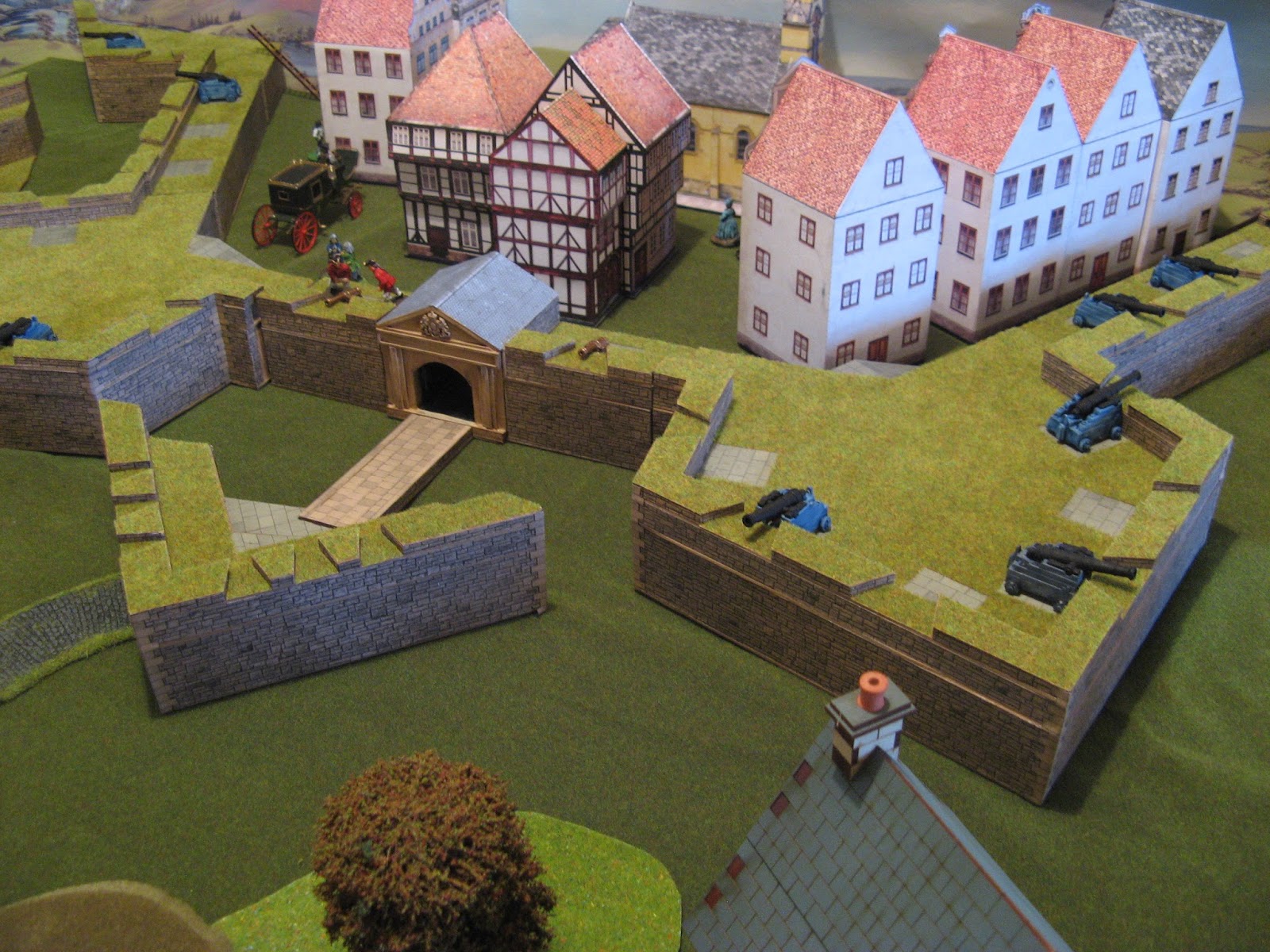
Captain Carl von Lackwitz, commander of Gross Schnitzelring's garrison regiment and aspiring military philosopher strides slowly around the capital's eastern bastion, reading carefully from a small book. Next to him, one of his soldiers on watch, a Private Stensch, peers through a telescope. Lackwitz pauses in his reverie.


'Anything out there, private?'
'No sir', says Stensch. 'The capital is absolutely safe, sir. I'll wager, sir, that the war will never, ever reach these walls'.
'Just so, private, just so'. Lackwitz reads a little more from his book, nodding and then muttering under his breath 'Genius. Words of genius'.
The private risks some further conversation.
'Good book, sir?'
Lackwitz nods emphatically. 'It is quite the most significant work of military philosophy that has ever been written. Every word is illuminating. It is an intellectual lantern. A cerebral lighthouse, its words, like golden rays, banishing the inky blackness of ignorance, allowing the ship of ... thingy ... to come safely ... into ..you know'.
'Would I know the author, sir', says the private, impressed.
'Oh yes', says the captain. 'It's me'.
'Crikey, sir. You're a real life author! Read me something clever!'
'I couldn't really, private ... it would be embarrassing: one doesn't want to blow one's own trumpet'.
'Fair enough'.
'But seeing as you've asked - how about this'. Lackwitz draws himself up, strikes a pose, and then begins to read.

'War is a continuation of pottery by other means'.
Stensch chews his lip for a moment, ruminating. 'Well, um, it's just ... well, is it? Like pottery?'
Lackwitz pauses, brow furrowed, and then nods. 'Dammit, you're, right'.
Stensch  nods. 'Well, it's just that I thought the word 'policy' might be a better ...'
Lackwitz continues pacing. 'Yes, I'm reaching. Pottery to too broad, too all-encompassing. It lacks rigour. But if I narrow the comparison down, should I then associate war with, say, purely cooking-related pottery? Or perhaps even just bowls? Or is the comparison that I'm looking for milk jugs. "War is a continuation of jugs by other means"'.
'I've certainly seen a fair few fights over the right kind of jugs ...' nods Stench. 'But no, sir. I think I mean that war seems to me to be less a piece of pottery, and more some kind of structured violence pursued by society for purposed defined by policy. Or whatever'.
'Interesting,' says Lackwitz, nodding. 'But no. It's definitely more like pottery. Or at least, some kind of general clay-related phenomena. We can say therefore in consequence that, "war is more than a true milk jug that slightly adapts its characteristics"'.
Stensch twiddles nervously with his telescope (something else that couldn't safely be done in Grand Fenwick). 'Well, sir - wouldn't a better point of comparison than a milk jug be something like a...a ... chameleon -  that changes a bit if you put it into a different context'.
'Do you have a chameleon?' says the captain.
'Well no, sir: not on me'.
'Have you ever seen a chameleon?'
'Well, no; but then perhaps that's because they change to blend in with the background. I've read about them.'
'Are they dangerous?' says Lackwitz looking around nervously.
'I don't know sir. But I don't think there are any around here'.
'Yes, but you said that you can't see them.' Lackwitz moves so that his back is against the wall. 'I mean, there could be hundreds of them. Right here. Right now. And we'd never know'.

Stensch intervenes quickly, trying to re-direct the conversation back onto a safer subject. 'So, has your book any advice on how we might win the current war, sir?'
The captain forgets invisible lizards and returns animatedly to his masterpiece. 'Yes, yes! Listen to this from page twenty two: "To achieve victory we must mass our forces at the hub of all power and movement. The enemy's centre of gravity or, as it might be more properly known, his testicles"'.
Stensch nods. 'So all war should focus on our enemy's gonads?'
'Without a doubt. Just give them a good kicking. Because, as I go on to note on the next page: "War is thus an act of force to compel our enemy to sod right off"'.
'Or perhaps', suggests the private, "to compel our enemy to do our will?"'
'Well, if our will is that they should sod right off, then yes'.
'"Will" sounds like it might fit better, sir'.
Lackwitz laughs. 'Ah, amusing: I'm sure it would to you, soldier. But then, you don't have the benefit as I do of a university education.'
'No sir, I don't', says Stensch. 'Ahh, the dreaming spires of Naffdorff.  How I should have liked to go to university, captain. The long hours of study. The exhaustive reading. Intensive engagement in lectures and discussion.'
Lackwitz frowns. 'No. no. I said 'university'. Thirty thousand thalers to go wandering around Naffdorf for three years, drinking wine and wearing a sedan-chair cone on my head. Marvelous. Only thus was I able to develop a honed, razor-like intellect capable of forensic, focused ... oooh shiny' he says and bends down to pick up a silver button.
Stensch notices something on the horizon and raises his telescope once again.


Lackwitz continues to pace the bastion. 'The key thing in war, though, is getting the right background music. I have a whole chapter on that: "No one starts a war - or rather, no one in his senses ought to do so - without first being clear in his mind where he will get an orchestra from and how he intends to conduct it".
Stensch look back distractedly. 'Music? But isn't there more to military success than that?'
The captain nods. 'Intellectuals like myself can look into war and see its essence. We know that war is composed of a fascinating trinity'.
At this, Stensch looks genuinely interested. 'Oooh yes sir: I can see it: primordial violence, hatred, and enmity, which might be regarded as a blind natural force; the play of chance and probability, within which the creative spirit is free to roam; and its element of subordination, as an instrument of policy, which makes it subject to pure reason'.
Lackwitz looks at the private as if the latter had just started flapping imaginary wings and making noises like a little pig. 'Where do you get this nonsense from? No, private, war is composed, in my experience of a cheese and ham sandwich'.
'Isn't that just one thing?' asks Stensch.
Lackwitz spells it out as if to a child. 'Cheese. Ham. Sandwich. Three things.'
'Oh. Is it ...', and here the private's face becomes furrowed, like a monkey doing quadratic equations, 'a ... a ... metaphor?'
'I don't know', says Lackwitz suspiciously, 'is it?'
'Well', says the private. 'I suppose "cheese" could encompass the enduring nature of war; "ham" is its changing character; and the slices of bread the concept of military genius that manages the interaction between the two.'
'It's possible, but unlikely', says the captain furiously crossing out some text and scribbling something new.

'Blimey, look what I can see!', says the private suddenly.
'Exactly', says Lackwitz triumphantly, 'I have opened your mind to the wonders of military philosophy!'
'I mean, philosophically, I can see lots of musketeers and Croats over there beyond the stream'.
Lackwitz looks around nervously. 'Are there any chameleons?'
'I think captain, that we've become overly fixated on camouflaged reptiles ...Those troops are ours: and they seem very excited about something. There's dirty work afoot. Call out the guard!'
Suddenly, to the west, comes shouting, some shots, and then the blowing of horns accompanied by the sound of the ancient Gelderland military cry of alarm: 'The enemy - they're everywhere! Flee! Flee! Out of the way old woman! Run! Run!'
Stensch turns. 'War, captain! Now you can put your theory into prac ...' he begins to say. But he is alone on the bastion. A small book lies on the ground, thrown aside carelessly, its pages flapping gently in the breeze...

Monday, 30 November 2015

Toplitz-Hande's Relief!

'Stop that, men!' shouts Captain Adolphus von Toplitz-Hande. The captain lays about his troops with the flat of his sword, driving them off from a harassed looking local. Breathing heavily, Toplitz-Hande stands in the middle of the main road to Gross Schnitzelring. Before him, a colourfully accoutered company of Croat light troops begins to form itself into a semblance of a line. Looking at them, the captain can't help but feel that somewhere along the way, his life took a wrong turn, apparently down a lane marked 'Disappointing military pantomime'.


Toplitz-Hande was no fool. He recognised that a career in the Gelderland army was unlikely to produce the same chances of mortal combat as, say, the army of Prussia. But then again, what one lost in glory, one gained in keeping body parts in the right place and in opportunities to survive to draw one's pension. The captain, though, had always believed that a man of his own calibre would certainly find rapid promotion, at least to Colonel, and probably to General. However, as it transpired in the army of Gelderland, opportunities for 'rapid advancement' seemed to comprise almost exclusively of running quickly to places where the enemy weren't. In the end, Toplitz-Hande volunteered to command a company of common Croat mercenaries. This was not because he actually admired or liked his grubby charges: as a Hapsburg-chinned hoorah. the captain had about as much sensitivity to the rights of the common man as Ivan the Terrible's slightly grumpier brother. No, it seemed merely that participation in Kleine Krieg offered some opportunities at least to 'smell the gunpowder'.

As he pulls the rumpled civilian out of grabbing distance from his kleptomaniac soldiery, captain Toplitz-Hande reflects that Croats were, in the end, a poor career choice. His war, thus far, has involved many smells, none of gunpowder, and most relating to the poor hygiene of his mercenary rank-and-file. His force is supposed to be guarding the roads, but instead they fleece the locals, and what they do with the sheep is best not mentioned. If the mercenaries have any positive qualities, reflects the captain, then they lost them a long time ago, along with their soap. To be fair, the Croats have been equally disappointed with Mittelheim. The squalid conditions in which locals live makes looting a depressing activity. Sometimes when they encounter local villages they can rustle up the enthusiasm to loot and pillage; but often they just do the ironing and leave.

Today, his troops have been in a better mood. Indeed, Toplitz-Hande has only just managed to get them out of a nearby house. They have spent just short of an hour smashing the furniture, burning the roof and relieving themselves on the floor. As the troops leave, the locals peer into their dwelling. Over the whooping of his men the captain can just hear the civilians saying to one another 'Crikey, I think they've tidied up'.

Now, however, the Captain is eager. Something is happening - and if it's not grapeshot that he whiffs, then it's not at least the armpits of his troops. There are local rumours of the passage of a strange military cavalcade pushing an abnormal load. Though he normally tries to stay as far away from strange military passages as he can, these rumours seem to be portents of potential action. There are strange descriptions of the passing of teasingly bearded womenfolk in fancy dress, all of which sounds suspiciously like the movement of a unit of Nabstrian troops. The captain's suspicions have been raised further now that his scouts have encountered a trail of half eaten pie crusts and the very, very deep marks left by a weightily laden wheelbarrow. And now, there is a witness to these intriguing events!

A sergeant steps forward, civilian in tow.
'We have a witness, sir, who says he has information that may be useful to us'.
The sergeant pushes forward a small, wigged, reptilian looking fellow who looks like a toad with a toupe.
Toplitz-Hande's eyes narrow. He crosses his arms. 'Give us your information, strange fellow. There is talk of the passage here of an odd creature on a wheelbarrow. What do you have to say?'
The little fellow bows, but then says slyly 'I saw it all, sir. But it'll cost you'.
The captain scowls. 'I'm not paying you a fortune for information that will probably be as weak as handshake from a Spanish hairdresser'.
'No, no, sir', says the little fellow, bowing again, 'I'm sure what I want is affordable - a mere trifle, in fact'.
'Well, what is it?' says the captain impatiently.
'Um, I just said - I want a trifle'.
Silence.
Toplitz-Hande then shakes his head incredulously. 'I am a Captain of a mercenary frei-battalion. I'm not in the habit of perambulating around the countryside with a fruit and custard based dessert on the off-chance that some witless wigged amphibian can waste my time. If you don't tell us what I need to know, I shall have you shot'.
The fellow looks worried, and licks his lips.
'I said trifle, sir, but of course I'm willing to accept any dinner-related desserts'.
Toplitz-Hande gesticulates. 'Where would I get such things? Do these britches look like they contain any delicious looking tea-time treats?'
The little civilian seems about to say something like 'Perhaps a tiny sponge finger' but then seems to think better of it and says instead  'I don't think that's for me to say, my Lord. Perhaps just some fruit cake?'
'Is there anything around here that looks remotely like a fruit cake?' says the captain.
The  toad-like local puffs his cheeks and looks at the Croats, one of whom is vigorously kissing what looks like a small dressing table.
The civilian shrugs and says. 'It would be impolite to say. Perhaps a small sum of money, instead?'
Toplitz-Hande produces a pistol, which he points lazily at the local.
'On the other hand', says the civilian quickly, 'I always like to help local law enforcement. So, what I saw was a red-faced fellow, wheezing and panting. And he was pushing a wheelbarrow which seemed to have a giant walrus on it'.
'A walrus', says Toplitz-Hande, musing. 'Was there anything strange about it?'
'Well, sir, it was a giant walrus on a wheelbarrow'.
'I mean, were there any distinguishing features that you could identify?'
'Apart from the fact that there was a wheelbarrow with a walrus on it?'
'Look, matey', says the captain, 'don't get clever with me. Answer my questions or I'll find some fruit-cake and I'll have my men stuff it up you so hard you'll be sneezing raisins for a week'.
The civilian raises his hands apologetically. 'Well, sir, I suppose if you got some more walruses I could, you know, do a line up or something'.
'Bah. There must be some other detail that you remember'. The pistol settles at a point somewhere between the civilian's eyes.
'Well. Um. Well. Actually, I think the walrus was wearing a crown'.
'By the Virgin Mary's amply dimpled buttocks!' shouts Toplitz-Hande. 'It's King Wilhelm!'

The civilian is sent packing.
'There's something strange happening here, sergeant. I wonder what's afoot?'
'This' says his sergeant helpfully, pointing at one of his feet.
The captain rolls his eyes. 'No, sergeant, it's a rhetorical question'.
'Crikey, sir!', says the sergeant looking around him in alarm, 'then where's my foot gone?'
The captain sighs. 'Look sergeant, fall the men in. Light equipment only. The Nabstrians have the King, and they're wheeling him to Gross Schnitzelring. We must relieve the capital! I feel a Knighthood coming on!'
In a few moments, Toplitz-Hande's relief column heads off rapidly down the road. At the back, one Croat seems to be hauling a small dressing table. Some way behind, an irate local fellow can be heard shouting 'Oi, give me back my wife!'

Thursday, 12 November 2015

Follow that sedan chair!

In the mean time, gentle reader, we turn our attention to the other portion of Zeigler's command: Captain Stefan von Kobblers' force, comprising of a company of regulars and two squadrons of dismounted cavalry. Kobblers quickly sends the company of musketeers forwards to establish a perimeter. Now, though, he must consider how it is that he will get the large barrel of gunpowder to the all-important bridge. It looks very, very heavy.

Kobblers is considering the problem, in the company of sergeant Steiner, when his contemplation is broken by the approaching sounds of feet, accompanied by heavy wheezing.
'Hang on', says Kobblers, 'is that a sedan chair? I know! We could hire them to take the gunpowder to the bridge'.
'They'll never accept a barrel of gunpowder as a fare', says Steiner dubiously.
'Hmmm, true', says the captain. He pauses for a moment. 'But I have an idea ...'


The sedan chair suddenly encounters an aristocratic captain of infantry, who waves imperiously.
'Halt!' says the captain. Gratefully, the two men drop their burden, none too carefully, and then stagger around slightly randomly, muttering to themselves "Breathe! Breathe!"'
'I wish to hire you', says the captain.
The sedan chair runners nod cheerfully.
'That's fine, sir. Step this way, sir. Just a couple of questions, though, for your own safety.'
'Questions?' says Steiner narrowing his eyes.

One of the footmen runs to the side of the sedan chair and opens the door, quickly brushing down the cushions inside. He peers in, tuts, and then begins to dab a little as well.

'Are you sure that you packed your own luggage, sir?'
'What?' says Kobblers.
'And that you're not carrying any sharp objects?'
'I have my sword', says Kobblers, suspiciously.
'Oh yes, sir, obviously sir', says the footman. 'And pistols I see. But I mean, sir, that you're not carrying anything really dangerous - like scissors, or tweezers; or small quantities of liquid'.
'No, no', says the captain. 'Just my ... wife'.
'Your wife?'
'Yes, yes: here she is'.
'Ah'. The two runners look at Kobblers' wife, and then at one another.
'Is there a problem?' says Kobblers.
'Well, sir, it's just that your wife ... looks a little bit like a barrel, with a dress stretched around it and a wig plopped on top'.
'Are you saying my wife is fat?'
'Oh no, no, no, no, no, sir. I suppose what I'm trying to say, sir, isn't that your wife looks as wide as a barrel - that would be very rude; rather, I think I'm trying to say that she might actually be a barrel'.
'I'd think I'd notice if my wife were a wooden container', says Kobblers tartly.
'Well, sir, you wouldn't be the first man whose wife had turned out to be to be a piece of furniture'.
'Wouldn't I?'
'Oh no. There was Ludwig, who lived near me. He was with his other half for ten years. She was insatiable; endless capacity'.
'Really?'
'Yes, but it turned out she was a commode. And then there was Frau Kettle'.
'Frau Kettle?'
'Yes', nods the runner, 'who turned out actually to be a kettle'.
'Oh yes, says the other runner, 'and don't forget Frau Bucket - who, ironically, wasn't a bucket, but turned out to be a door. And lovely Frau Gertrude'.
'Oooh yes', says the other. 'Lovely Frau Gertrude - marvelous legs'.
'Mmmm', says his comrade. 'Four of them; and a lovely lacquer inlay, the little minx'.
'What sort of place is this?' asks Kobblers, appalled.
'Well, sir, around here the winters are long, the nights are dark, and the standards are low'.

Money is exchanged, and with the usual round of 'left hand down a bit, right hand up', the captain's "wife" is eased into the sedan chair.
Captain Kobblers addresses the two footmen directly. 'Look, I just want you to take my wife to that bridge over there. And don't, for God's sake, drop her into the water'.
'No worries sir', one footman says to Kobbers. 'Though if we did', he sniggers, 'I suspect that she might float better than you think'.
Sergeant Steiner eyes the captain and then steps forward awkwardly. 'One thing about the captain's wife - she, er, she loves to smoke'.
Kobblers nods equally awkwardly and then says, rather too loudly, 'I'm just going to light this cigarillo for her'. He leans forwards and lights a small taper protruding from under the wig.
The footmen nod. 'Certainly sir, but ... why is everyone shuffling backwards?'
'Well, we're, um, in a rush', says Kobblers stepping rearwards quickly, and appearing to cover his face with his arms. 'Now - off you go'.
'Hang on, sir. We have to go through the safety briefing for passengers - emergency exits, that sort of th...'
Kobblers cuts them off brusquely. 'Listen, if my wife doesn't get to that bridge in twenty minutes, she won't be pleased'.
'Bit of a temper, then, sir?'
'You've no idea', says the captain, breaking into a sprint. 'Explosive'.

'Phew', says Kobblers, watching the sedan chair disappear into the distance. 'Off they go. Splendid'. The captain catches a strange look on Steiner's face.
'Sergeant, are you alright?'
'Yes sir, its just ... my wife'.
'What about her?'
'Well, it just occurred to me that she has a lid'.


Saturday, 7 November 2015

In a postern, far, far away ...

In the postern tunnel through the walls of Gross Schnitzelring, Zeigler's intrepid force continues its journey. After a little way, they encounter another small door; this one, presumably, leading out of the wall and into the town itself.
Rapping briskly upon the door, a small hatch opens, revealing the thin face of a member of the Gelderland garrison regiment.
'Who are you? State your business! And don't tell me that you're Gelderland jager seeking an alternative way into the town, because I'm on the look out for interlopers that might have stolen some uniforms as a way of gaining secret access to the capital'.
'Hmmm', says Zeigler. 'You're a bit brighter than the other guard'. The Colonel makes a strange gesture in front of the guard's face.
'These are not the interlopers you're looking for'.
'What?' says the guard.
'Nothing', says Zeigler. 'I just thought that it was worth a try'.
Zeigler thinks quickly. 'Um, actually, I'm taking my sisters here to see the mechanism that works the town clock. I told them it's really big and has clockwork, um, stuff in it and they don't believe me'.
The guard squints into the gloom beyond the Colonel. 'Blimey, your sisters are ugly. They've got beards. I can see the marks the barge poles have made on them'.
'Ah, well, they're members of a Zentan travelling circus. So they don't shave much'.
'Hmm, sounds plausible', says the guard. 'But I'm going to need the password if you're to gain access'.
'Dammit', says Zeigler. 'Well, ah, how about my date of birth?'
'What's that?'
'30, 10, 1720'.
'Nope. Wrong. And if you get it wrong three times then I'm going to lock you out'.
'Blinking flip. Okay, well, how about ...... "1, 2, 3, 4"'.
The guard chuckles. 'Clever, clever; I can see that you've done this before, sir. But no, that's not it. Last guess'.
'Ah, well ... then ... what have I got in my pocket?'
'You what?' says the sentry.
'Nothing', says Zeigler. 'I just thought that that might be worth a try as well'.
The seconds pass. Despite the cold, sweat breaks out on Zeigler's brow.
'Got to hurry you , sir'. Zeigler sees the guard move to close the hatch.
Suddenly Zeigler snaps his fingers. 'I know ... how about "password"'.
'Bah and fiddlesticks', says the sentry, and unlocks the door.
As the doors open, the Colonel leaps through, a blow from the hilt of his sword sending the guard spinning.
'You ... lied' says the guard, falling to the floor.
Zeigler shrugs. 'It's what I do'.

Friday, 30 October 2015

Postern!

Colonel Zeigler and his intrepid force of troops approach the capital in the bright sun of the early morning. The Colonel is not pleased: his plan to attack at dawn has foundered on the inability of his scouts to agree on the relative importance on the Gross Schnitzelring clock tower of the big hand and the little hand. Still, with the sun up, it gives everyone, including any Gelderland guards, the opportunity to admire the uniforms, of a stylish jager fashion, acquired by Zeigler en route. Right about now, a unit of Gelderland jager some ten miles to the west will be waking up in an inn to find that their uniforms seem now to include rather more in the way of petticoats than is normal and also are substantially roomier around the chest. The Colonel has managed to acquire, not just a marvelous new uniform, but also a rakish eye-patch.
'It looks a bit nautical, sir,' says his Sergeant. 'A bit, you know, pirate-ish.'
'Really?' says the Colonel, warming to his new accoutrement. 'Well, then, I shall wear it - I like the buccaneer look.'
'I think it's a mistake, sir,' says the sergeant, 'begging your pardon.'
'A mistake, eh?' says Zeigler. 'Well, you know what they say, sergeant: to err is human, but to 'aaarh!' is pirate.'


In addition to the uniforms, Zeigler has managed to impose a semblance of discipline on his force, as the plethora of black eyes can testify. All told, the Colonel's force looks rather more military, and certainly much more imposing, than it did when it commenced its journey. The Colonel has also received welcome reinforcements: two companies of musketeers, and  two squadrons of dismounted cavalry.
Zeigler eyes the cavalry suspiciously: 'Where are their horses, sergeant?'
'They ate them, sir.'
'Zounds! Is our supply situation so perilous?'
'No sir, they, um, just ate them.'

Zeigler divides up his force. The Jager and one company of musketeers heads for the walls, in search of the secret postern gate revealed in Miss Nora Hindquarters' intelligence. The Colonel, though, is also keen to destroy the bridge leading to Gross Schnitzelring, in order to make it impossible to wheel Wilhelm back over the stream should any of the Gelderlanders have the strength to unwedge King Wilhelm and the mind to 'unfind' him. Zeigler details the cavalry, the other company of musketeers, and a large barrel of gunpowder for this task, all under the command of Captain Stefan von Kobblers. As Kobblers' force heads off to the south, Zeigler turns his attention to the question of the postern gate. The small door itself isn't difficult to find, but the Colonel is worried - password protected defences: whatever might that mean?


With some trepidation Zeigler approaches the small portal. The door seems very, very robust. The men look on expectantly, and Zeigler suddenly realises that he has no idea at all how it is that he is going to get through. The moments pass. It all starts to get very, very embarrassing. Suddenly, a small sentry door at head height whips open, revealing the grim visage of a thickly mustachioed guard of the garrison regiment.
'Halt - what's the password!', the Gelderland sentry barks.
Zeigler shrugs despondently, nonplussed - 'Dammit, how should I know?'
'Well, then,' says the guard. 'You can't come in.'
'But,' says Zeigler, 'we really need to come in. I'd enter through the main gate, but I'd be embarrassed to be seen marching in public with this lot.'
The guard looks at the gaggle of jager behind Zeigler. 'Fair enough,' he says. 'But I still can't let you in. You might be a Trojan.'
'I'm not a Trojan,' says Zeigler, 'I'm German.'
'It's a classical allusion, sir' says the sergeant. 'Secret infiltrator, like the Trojan horse of the Iliad.'
'I haven't got a horse either,' says Zeigler.
The sentry pauses. 'Well, in that case, I need your security question.'
'Eh' says Zeigler. 'What's the security question?'
'Well,' says the sentinel, 'I ask you what your mother's maiden name is, and then, if you get it right, I can give you a copy of the password.'
Zeigler looks nonplussed, and then shrugs.
'Er, okay.'
'So, Herr Colonel, 'what's your mother's maiden name?'
'Ur, well, it's Hofstedter.'
The sentry nods. 'Is that right?'
'Um. Yes?' Zeigler says hopefully.
'Promise?' says the guard.
'Um. Yes?' says Zeigler.
'Marvelous' says the sentry, passing Zeigler a small envelope. 'The password is written on that. Or, if you like, you could re-set it by choosing another.'
'You know,' says Zeigler to the guard, as he opens the door, 'wouldn't a sturdy padlock be more secure? Isn't all this talk talk rather ... insecure?'
'Oh no, no, no,' says the guard. 'This is the future, believe me. Safe as houses. Although my predecessor was hacked.'
'Hacked?'
'Yes - cavalry sabre: his head came right off.'
Zeigler's force heads into a dark corridor leading through the fortress walls.
The Colonel turns to the sentry. 'There's just one more thing.'
'What's that?' says the sentry.
'This,' says Zeigler. There is a hollow 'bonk' sound as the last jager hits the sentry over the head with his horn.
'I'll bet that hurt', says the Colonel to the jager. 'Next time use your instrument.'

Friday, 23 October 2015

Gross Schnitzelring!

And so, gentle reader, we find ourselves contemplating the Mittelheim metropolis that is Gross Schnitzelring, capital of the Kingdom of Gelderland. 


It would only partially be accurate to say that the city was founded in 843AD; for the word 'founded' implies some deliberate act. It would perhaps be more true to say that the city 'happened to occur' on that date as a result of the Bishop of Prick's wheeled commode having got stuck at the muddy crossroads that marked the centre of what would become the city. It then just seemed too much effort to continue the journey, not least because his destination was Rotenburg. Over the years, the settlement expanded until in 1503 it was declared by King Oskar II the capital of the Kingdom of Gelderland. Oskar, it is fair to say, did not do this with much enthusiasm: Gross Schnitzelring did not have much to recommend itself except that everywhere else was slightly worse: slightly damper; slightly muddier; smelling slightly more of boiled cabbage and leeches. None of the Kings of Gelderland had been keen on the place, generally with good reason. Still, it was Oskar who made Gross Schnitzelring the capital, and it was Oskar who first ordered the building of walls to surround the city, though this was less to defend the town than it was to keep the mud in.


Over the years, in an attempt to improve the general ambiance of the city, the Kings of Gelderland had made strenuous efforts to encourage various marauders and ravening hordes to sack the place, but to no avail. In 1597, King Herman 'the horse buttocked' went so far as to make use of his recently acquired printing press to send  formal invitations to every pirate, sell-sword, mercenary, and ego-maniacal monarch in Europe, inviting them to his capital for a 'wine, gunpowder and matches' party. The response was disappointing, though that was not so surprising given that Herman's lamentable spelling had led him to offer an opportunity for 'days of drinck and fisting'.

Khan Chaka of the Mongols, known widely as Khan Chaka 'the bastard son of a thousand maniacs' stopped briefly at Gross Schnitzelring on his grand reconnaissance into Europe as part of his search for a defensible frontier, more slaves to crucify and some more kittens to glue together. But he left quickly suffering from mild depression. Gross Schnitzelring was then occupied by Gustavus Adolphus' Swedes during the 30 Years War, but after a few days in the city they just could not get into the mood for fire, bloodshed, and pillage. After stealing some spoons, just to show that they could, they contented themselves with constructing some furniture and enacting some new by-laws creating a more socially just society.


One could pen many poems or write many songs in praise of the wonderful charms of the Gelderland capital. But, if one did, one would clearly be drunk, or have never been there, or perhaps been in the process of being threatened with a very large cudgel. Possibly the only reference to the place in wider European culture is Handel's little known ditty, 'Maybe it's Because I'm in Gelderland / That I love London so'. Herr Hans Pantzpuller, Mittelheim's famous poet and badger wrestler, wrote perhaps the only specific piece on Gross Schnitzelring, shortly before the voyage that would lead him to the Leech Coast. An autobiographical work, his poem 'I'm Not Going Back There, You Can't Bloody Make Me' was a long poem, of which only the first two verses survive:

'Gross Schnitzelring! My little Sack!
Has shrivelled, for I am ordered back!
From Paris, post haste to you, alack!
The thought has made my wurst go slack!

Gross Schnitzelring! Please find a quack!
With poisons many, who has the knack!
To kill me now, before I pack!
Wild horses could not drag me back!

The War of the Spanish Suck Session has ravaged Mittelheim, but Gross Schnitzelring has remained largely untouched. Death has stalked the land like a large stork, which, given his age, has played merry hell with his joints. War, Famine and Pestilence have blighted the lives of everyone from prince to pauper; except when the blighting has had to stop because War and Pestilence have been arguing with Famine over who has eaten all of the biscuits. In general though, the populace are in an optimistic mood, thanks to the continued absence of King Wilhelm from the tiller of government. Actually, it's not just the tiller that has been free of wobble-bottoms: Wilhelm seems to have jumped the whole of the metaphorical ship of state.

The King's Royal Chamberlain, Graf Petr Peiper-Pickderpeck, lord of  Pickelpeipers, has been promising publicly to do his best to make Wilhelm once again the hub of government. In reality, however,  the Chamberlain, like the King himself after a hard night on the figs, has really been going through the motions. The story that the King was merely stuck in a doorway had begun to wear, ironically considering the state of the King, rather thin. Graf Petr has now put about the notion that the King managed to free himself, but was then abducted by Nabstrian agents. The palace has issued descriptions of the abductors: 'four men' with 'heads and noses', that were reported 'to be wearing clothes, possibly including britches'. One of the felons was reported to be 'possibly Italian, Russian, or ginger, with a moustache or belly-button.' The local garrison has carried out pain-staking searches of taverns, bakeries, ladies boudoirs, and exporters of lard and walruses but nothing has been found. There has also been an extensive campaign of posters. The walls in Gross Schnitzelring are plastered with missives bearing the words 'Wanted - but only if you have time,' and 'Have You Seen This Man - if so, tell the authorities (but, you know, there's no rush, it you have something else urgent to do),' and 'Reward! But it's probably not as big as you think'.

Absent King Wilhelm, Don Penguino has become the power behind the throne. However, Wilhelm's throne is actually very large with plenty of space for others behind it as well. In consequence, Don Penguino has usually had to share the back of the chair with the Chamberlain, Lord Petr, and also the Minister for War and Strudels, Count Matthias von Sachsenblaus. The three have divided up the rule of the kingdom. All matters relating to internal affairs are dealt with by the Chamberlain; all those relating to war, foreign affairs, and pastry products are the remit of Sachsenblaus; and any issues best handled through the medium of a comedic Spanish accent go to Don Penguino. Naturally, Don Penguino is by far the busiest of the triumvirate.

The three have taken as read the ability of the capital's defences to ward off an enemy attack. In this, they are perhaps a little over-confident. The garrison consists of a company of jager, who, their poor standard of drill meaning that they are widely recognised as being unable to find their own backsides with both hands and a lantern, spend most evenings with lanterns telling one another worriedly, 'My arse! It's been stolen!' The jager are supplemented by a company from the Gelderland garrison regiment. Since the Gelderland regular army is less likely to see military action than a collection of pacifist toddlers, the garrison regiment can be reliably assessed as being about as war-like as a kindergarten for piglets during their afternoon nap.


There has been some investment in the physical defences around the capital. Gross Schnitzelring is protected by a modern system of walls, bastions, and ravelins. There is no glacis, though, because the King could see no use in surrounding the walls with French ice creams. Citizens have no doubt been comforted by the sight of so many cannon peeking menacingly from the battlements. However, the effectiveness of these pieces is questionable. Gelderland was intent on acquiring, in the fashion of King Frederick II, a selection of 24 pounder 'brummers'. However, entirely predictable bureaucratic confusion led the garrison artillery to procure some 240 pound 'brummies' instead. The appearance of four cart-loads of folk from the midlands of England was compounded by the fact that even those Gelderlanders who spoke English couldn't really understand anything that the brummies said. The new arrivals having been sent off profitably to the Leech Coast, the capital is protected now by some antiquated ships guns that lack crews.


Still - why would the peaceful folk of Gross Schnitzelring need defensive artillery? The sun is shining, the mud is less sticky than usual, and the typhus has carried off fewer than one might expect at this time of year. But the gentle reverie of the locals is about to be cruelly, and somewhat incompetently, broken, as, across the fields, we espy a body of what could only very loosely be described as soldiers (or indeed, men) pushing a very, very heavy wheelbarrow ....


Sunday, 27 September 2015

This way, men!

The place: a small patch of Nabstria, near the River Strudel on the frontier with Gelderland. The time: five days before the battle of Heisenleman, just before supper. The dramatis personae: Captain Hugo von Stumpe, staff officer to General von Rumpfler; Colonel Zeigler of the Nabstrian army; and a select body of troops chosen especially for ...

'Operation Probable Death?' says Zeigler, an eyebrow raised higher than a gymnastic caterpillar.
Stumpe nods. 'I wanted a code-name that was dramatic but that was also broadly accurate. I thought that "Operation Certain Death" might be bad for morale.'
'You can't include the word "death" in the code-name,' says the Colonel: 'think of something more optimistic; something that will buoy up the spirits of the troops.'
Stumpe reflects for a moment. 'Fair enough, Colonel: "Operation Possible Survival," it is.'
Zeigler casts a look at King Wilhelm, strapped, for his journey to Grosschnitzelring, onto a specially strengthened wheelbarrow.
'If you want accuracy', says Zeigler, 'then "Operation Certain Hernia" would seem a reasonable one. Look at him. He's like a middle-aged walrus that's really let himself go.'
Stumpe continues. 'I've taken the liberty of picking the best fellows available for your mission. Now bear in mind', and here his voice becomes to Zeigler suspiciously placatory, 'that with the need to bring our musketeer regiments up to strength, the pool of available manpower for your mission was not as large as it might otherwise have been.'
'How big was the pool?' asks Zeigler.
Stumpe shrugs. 'Well, I say pool; it was more of a ... puddle, really.' He shouts out an order, and Zeigler's intrepid troops shuffle forwards. Zeigler groans inwardly: these are 'rank and file' only in the sense that they 'file in, smelling rank.'
Also, to man, they are dressed in women's clothes.
At this, Zeigler nods approvingly: 'Excellent idea, men - on a secret mission like this, we need to disguise ourselves.'
The troops look confused: 'What secret mission? Are we going somewhere?'
The Colonel looks despairingly at Stumpe. 'How am I to complete this mission with such a force? You may as well have recruited for me a flock of sheep.'
At this, there is some grumbling from the front rank of troops, and then some 'baas' from the second. 'When I said "puddle of manpower,"' says the Captain. 'it was really more of a ... small spillage. Anyway, I have to be off: you should say a few appropriate words to, you know, enthuse them for the mission.'
'A few appropriate words?' whispers Zeigler to Stumpe incredulously. 'Well, yes: how about "sodding hell, we're all going to die."'
Zeigler closes his eyes, slows his breathing and takes himself to his happy place - a place, unsurprisingly, that is far, far away from Mittelheim.
Zeigler sighs wearily and then turns to his troops.
'Time for the men to tool up, Sergeant', he says.
'Righto sir, I'll sort it out'

Mopping his brow, a soldier propels Wilhelm slowly back
to Gelderland.
Stumpe mounts his horse, and then leans over to Zeigler, addressing him quietly. 'The mission is even more dangerous than we thought - as it turns out, Ms Hindquarters' intelligence was not complete. The postern gate which will be be your means of ingress through the defences of Grosschnitzelring has a state of the art security system, comprising of  successive layers of password protection. You will need to navigate your way through by using your wits.'
Stumpe then addresses Zeigler's men. 'This is it, my brave fellows - it is time now to do or die in the name of our Burgrave. God save Nabstria!'
Amidst answering rousing cries of 'God save the Burgrave!', 'Death before dishonour!' and 'Oooh, my corset's killing me', Stumpe rides off to rejoin Rumpfler's army.
Zeigler busies himself awhile with the last preparations for his mission, and then, at midnight, the small force assembles for the march on the Gelderland capital.
'Everything ready sergeant?'
'Yes sir, all done.'
Zeigler pauses as if he has just had a thought.
'Sergeant.'
'Yes sir?'
'When I said that the men should tool up ... they've got muskets, pistols and swords, yes? Not screwdrivers or, um, lathes and stuff.'
There is an awkward pause: 'Sir ... I'll be back in a minute'.
Zeigler nods wearily. 'Of course, sergeant; of course.'